
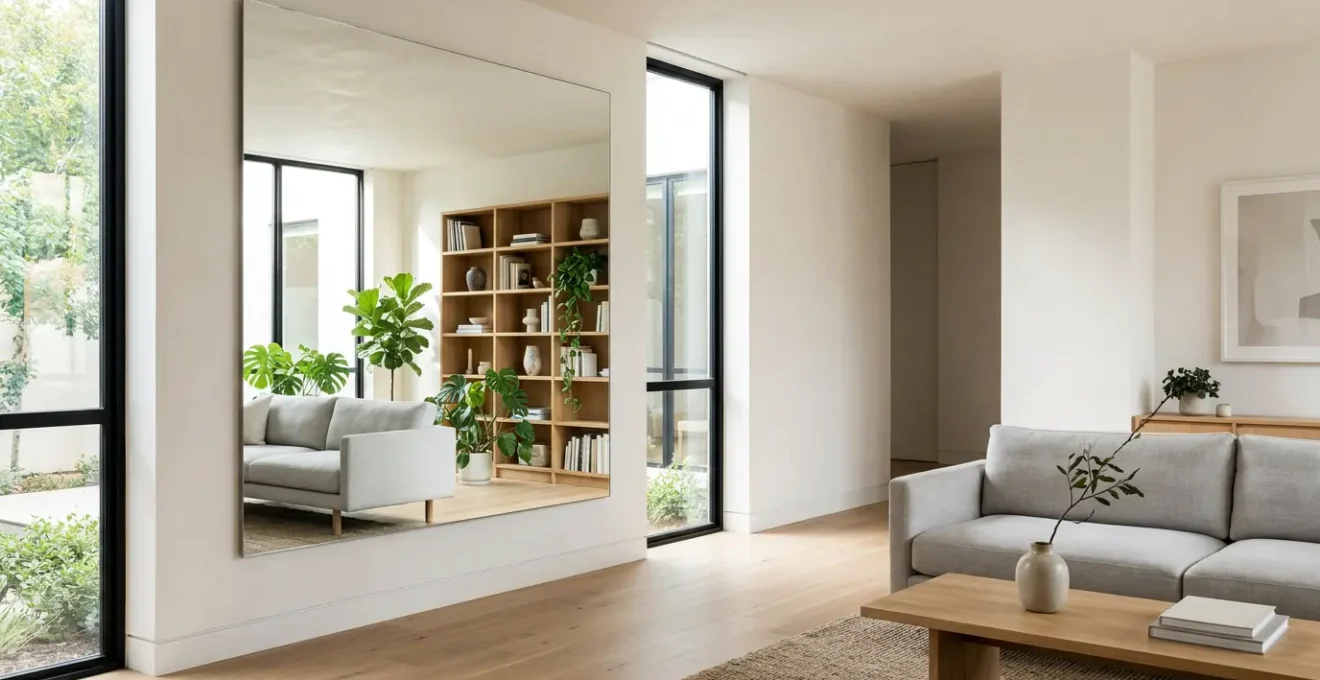
Hanging a mirror opposite a window isn’t always the master trick; the real magic for expanding a small space lies in the precise angle of reflection and, most importantly, *what* that mirror is aimed at.
- Light can be strategically channeled into the darkest corners of a room using a simple flashlight technique to find the perfect reflection point.
- The style of the frame—or its complete absence—fundamentally dictates whether a mirror expands a room through seamless visual continuity or creates a “portal effect” that adds perceived depth.
Recommendation: Treat every mirror placement as a deliberate act of optical alchemy, focusing on manipulating light, space, and energy, rather than simply as a decorative choice.
For the apartment dweller navigating the beautiful constraints of a compact space, a mirror is more than just a reflective surface. It is a tool of spatial alchemy, an instrument capable of bending light, warping perception, and transforming a confined room into an airy, expansive haven. The common advice—to simply hang a large mirror—scratches only the surface of this object’s profound potential. It’s the equivalent of telling a painter to just use a big brush, ignoring the nuances of color theory, composition, and light.
Most guides will tell you to place a mirror opposite a window to reflect light. While not incorrect, this is a platitude that misses the strategic heart of the matter. The true art lies not just in capturing light, but in directing it. It’s about understanding the subtle physics of reflection and the psychology of spatial perception. It’s about knowing when a mirror should disappear into a wall and when it should stand proud as an architectural feature.
But what if the key to unlocking your space wasn’t about following one-size-fits-all rules, but about mastering the principles of optical deception? This guide abandons generic tips in favor of an illusionist’s perspective. We will delve into the science and strategy behind mirror placement, treating each surface as a potential portal and each ray of light as a resource to be managed. Forget just making your room look bigger; we are about to learn how to fundamentally reshape its perceived dimensions.
This exploration will equip you with the knowledge to not only brighten dark corners but to create visual narratives that guide the eye, generate energy according to ancient principles, and turn your entryway into a masterpiece of functional design. Prepare to see your space—and your mirrors—in a completely new light.
Summary: A Strategic Guide to Expanding Small Rooms and Brightening Dark Corners
- Bedroom vs. Entryway: Where Should You NEVER Place a Mirror According to Feng Shui?
- How to Angle a Mirror to Bounce Window Light into a Dark Corner?
- French Cleat vs. Wire: How to Hang a 20kg Mirror So It Doesn’t Kill Someone?
- Frameless vs. Ornate: Which Style Makes the Room Feel Bigger?
- The Alcohol Trick to Getting a Streak-Free Mirror in Sunlight
- How to Position Mirrors to Double the Natural Light in Deep Rooms?
- The Layout Mistake That Blocks Natural Light and Shrinks Your Room Visually
- Designing an Entryway That Organizes Your Family Life From the Moment You Walk In
Bedroom vs. Entryway: Where Should You NEVER Place a Mirror According to Feng Shui?
In the art of Feng Shui, a mirror is not a passive object but an active amplifier and redirector of energy, or “Qi.” Its placement can either invite harmony or create subtle, persistent disruption. While an entryway mirror can be auspicious, its positioning is critical. The most significant rule is to avoid positioning a mirror to directly face the front door. This placement acts like a defensive shield, reflecting all the positive energy that tries to enter your home straight back out, preventing it from circulating and nourishing your living space.
The bedroom is another area requiring mindful placement. A mirror directly facing the bed is considered highly disruptive to a restful state. From a psychological standpoint, it can create a subconscious sense of being watched, leading to anxiety and poor sleep quality. Feng Shui principles suggest this placement can also invite the energy of a third party into a couple’s relationship. Furthermore, any mirror that reflects clutter or chaos—be it in the bedroom, entryway, or elsewhere—is believed to double the negative visual energy associated with that mess, amplifying stress and feelings of being overwhelmed.
Finally, the “command position” is a core principle of safety and control. A mirror should never be placed where it shows you with your back to a door or entryway. This violates your sense of security, as you cannot see who or what might be approaching. Instead, mirrors should be used to enhance the command position, for instance, by placing one where it allows you to see the reflection of a doorway from your desk or favorite chair. By avoiding these key placements, you ensure that your mirrors are working to create a serene and welcoming flow of energy, not to obstruct it.
How to Angle a Mirror to Bounce Window Light into a Dark Corner?
Channeling natural light into a room’s shadowy recesses is one of the most powerful illusions a mirror can perform. This isn’t about guesswork; it’s about applied physics. The goal is to capture the light from its source—the window—and redirect it with precision. To become a true light bender, you must first identify the exact target for your mirror. The most effective way to do this is with a simple yet brilliant technique known as the flashlight method.
As the diagram illustrates, the angle of incidence equals the angle of reflection. Your mission is to find the perfect spot on the wall that will catch the light and bounce it exactly where you want it to go. To do this, wait until evening and stand in the dark corner you wish to illuminate. Shine a flashlight from that corner toward the wall where you intend to hang the mirror. The exact spot where the beam of light hits the wall is the center point for your mirror. By placing your mirror there, you guarantee it will catch daylight from the window and redirect it into that corner.
Once the position is set, you can refine the effect. For a soft, ambient glow, angle the mirror slightly upward; this will bounce the light off the ceiling, diffusing it more broadly. The time of day also matters. To capture gentle morning light, a more vertical angle is effective. To diffuse harsh afternoon sun, tilting the mirror slightly away from the window can prevent glare. For very large dark areas, consider a convex mirror, which scatters light over a much wider field, bathing the entire zone in a gentle, reflected brightness.
French Cleat vs. Wire: How to Hang a 20kg Mirror So It Doesn’t Kill Someone?
The aesthetic power of a large, heavy mirror is matched only by the gravitational force pulling it toward the floor. When hanging a significant weight (anything over 10kg or 22lbs), “good enough” is a recipe for disaster. Safety is non-negotiable, and the choice of hardware is paramount. A standard picture-hanging wire, while fine for lighter pieces, is often insufficient for a heavy mirror, as it concentrates the entire weight onto two small points on the frame and one hook on the wall. This creates stress that can lead to frame damage or anchor failure over time.
To secure a heavy mirror, you must distribute its weight. According to professionals, the cardinal rule of safety is to choose the right hardware for the mirror’s weight and the wall’s material. A crucial safety margin is also essential; an industry best practice is that professional installers recommend using anchors rated for double the mirror weight to account for vibrations, accidental bumps, and material fatigue.
For truly heavy pieces, methods like the French cleat or a Z-bar system are vastly superior. A French cleat consists of two interlocking pieces of wood or metal cut at a 45-degree angle. One is mounted to the wall (ideally into studs), and the other to the mirror’s back. The mirror then securely hangs on the wall-mounted cleat, distributing the weight across its entire length. This method is exceptionally stable and a favorite among cabinetmakers and professional installers.
| Hanging Method | Weight Capacity | Best Wall Type | Safety Rating | Key Advantage |
|---|---|---|---|---|
| French Cleat | 20-50kg | All types | Excellent | Weight distributed evenly across entire length |
| Heavy-Duty Wire | 10-20kg | Drywall with studs | Good | Easy adjustment after hanging |
| Z-Bar System | 15-40kg | All types | Excellent | Invisible mounting, very secure |
| Toggle Bolts | Up to 25kg | Hollow drywall | Good | Strong hold without studs |
Frameless vs. Ornate: Which Style Makes the Room Feel Bigger?
The frame of a mirror is not just a decorative edge; it is a critical component that dictates how the mirror performs its spatial illusion. The choice between a frameless design and an ornate one is a choice between two different kinds of magic: seamless expansion or the creation of a focal point. For the purest illusion of a larger space, the frameless mirror is the undisputed champion. It excels at creating what designers call “visual continuity.”
A frameless mirror minimizes the transition between the wall and the reflection. Its clean, uninterrupted edges trick the eye into perceiving the reflected image not as a picture in a frame, but as a genuine continuation of the room. It’s as if you’ve punched a hole in the wall, revealing more space beyond. This seamlessness is what makes a small room feel instantly more open and airy. The mirror becomes an invisible tool, quietly doing its work without drawing attention to itself.
Visual Continuity vs. The Portal Effect
An analysis from design experts at Kouboo highlights this strategic difference. While frameless mirrors achieve spatial expansion through seamlessness, they found that an ornate frame can create a powerful “portal effect.” A heavy, detailed frame acts as a strong architectural feature, much like a grand window or doorway. Instead of extending the room, it suggests the existence of another, equally grand room just beyond the wall. This adds a different kind of perceived depth. Windowpane mirrors, with their grid-like frames, are particularly effective at this, as they explicitly trigger the brain’s window-recognition response, powerfully suggesting an exterior world beyond the solid wall.
The decision, therefore, depends on your objective. If your sole goal is to make the room feel as large and uncluttered as possible, choose frameless. If you want to add architectural interest, create a dramatic focal point, and hint at a larger world beyond, an ornate frame can be a magnificent tool of illusion.
The Alcohol Trick to Getting a Streak-Free Mirror in Sunlight
A mirror’s purpose is to provide a perfect reflection, but a surface covered in streaks and smudges shatters the illusion. The frustrating irony is that cleaning a mirror in bright sunlight—when you can see every speck of dust—often results in the worst streaks. This happens because the heat from the sun causes typical cleaning solutions to evaporate too quickly, leaving behind residue before you can wipe it away. The secret to a flawless, streak-free shine, even in the most unforgiving light, lies in a simple, professional-grade solution: isopropyl alcohol.
Unlike many commercial glass cleaners that contain soaps and dyes, a simple mixture of equal parts distilled water and 70% isopropyl alcohol creates a potent, fast-evaporating solvent that leaves nothing behind. The alcohol cuts through grease and grime, while the distilled water ensures no mineral deposits are left on the surface. It’s the purity of the solution that guarantees a streak-free result. The other half of the equation is your technique. The professional two-cloth method is essential.
It’s also crucial to avoid ammonia-based cleaners. While they may seem effective, they can be destructive in the long run. Over time, glass experts report that ammonia cleaners cause permanent black edge spots by penetrating and oxidizing the mirror’s silver backing. This damage, known as “desilvering,” is irreversible and typically appears within 2-3 years of regular use. The alcohol solution is not only more effective but also infinitely safer for the longevity of your mirror.
- Mix equal parts distilled water and 70% isopropyl alcohol in a clean spray bottle.
- Lightly spritz the solution onto a clean, lint-free microfiber cloth (Cloth #1), not directly onto the mirror.
- Clean the mirror in small, manageable sections, starting from the top and working your way down.
- Immediately after wiping a section with the damp cloth, use a second, completely dry microfiber cloth (Cloth #2) to buff the surface to a brilliant shine.
- For stubborn spots like hairspray or toothpaste, let the solution sit on the spot for 30 seconds before wiping.
- Always clean mirrors when they are cool to the touch and out of direct sunlight to prevent rapid evaporation.
How to Position Mirrors to Double the Natural Light in Deep Rooms?
In long, deep rooms like narrow living rooms or hallways, a single mirror placed opposite a window often isn’t enough. The light it reflects may only brighten the front half of the room, leaving the back depths in shadow. To truly pull light through the entire length of a space, you must think like a lighting designer, creating a chain of reflections that guides the light from one point to the next. This requires moving beyond simple, direct reflection and embracing more advanced, strategic placements.
One of the most effective advanced strategies is placing mirrors on walls that are perpendicular to the window wall. As light streams in from a window, much of it travels along the sides of the room. A mirror placed on a side wall can catch this side-streaming light and cast it forward, illuminating the darker back areas that a direct reflection would miss. This technique is particularly powerful for bringing brightness to the far end of a deep living room or a long bedroom.
The “Offset Hall of Mirrors” Technique
For exceptionally long and narrow spaces like hallways, interior design teams at Edward Martin developed the “Offset Hall of Mirrors” technique. This strategy explicitly avoids placing mirrors directly opposite each other, which creates a disorienting “infinite reflection” effect. Instead, they stagger mirrors on opposite walls down the length of the hall. The first mirror catches light from the source and bounces it across to the second mirror further down, which in turn bounces it even deeper into the space. This creates a progressive bounce that pulls light along the entire corridor. Their approach also includes “Strategic Light Layering”—for example, placing a large floor mirror behind a console table that has a lamp on it. This setup effectively triples the light output by reflecting the ambient room light, the lamp itself, and the light produced by the lamp.
By adopting these multi-mirror, angled strategies, you graduate from simple light reflection to active light distribution. You are no longer just doubling the light from one source; you are creating a network of reflective surfaces that work in concert to pull brightness into every corner of your home, transforming deep, shadowy rooms into vibrant, illuminated spaces.
The Layout Mistake That Blocks Natural Light and Shrinks Your Room Visually
The most common layout mistake isn’t necessarily the most obvious one, like placing a tall bookshelf directly in front of a window. While that is a cardinal sin of small-space living, a far more subtle and insidious error is hanging a mirror in a position where it reflects nothing of value. A mirror is a canvas, and what it reflects becomes a permanent piece of art in your room. When that reflection is a blank wall, a dark and empty corner, or a cluttered surface, you are actively working against your own goals.
This is the error of the “dead-end reflection.” It creates an abrupt visual stop that makes a space feel smaller and more confined. The mirror, instead of opening a portal to a brighter, more expansive view, simply doubles the most uninteresting or negative part of your room. It amplifies blankness and chaos, which is the exact opposite of the airy, vibrant feel you are trying to achieve.
The biggest error isn’t just physically blocking a window. It’s hanging a mirror where it reflects a blank wall, a dark corner, or a cluttered area. This doubles the negative visual information and makes the space feel more confined and chaotic.
– American Art Decor Design Team, Best and Worst Places to Hang Mirrors Guide
Another critical error is one of scale. A mirror that is too small for its wall can look like clutter itself, breaking up the clean visual plane rather than expanding it. As a rule of thumb, it’s often better to go one size larger than you initially think. A generously sized mirror feels intentional and can anchor a space effectively. The ideal reflection should capture something beautiful or dynamic: the light from a window, a favorite piece of art, a statement chandelier, or the greenery of a houseplant. By carefully curating what your mirror reflects, you turn it from a passive object into an active part of your design narrative, one that tells a story of light, beauty, and expansive space.
Your 5-Point Mirror Placement Audit
- Reflection Points: Identify all potential mirror locations and list what each spot would reflect (e.g., window, blank wall, artwork, cluttered desk).
- Light Path Inventory: Observe how natural light moves through your room during the day. Note the brightest paths and the darkest corners that need illumination.
- Coherence Check: Confront your potential placement with your room’s purpose. Does reflecting the TV in the living room add energy or distraction? Does reflecting the doorway in a bedroom add security or anxiety?
- Emotional Impact: For each potential reflection, quickly rate its emotional impact. Does it reflect something that brings you joy (artwork, window view) or stress (clutter, blankness)?
- Integration Plan: Based on the audit, create a priority list. Replace mirrors with “dead-end reflections” first. Plan to acquire a larger mirror if you’ve identified an “error of scale.”
Key Takeaways
- The most powerful mirror placements often involve angling to bounce light deep into a room, not just simple opposite-the-window reflection.
- Frameless mirrors excel at seamless spatial expansion, while ornate frames create “portals” that add architectural depth and serve as focal points.
- The safety of a heavy mirror depends entirely on using the right hardware, like a French cleat, and choosing anchors rated for at least double the mirror’s weight.
Designing an Entryway That Organizes Your Family Life From the Moment You Walk In
The entryway is the first and last space you experience in your home. It sets the tone for your entire living environment, and in a small apartment, it must be a masterclass in efficiency and illusion. Here, a mirror transcends its decorative function to become a cornerstone of both spatial expansion and practical organization. A strategically placed entryway mirror can make a narrow, chaotic corridor feel wide, bright, and welcoming from the moment you step inside.
The first principle is to use the mirror to visually widen the space. In a typical narrow entryway, placing a large or full-length mirror on the longest wall instantly doubles the perceived width of the corridor. This simple act counteracts the feeling of being squeezed as you enter. The second principle is light. As we’ve established, entryways are often dark. The mirror should be positioned to catch and reflect light from an adjacent, brighter room or a nearby light fixture, creating a psychological lift and a sense of welcome.
But the true genius of an entryway mirror lies in its multi-functionality. This is your “last look” station before you leave the house, but it can be so much more. Combine the mirror with organizational features to create a highly efficient hub. Consider models with a slim, integrated shelf beneath for keys and mail, or add a small floating console table. Install hooks or pegs on either side for bags and scarves. Some of the most innovative solutions feature mirrors that also serve as the door to a hidden, shallow storage cabinet—perfect for tucking away small items and maintaining a clutter-free first impression. By making the mirror work harder, you organize your family’s daily life while simultaneously deploying a powerful tool of spatial alchemy.
Now that you are equipped with the illusionist’s secrets, the next step is to conduct a strategic audit of your own space. Assess each room not for where a mirror could go, but for where light needs to be directed and where a sense of depth needs to be created.