
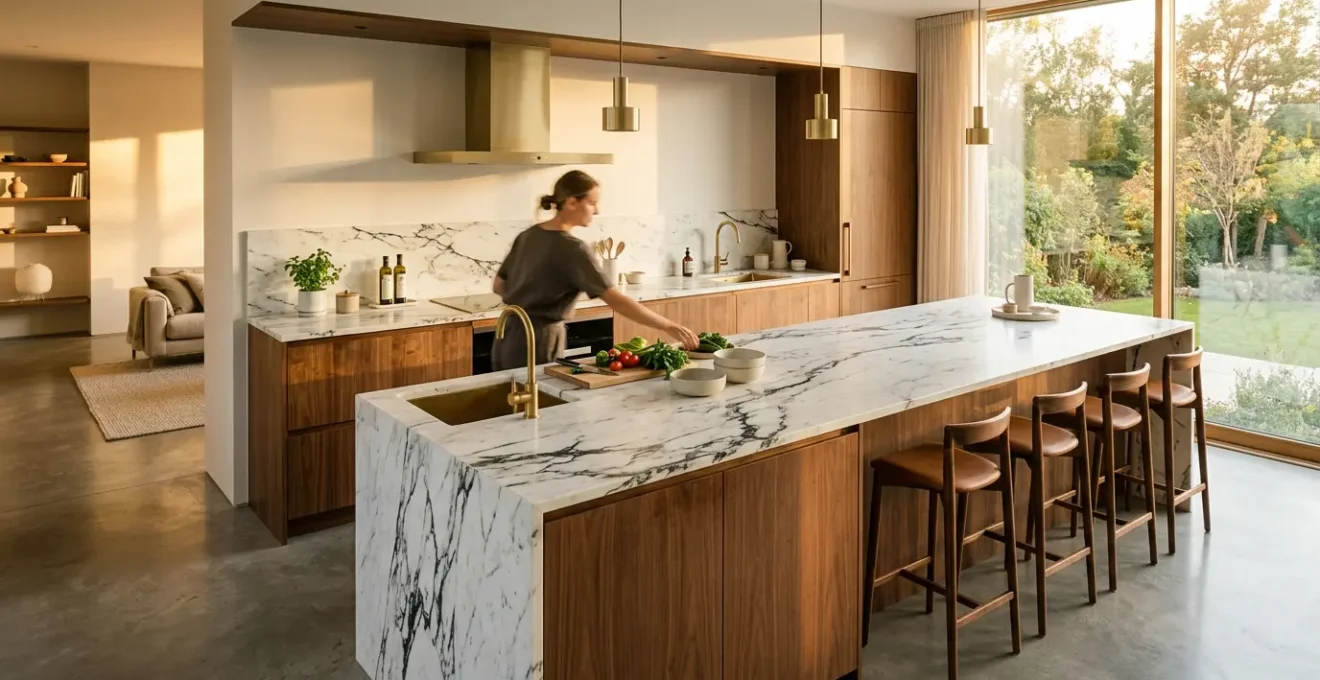
The rigid “work triangle” is no longer the key to an efficient kitchen; it has been replaced by the more flexible concept of “work zones.”
- Modern kitchens have become social hubs, creating traffic patterns the old triangle model cannot handle.
- Designing around task-specific zones (cooking, cleaning, prep) and natural human movement paths (“desire lines”) is far more effective.
Recommendation: Instead of measuring the distance between your sink, stove, and fridge, audit your personal workflow to design a kitchen that supports how you actually live and cook.
For decades, the kitchen work triangle has been the undisputed champion of kitchen design. Coined in the 1940s, this ergonomic principle dictates that the three primary work areas—the sink, the refrigerator, and the stove—should form a neat triangle to minimize the steps a cook takes. The total distance between the three points should be no more than 26 feet, with each leg of the triangle measuring between 4 and 9 feet. For a generation of solitary cooks in closed-off kitchens, this geometric formula was a revelation in efficiency.
But look at the kitchen of today. It’s rarely a closed-off room, and it’s almost never for a solitary user. It has exploded into the heart of the home: an open-plan, multi-functional space for cooking, entertaining, homework, and remote work. This fundamental shift from a purely functional factory to a dynamic social hub raises a critical question for anyone planning a renovation: has the work triangle finally lost its relevance? The answer isn’t to discard it, but to understand why it fails in modern contexts and embrace a more intelligent evolution.
This article will analyze the breakdown of the classic triangle and provide a new framework for planning a truly efficient modern kitchen. By exploring concepts like work zones, desire lines, and social ergonomics, you’ll learn how to design a space that works for multiple people, not just for a single cook’s simple geometry.
Summary: Rethinking Kitchen Flow Beyond the Triangle
- Why the Classic Work Triangle Fails in Modern Open-Plan Kitchens
- How to Design “Work Zones” Instead of a Triangle for Better Efficiency
- Galley vs. Island Layout: Which Offers the Most Efficient Steps-Per-Meal?
- The Risk of Traffic Cutting Through Your Cooking Zone in Open Layouts
- How to Adapt the Workflow When Two Cooks Share the Kitchen
- The Mistake of Placing Furniture Across Natural “Desire Lines” in Your Home
- Sink on Island vs. Cooktop on Island: Which Configuration Is More Social?
- Central Islands: Designing the Ultimate Hub for Cooking and Socializing
Why the Classic Work Triangle Fails in Modern Open-Plan Kitchens
The primary failure of the work triangle is that it was conceived for a world that no longer exists. It assumes a single cook performing a linear sequence of tasks: retrieve from fridge, wash at sink, cook on stove. This model collapses under the weight of modern living. In an open-plan home, the kitchen is no longer a secluded workshop; it’s a busy intersection of household activity. This creates a constant conflict between the “cook” and everyone else.
Think about the real-world scenarios that shatter the triangle’s logic. How does a person cooking work easily without bumping into family members trying to get a drink from the fridge? What happens when guests gather around the island, spreading out mail or laptops, right in the middle of the prep area? These interruptions aren’t exceptions; they are the new norm. The classic triangle offers no solution for this “social traffic,” effectively turning the kitchen into a zone of constant, low-level frustration and inefficiency.
Furthermore, the scale of modern kitchens has changed. Larger spaces and the addition of central islands often stretch the triangle’s legs beyond their efficient limits, forcing the cook to take more steps, not fewer. The simple three-point system cannot account for secondary appliances like a prep sink, a microwave drawer, or a dedicated coffee station, all of which are common in contemporary designs and create their own mini-workflows.
How to Design “Work Zones” Instead of a Triangle for Better Efficiency
The modern solution to the triangle’s rigidity is the concept of “work zones” or “stations.” Instead of linking just three appliances, this approach involves grouping everything needed for a specific task into one dedicated area. By designing a kitchen as a collection of zones, you create a more intuitive and organized workflow that can easily accommodate multiple users without them getting in each other’s way. The goal is to perform all aspects of a task in one spot, minimizing movement across the kitchen.
A well-designed kitchen typically includes several key zones, which should be plotted out based on your personal workflow:
- Cooking Zone: This is centered around the stove, cooktop, or range. Essential storage for pots, pans, cooking utensils, and spices should be immediately at hand, often in drawers below or cabinets beside the cooktop.
- Cleaning Zone: This area houses the sink, dishwasher, and waste/recycling bins. Locating them together streamlines the process of rinsing, loading the dishwasher, and disposing of scraps.
- Prep Zone: This is arguably the most-used zone. It needs ample, uninterrupted counter space and should be located with easy access to the refrigerator, sink, and knives, cutting boards, and mixing bowls.
- Storage Zone: This encompasses the pantry and refrigerator for food items, as well as drawers and cabinets for everyday dishes and cutlery. It’s often smart to place the dish storage near the dishwasher for easy unloading.
- Serving or Entertainment Zone: Often located at the end of an island or near the dining area, this zone might include bar stools, storage for crockery, and a beverage fridge to keep guests out of the primary cooking area.
This zonal approach creates a logical “workflow choreography” that flows from one task to the next. For instance, a natural sequence might move from the food storage zone (pantry/fridge) to the prep zone, then to the cooking zone, and finally to the cleaning zone.
As seen in this example of a prep zone, effective organization within each station is key. Storing items at their point of use, like having vertical dividers for cutting boards and sheet pans right where you do your chopping, is the essence of making work zones truly efficient.
Galley vs. Island Layout: Which Offers the Most Efficient Steps-Per-Meal?
The efficiency of a kitchen is deeply tied to its fundamental layout. While the work triangle can technically be applied to any shape, the shift toward a zone-based approach favors layouts that organize workflow in a more linear and less obtrusive way. The debate between a classic galley kitchen and a modern island layout offers a clear look at this trade-off between compact efficiency and social functionality.
A home construction specialist from ABC Home Ltd offers this practical advice: “For galley kitchens, I often recommend placing the sink and fridge on one side, with the stove and prep area on the other. This creates a natural workflow as you move from one side to the other during cooking. In L-shaped kitchens, the corner area can make an excellent prep zone, with storage and cooking zones on either arm of the ‘L’. The cleaning zone typically works well at the end of one of these arms.”
The choice of layout ultimately depends on the available space and the homeowner’s lifestyle. The following comparison, based on an analysis of kitchen archetypes, breaks down the key benefits of each.
| Layout Type | Key Benefits | Best For |
|---|---|---|
| Galley Kitchen | Compact size can be adapted to suit various needs. Maximizing functionality involves incorporating smart storage solutions and carefully considering workflow. | Small spaces, single cooks |
| Island Kitchen | With workstations strategically placed around the island, this layout promotes efficiency and a smooth workflow while encouraging social interaction. Guests or family members can gather around the island without disrupting the primary cooking zone. | Large spaces, multiple cooks, entertaining |
| L-Shaped | This layout naturally supports an efficient work triangle between the key kitchen zones—the sink, stove, and refrigerator—ensuring a smooth workflow and reducing unnecessary movement. | Medium to large kitchens, open-plan designs |
While a galley kitchen can be supremely efficient for a single cook due to the minimal steps required, an island kitchen excels at managing the “social ergonomics” of a modern home, allowing simultaneous cooking and socializing without conflict.
The Risk of Traffic Cutting Through Your Cooking Zone in Open Layouts
In an open-plan home, one of the greatest threats to kitchen efficiency is “thoroughfare traffic”—people walking through your primary work area to get to another part of the house, like a back door or dining room. If your core work triangle or cooking zone is directly in this path, you’re setting yourself up for constant interruptions and potential safety hazards. The kitchen island, often seen as a problem, can actually be the most powerful solution.
By strategically placing an island, you can create a physical barrier that diverts foot traffic away from your main work zones. It effectively divides the space into a “cooking zone” on one side and a “walkway” or “social zone” on the other. This is a core principle of modern kitchen workflow choreography: guiding movement rather than letting it happen by chance. A 2024 Houzz study underscores this social function, revealing that 54% of renovating homeowners use their islands for entertaining.
To solve traffic bottlenecks, consider these strategies:
- Create a Destination Station: Set up a coffee machine, snack drawer, and beverage fridge in a dedicated cabinet or counter area away from the main cooking zone. This diverts family members and guests who are just looking for a quick grab-and-go item.
- Utilize the Island for Secondary Tasks: An island is a great place to install a microwave drawer. This keeps people who just need to heat something up away from the hot range and main work triangle. It also places the appliance at a safer height for children.
- Designate Clear Zones: If space allows, use the island to create a clear boundary. The side facing the living area becomes the “social zone” with seating, while the side facing the perimeter counters becomes the protected “work zone.”
By anticipating and managing traffic flow, you transform the kitchen from a chaotic free-for-all into an organized and pleasant space for everyone.
How to Adapt the Workflow When Two Cooks Share the Kitchen
The ultimate stress test for any kitchen layout is accommodating two cooks working simultaneously. A design based on a single work triangle will inevitably lead to collisions and frustration. A zone-based approach, however, is perfectly suited for multi-cook households, provided the zones are well-defined and spacious enough. Certain layouts are inherently better at facilitating this cooperative workflow.
Case Study: The U-Shaped Layout for Multiple Workstations
The U-shaped kitchen is often hailed as ideal for families who enjoy cooking together. By surrounding the cook with cabinetry and countertops on three sides, it forms a highly functional and protected workspace. Its generous design naturally accommodates multiple workstations. For example, one person can be at the stove on one leg of the “U,” while another uses a long stretch of counter on the opposite leg for prep work, with a shared sink at the base. This keeps each cook in their own zone while still being close enough for easy collaboration.
For those with larger spaces, the concept of double islands is a growing trend that offers the ultimate solution for multi-cook functionality. This configuration provides clear separation of tasks, enhancing both workflow and aesthetics. Here’s how it works:
- The “Work” Island: One island can be dedicated entirely to food preparation. It might be equipped with a large prep sink, integrated cutting boards, and ample counter space, becoming the primary prep zone.
- The “Social” Island: The second island serves as the entertainment and serving hub. It would typically feature seating, storage for glassware, and integrated appliances like a wine cooler or microwave drawer, keeping guests and secondary tasks completely separate from the main cooking action.
This separation creates a highly organized and efficient environment, preventing the common “kitchen dance” of two people trying to sidestep each other in a cramped space.
The Mistake of Placing Furniture Across Natural “Desire Lines” in Your Home
One of the most insightful concepts in architecture and urban planning is the “desire line.” It refers to the path that people naturally choose to take between two points, regardless of the designated walkways. You see it in parks where worn-down grass shows a shortcut across a lawn. This same principle applies inside your home, especially in the kitchen. A major design mistake is placing an obstacle—like the corner of an island or a poorly positioned stool—directly across a major desire line.
The most common kitchen desire line is the path from the main entry point (e.g., from the grocery bags) to the refrigerator and pantry. Another is the path from the sink to the dishwasher or trash bin. If your layout forces you to constantly walk around an obstacle to complete these frequent tasks, your kitchen is inherently inefficient, no matter how perfect the work triangle looks on paper. The frustration you feel when navigating around that misplaced bar stool is your desire line being blocked.
Honoring these intuitive paths is a cornerstone of modern ergonomic design. The goal is to create a layout with clear, unobstructed pathways between your most-used work zones. This is where auditing your own movement becomes a powerful design tool, allowing you to create a kitchen that feels effortlessly functional because it aligns with your natural habits.
Your Action Plan: Audit Your Kitchen’s Desire Lines
- Analyze Your Movement: Spend a day consciously tracking your steps while cooking a meal. Where do you waste the most movement or have to awkwardly sidestep an obstacle? Make a note of these friction points.
- Map Appliance Placement: List your most frequently used small appliances (coffee maker, toaster, stand mixer). Are they stored near their point of use, or do you have to cross the kitchen to get them?
- Clear the Pathways: Identify any obstacles that block the direct path between your sink, stove, and fridge. This could be a trash can, a kitchen cart, or seating that juts out too far. Find a new home for them.
- Optimize Your Zones: Create dedicated zones for specific tasks like making coffee or baking. By grouping all the necessary items together, you contain the workflow to one area and prevent cross-kitchen travel.
Sink on Island vs. Cooktop on Island: Which Configuration Is More Social?
Placing a primary appliance on the kitchen island is a defining choice that heavily influences the room’s social dynamics. The decision often comes down to putting either the main sink or the cooktop at the center of the action. While both can work from a functional perspective, they create vastly different experiences for both the cook and the guests.
The core of the debate revolves around sightlines and interaction. A sink on the island generally allows the cook to face outwards towards guests while prepping vegetables or washing up. It keeps the vertical space clear, preserving open sightlines across the room. The primary downside, however, is that dirty dishes tend to pile up in the most visible spot in the kitchen, which can be an eyesore during entertaining.
Conversely, a cooktop on the island turns the act of cooking into a performance. It can foster more inclusive conversations, as guests can watch and interact with the cook in action. The downside is the need for ventilation. A large, overhead range hood can become a significant visual and physical obstruction, breaking up the open feel of the space. While downdraft systems are an alternative, they are often less effective. The following table, informed by insights on conversational island design, summarizes the social trade-offs.
| Configuration | Social Benefits | Considerations |
|---|---|---|
| Sink on Island | No overhead obstruction, maintains open sightlines | Dirty dishes visible during entertaining |
| Cooktop on Island | Fostering inclusive conversations rather than merely observing the cook in action. The conversational islands promote a sense of togetherness and create a cozy atmosphere. | Requires overhead ventilation that can block views |
| Clean Island (No Fixtures) | Maximum flexibility for prep, serving, and socializing | All wet and hot work relegated to perimeter |
Ultimately, the most “social” configuration depends on your personal style. Do you prefer an unobstructed view while you work, or do you enjoy making the act of cooking the main event?
Key Takeaways
- The classic work triangle is too rigid for modern, multi-user, open-plan kitchens.
- “Work zones” (e.g., prep, cooking, cleaning) offer a more flexible and efficient model for organizing workflow.
- Successful kitchen design must manage foot traffic and honor the natural “desire lines” of movement to prevent bottlenecks.
- The kitchen island has evolved from a simple work surface into a powerful tool for directing traffic and creating a social hub.
Central Islands: Designing the Ultimate Hub for Cooking and Socializing
The evolution from the rigid work triangle to flexible work zones finds its ultimate expression in the modern central island. It is no longer just an extra piece of countertop; it has become the command center of the kitchen, a versatile anchor around which all household activity revolves. A well-designed island successfully synthesizes the need for both functional efficiency and social connection, solving the very problems that made the old triangle obsolete.
By embodying the principles of zone-based design, the island can serve multiple roles at once. It can house a dedicated prep zone with a second sink, a cooking zone with a cooktop, or a cleaning zone with a dishwasher and waste bins. More importantly, it acts as the primary social interface of the kitchen. With integrated seating, it provides a designated spot for guests and family to gather, chat, and participate in daily life without ever crossing into the primary work paths along the perimeter.
This multifunctionality is the island’s greatest strength. As the KCCNE Kitchen Design Team notes:
The evolution of kitchen islands in 2024 reflects an ongoing general trend towards multifunctionality in our homes. No longer just a place for meal preparation, the kitchen island has morphed into an all-in-one hub, housing sinks, appliances, storage solutions, and even comfortable seating areas. With this, the island has truly become the powerhouse of the modern kitchen.
– KCCNE Kitchen Design Team, The Latest Kitchen Design Trends for 2024
By thoughtfully designing this central hub, you are not just planning a kitchen; you are choreographing the flow of your home life, creating a space that is as enjoyable to live in as it is efficient to work in.
As you plan your renovation, move beyond the outdated geometry of the work triangle and begin thinking in terms of zones, workflows, and social dynamics. By applying these modern principles, you can design a kitchen that is truly the heart of your home—efficient, welcoming, and perfectly adapted to the way you live today.