
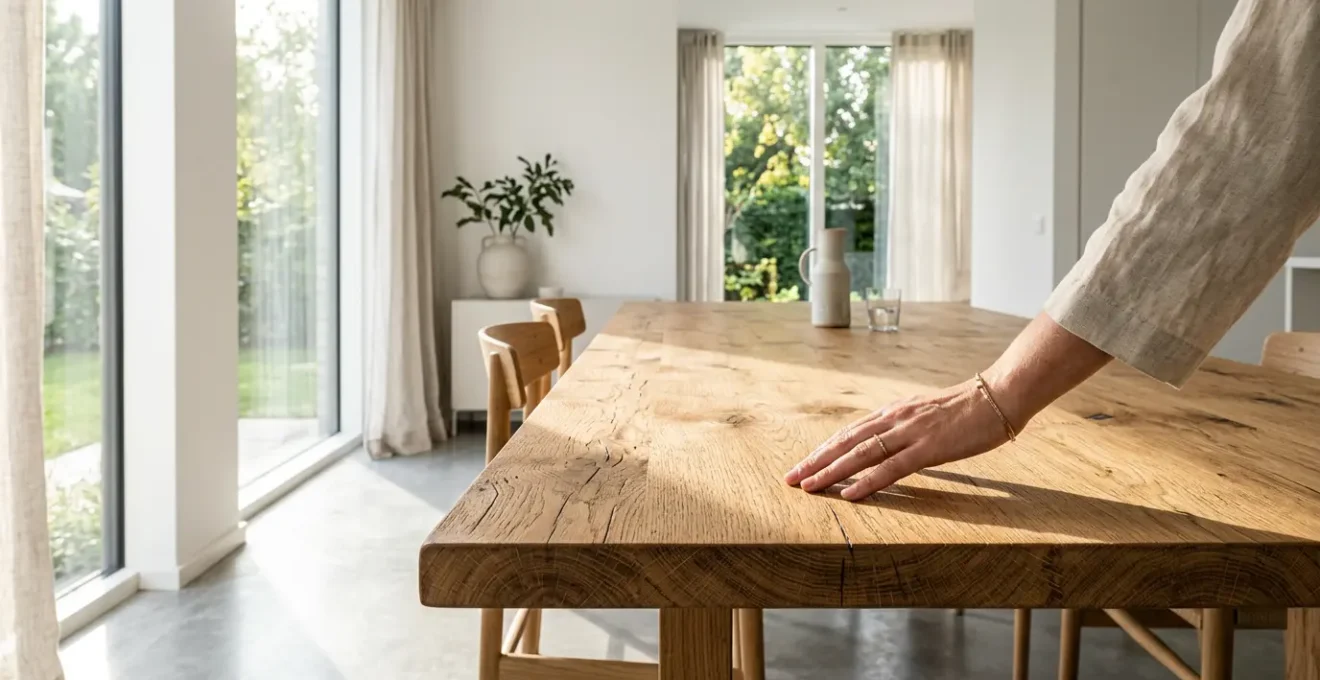
True heirloom furniture isn’t just about the type of wood; it’s about understanding its structure, finish, and environment to ensure its longevity.
- Superior joinery, like dovetail or mortise-and-tenon joints, is a non-negotiable sign of durability that far outweighs aesthetic trends.
- The right finish (e.g., hardwax-oil) and a stable indoor humidity are often more critical for withstanding daily family life than the wood species alone.
Recommendation: Treat your furniture as a living material. Allow it to acclimatize, use proper cleaning methods, and learn simple repair techniques to become an informed custodian of its value for generations.
In a world of fast furniture, the desire for pieces with permanence—items crafted from solid wood that can be passed down through generations—has never been stronger. Many eco-conscious buyers, seeking both sustainability and durability, believe the secret lies in simply choosing “solid wood” over veneers or particleboard. They might check a piece’s weight or knock on its surface, following conventional wisdom to gauge quality. These are good starting points, but they barely scratch the surface of what makes furniture truly last.
The reality is that a solid wood table can crack in months, an expensive chair can wobble after a year, and a beautiful finish can be ruined by a common cleaning product. Why? Because wood is a living material. It breathes, moves, and reacts to its surroundings. The true key to selecting and preserving heirloom furniture is not just to buy it, but to understand it. It requires adopting the mindset of a craftsman, focusing on the invisible details of its construction and the principles of its care.
This guide moves beyond the basics. We will not just tell you what to look for; we will explain *why* it matters. We will explore the critical role of humidity, dissect the joinery techniques that signal true craftsmanship, compare wood species for the rigors of family life, and reveal the secrets to maintaining and repairing your investment. This is your journey to becoming an informed custodian, capable of choosing a piece that will not only last 50 years but will gather stories for a century.
To navigate this essential knowledge, this article breaks down the core principles of furniture longevity. The following summary outlines the key areas we will explore to empower you with a craftsman’s eye for quality.
Summary: A Craftsman’s Eye for Heirloom Furniture
- Why Humidity Changes Can Crack Your Expensive Table Within 6 Months?
- How to Spot Superior Joinery Techniques When Shopping for Wood Furniture?
- Oak vs. Walnut: Which Wood Species Withstands Family Life Better?
- The Common Cleaning Product That Slowly Destroys Your Wood Finish
- How to Fix Minor Scratches and Water Rings Without Refinishing the Whole Piece?
- Bespoke vs. Mass-Produced: When Is the Investment Truly Worth It?
- Oil vs. Varnish: Which Finish Keeps the “Raw” Feel but Protects Against Stains?
- How to Fix a Heat Mark on a Wood Table Without Stripping the Whole Top?
Why Humidity Changes Can Crack Your Expensive Table Within 6 Months?
The most common and devastating threat to solid wood furniture is not wear and tear, but an enemy you can’t see: fluctuating humidity. Wood is hygroscopic, meaning it acts like a sponge, absorbing and releasing moisture from the air. When humidity is high, wood swells. When it’s low, it shrinks. This constant, subtle movement creates immense internal stress. If a table is built from wide planks of solid wood, this expansion and contraction can lead to splits, cracks, and warped surfaces, sometimes within a single season.
A master craftsman anticipates this movement. They use construction techniques that allow the wood to “breathe” without compromising the piece’s structural integrity. However, even the best-made furniture is vulnerable to extreme environmental shifts. Experts agree that to protect your investment, you should maintain indoor conditions within a 35 to 45 percent humidity range. A simple hygrometer can help you monitor this. In dry winters, a humidifier is essential; in damp summers, a dehumidifier may be necessary.
Furthermore, when a new piece of furniture arrives, it needs time to adjust to your home’s unique “microclimate.” This process is called acclimatization. Before it even leaves the workshop, its internal moisture content should be between 7% and 12% for indoor furniture to ensure stability. Rushing this adjustment period by placing it near a radiator or in direct sunlight can accelerate moisture loss and cause immediate damage. Giving your furniture the right environment is the first and most crucial step in its long-term preservation.
Your Essential New Furniture Acclimatization Checklist
- Placement: Immediately place the furniture in its final room, keeping it away from direct heat sources like vents or radiators.
- Humidity Control: Use humidifiers or dehumidifiers to actively maintain the room’s humidity between the ideal 35% and 45% range.
- Initial State: If possible, verify the moisture content upon arrival; it should be between 7% and 12%.
- Patience: Allow the piece to gradually acclimatize for at least 2-3 weeks before placing heavy or permanent items on its surfaces.
- Monitoring: Be mindful of seasonal changes and be prepared to adjust your room’s humidity accordingly to prevent future stress on the wood.
How to Spot Superior Joinery Techniques When Shopping for Wood Furniture?
While the wood itself is important, the true test of a piece’s longevity lies in how it is held together. Joinery is the craft of connecting pieces of wood, and it is the clearest indicator of quality. Mass-produced furniture often relies on staples, glue, and screws, which are fast and cheap but inevitably fail under the stress of daily use. True heirloom furniture employs traditional joinery techniques that create structural integrity through mechanical strength, not just adhesion.
When you inspect a piece, look beyond the surface. Open drawers, look underneath tables, and examine where legs meet aprons. As a study on furniture quality confirms, traditional methods consistently outperform modern shortcuts in durability tests. Here are the key joints to identify:
- Dovetail Joints: Often found in the corners of high-quality drawers, these interlocking “pins” and “tails” create an incredibly strong mechanical lock that is almost impossible to pull apart. They are a hallmark of fine craftsmanship.
- Mortise and Tenon Joints: This is the workhorse of quality furniture construction, used to join pieces at a right angle (like a chair leg to its seat rail). A “tenon” (a projecting tongue) fits snugly into a “mortise” (a hole or slot), creating a powerful, stable connection that resists wobbling.
- Tongue and Groove Joints: Used to join flat boards edge-to-edge to create wider panels (like a tabletop or cabinet back), this joint provides a tight, seamless connection that helps manage wood movement across the panel.
The presence of these joints is a clear message from the maker: this piece was built to last, not to be replaced. They require skill, precision, and time—commodities that are the first to be cut in the name of cost savings.
As this close-up view demonstrates, the intricate, interlocking nature of traditional joinery is fundamentally different from a simple screw or staple. It is a physical promise of endurance. Learning to spot these details transforms you from a consumer into a connoisseur, able to recognize true value that will stand the test of time.
Oak vs. Walnut: Which Wood Species Withstands Family Life Better?
Once you’ve confirmed quality construction, the choice of wood species becomes a matter of balancing aesthetics, durability, and budget. While dozens of hardwoods are used in furniture, Oak and Walnut are two of the most popular choices, each with distinct advantages for a busy household. The “best” wood is not an absolute; it depends on your family’s lifestyle and your tolerance for the natural patina of use.
Oak is renowned for its hardness and prominent, open grain. This combination makes it exceptionally resistant to dents and scratches. Furthermore, its strong grain pattern is fantastic at camouflaging the minor wear and tear that is inevitable with children and pets. It tends to be more affordable than other premium hardwoods and takes stains very well, allowing for a wide range of stylistic options. Its primary drawback is that its hardness can make repairing deeper dents more challenging.
Walnut, by contrast, is prized for its rich, dark color and smooth, fine grain. While technically softer than Oak on the Janka hardness scale, it is still a very durable and tough wood. Its darker color can make scratches more apparent, but its softer nature means that minor dents and dings are often easier to steam out or repair. The beauty of Walnut is in its natural character; it’s a wood that is often finished clear to showcase its elegant grain, which develops a beautiful patina over time.
For a family primarily concerned with maximum resistance to daily abuse and a more forgiving surface, Oak is often the superior choice. For those who prioritize a refined aesthetic and are diligent with care, the inherent beauty and repairability of Walnut make it a worthy investment. The following comparison breaks down their characteristics for family life.
| Factor | Oak | Walnut | Winner for Families |
|---|---|---|---|
| Scratch Resistance (Janka Hardness) | 1290-1360 lbf | 1010 lbf | Oak |
| Dent Resistance | Excellent | Good | Oak |
| Stain Absorption | Takes stains evenly | Beautiful natural grain | Oak (more forgiving) |
| Grain Camouflage | Prominent grain hides wear | Fine grain shows imperfections | Oak |
| Repairability | Harder to steam out dents | Easier to repair minor damage | Walnut |
| Price Point | More affordable | Premium pricing | Oak |
The Common Cleaning Product That Slowly Destroys Your Wood Finish
You have invested in a beautiful solid wood piece, built with superior joints and from a durable species. Now, the goal is to protect it. Ironically, the greatest threat to its finish often comes from products marketed specifically for wood care. Many common spray polishes, especially those containing silicone, are the silent destroyers of heirloom furniture.
Silicone-based sprays (like the popular brand Pledge) create a slick, shiny surface that looks clean initially. However, over time, the silicone builds up into a hazy, cloudy film that is extremely difficult to remove. This buildup not only dulls the wood’s natural beauty but, more critically, it prevents the piece from ever being properly repaired or refinished. The silicone penetrates the finish and even the wood itself, causing any new coat of lacquer or oil to bubble and fail to adhere. It effectively ruins the piece’s long-term potential.
The true enemy of a wood finish is excessive water. All-purpose cleaners and soaking wet rags should never be used. The proper method for cleaning is simple, gentle, and requires no fancy products. The goal is to remove dust and grime without compromising the protective skin of the finish. For daily care, a dry, soft microfiber cloth is all that is needed. For more thorough cleaning, the “Damp-Wipe-Dry” method is the professional standard.
True care is about maintenance, not masking. Instead of silicone sprays, using a quality paste wax or an appropriate conditioning oil (depending on your finish type) once or twice a year will nourish and protect the wood far more effectively. Here is a guide to safe and effective cleaning:
- Avoid all silicone-based spray polishes. They create a cloudy buildup and contaminate the wood, preventing future refinishing.
- Never use all-purpose cleaners or excessive water. Water is the primary cause of finish damage.
- Apply the ‘Damp-Wipe-Dry’ method: Use a cloth that is only barely damp, and immediately follow with a clean, dry cloth.
- For film finishes (like varnish or lacquer), your job is to clean the surface only, never to “condition” it.
- For penetrating finishes (like oil or wax), clean monthly and re-condition quarterly with the appropriate furniture oil or wax.
How to Fix Minor Scratches and Water Rings Without Refinishing the Whole Piece?
Part of owning heirloom-quality furniture is accepting that life happens. A slipped fork, a forgotten coaster, or a misplaced hot dish can leave a mark. The beauty of solid wood, however, is that many of these minor blemishes are not permanent damage but opportunities for care and restoration. An informed owner can handle most common issues without needing to call a professional or resort to a full, costly refinishing project.
The key is to correctly identify the problem and use the least invasive method first. Scratches, for instance, come in different levels of severity. A superficial scuff that has only disturbed the finish is often easily remedied. A deeper gouge that has reached the bare wood requires a more involved, but still manageable, approach.
- Level 1 (Superficial Scratches): For the lightest scratches that have not broken through the color, you can often make them disappear by simply rubbing the meat of a walnut or pecan over the area. The oils from the nut will darken and polish the scratch. Alternatively, a color-matched scratch cover polish can work wonders.
- Level 2 (Deeper Scratches): When a scratch has removed some of the color, a wax filler stick is the tool of choice. These come in various wood tones. Gently heat the stick, apply the wax to the scratch, level it with a plastic card, and buff the area to blend it in.
- Level 3 (Gouges): For deeper indentations where wood fiber has been compressed, the steam swell technique is remarkably effective. Place a damp cloth over the gouge and apply a warm iron for a few seconds. The steam will cause the compressed wood fibers to swell back to their original position, often raising the dent completely.
Water rings are another common ailment. It’s crucial to distinguish between white rings and dark rings. A white ring means moisture is trapped within the top layers of the finish and has not reached the wood. According to furniture restorers, the ‘Iron and Towel’ method (placing a dry towel over the mark and applying a warm, dry iron for 10-15 seconds) is often effective. For stubborn white marks, applying mayonnaise and leaving it overnight can also work; its oils displace the trapped moisture. A dark ring is more serious, indicating water has penetrated the finish and stained the wood itself. This typically requires more advanced treatment, sometimes involving oxalic acid, and may be a job for a professional.
Bespoke vs. Mass-Produced: When Is the Investment Truly Worth It?
In the search for longevity, the question inevitably arises: is it worth investing in a bespoke, custom-made piece over a high-end, mass-produced one? While premium retail brands can offer good quality, the investment in bespoke furniture becomes truly worthwhile when you require something that mass production simply cannot offer: a perfect fit, unique materials, and a human connection.
The most practical reason to go bespoke is for a perfect fit. If you have an awkwardly shaped alcove, need a dining table of non-standard dimensions, or want a bookshelf that perfectly matches the height of a window, a custom maker can build to the millimeter. This level of personalization solves spatial problems that off-the-shelf furniture cannot, turning a challenging space into a functional and beautiful feature of your home.
Second is the choice of unique materials. A bespoke maker can source a specific slab of wood for you—a piece of spalted maple or a book-matched walnut slab with a grain so striking it becomes a piece of art. You can be involved in selecting the exact material for your piece, ensuring its character is precisely what you envision. Mass production, for all its efficiencies, can never offer this level of material intimacy.
Finally, and perhaps most importantly for an heirloom piece, is the human story. With bespoke furniture, you are not just buying an object; you are commissioning a work from a specific craftsperson. You can often visit their workshop, see your piece during its construction, and understand the philosophy behind their work. This connection imbues the furniture with a story and a provenance that a factory-made item can never possess. To determine if a maker is truly bespoke, you must ask the right questions.
- The Perfect Fit Test: ‘Can you build this to my exact dimensions of 183.5cm by 88cm?’
- The Unique Material Test: ‘Can I see and approve the specific wood slab before you begin construction?’
- The Human Story Test: ‘Who will be making my piece, and where do you source your lumber from?’
- Red Flags: Vague answers, an inability to accommodate custom dimensions, offering only a few standard stain options, or not allowing workshop visits are signs of a reseller, not a true maker.
Oil vs. Varnish: Which Finish Keeps the “Raw” Feel but Protects Against Stains?
The finish on a piece of wood furniture does more than just make it look good; it is its primary line of defense against moisture, stains, and wear. The choice of finish fundamentally alters the furniture’s feel, appearance, and, most importantly, its repairability. The two main families of finishes are penetrating finishes (like oils) that soak into the wood, and film finishes (like varnish or lacquer) that create a protective layer on top. Understanding the trade-offs is crucial for choosing a piece that suits your lifestyle.
Traditional oil finishes are beloved for the way they enhance the natural beauty and feel of the wood. You can feel the actual wood grain, giving it a warm, organic tactility. However, their protection against stains is poor, and they require regular reapplication. Varnish and polyurethane, on the other hand, offer excellent protection. They form a hard, durable film that is highly resistant to water and scratches. The trade-off is that they create a plastic-like barrier on the surface; you are touching the finish, not the wood. Furthermore, when this film is damaged, repairs are difficult and often require stripping the entire surface.
For years, this was the dilemma: choose feel or choose protection. However, modern innovations have bridged this gap. Hardwax-oils (from brands like Rubio Monocoat or Osmo) have become a favorite among modern craftsmen. These finishes are a blend of natural oils that penetrate the wood and waxes that cure to form a durable, matte surface. They offer the “close to the wood” feel of a traditional oil but with stain and water resistance that rivals many varnishes. Best of all, they are spot-repairable. A scratch or worn area can be lightly sanded and re-oiled, blending seamlessly with the surrounding finish without a full refinishing job.
This combination of natural feel, solid protection, and easy maintenance makes hardwax-oil an ideal choice for high-use pieces like family dining tables, where you want both beauty and practicality. This table outlines the key differences in common finishes.
| Finish Type | Natural Feel | Stain Protection | DIY Repair Score | Best For |
|---|---|---|---|---|
| Traditional Oil | Excellent (feel the wood) | Poor | 5/5 | Low-traffic pieces |
| Hardwax-Oil (Rubio, Osmo) | Excellent | Very Good | 4/5 | Family dining tables |
| Shellac | Good | Moderate | 3/5 | Antique restoration |
| Varnish/Poly | Poor (plastic feel) | Excellent | 2/5 | High-moisture areas |
| Catalyzed Lacquer | Poor | Excellent | 1/5 | Commercial use |
Key Takeaways
- Wood is a living material: Stable humidity (35-45%) is more critical for preventing cracks and warps than any other factor.
- Look for mechanical joints: Dovetail and mortise-and-tenon joints are the clearest signs of furniture built to last, unlike pieces held by staples and screws.
- Choose finish based on lifestyle: Modern hardwax-oils offer the best balance of natural feel, good protection, and easy spot-repairability, making them ideal for family use.
How to Fix a Heat Mark on a Wood Table Without Stripping the Whole Top?
A white, cloudy mark left by a hot pizza box or coffee mug is a common and disheartening sight on a beloved wood table. Many assume this is a permanent burn requiring a complete refinish, but that is rarely the case. These marks are almost always not burns, but simply moisture from the condensation trapped within the finish itself. Understanding this is the key to a simple, non-destructive repair.
Before attempting any fix, it is critical to diagnose the mark. A white or cloudy mark is good news; it means the damage is confined to the finish layer. A dark or black mark is more serious, indicating the heat was intense enough to scorch the actual wood fibers beneath the finish. Black marks are much harder to fix and may require spot-sanding and refinishing, a technique best suited for penetrating oil finishes.
For the far more common white heat marks, there is a clear escalation of methods, starting with the gentlest. You are essentially trying to gently release the trapped moisture from the finish. Here is the craftsman’s step-by-step approach:
- Step 1 – The Mayonnaise Method: This sounds strange, but it is highly effective. Apply a generous layer of full-fat mayonnaise to the white mark, cover it, and let it sit for at least an hour (or even overnight). The oils in the mayonnaise slowly penetrate the finish and displace the trapped water. Wipe clean and buff.
- Step 2 – The Toothpaste Method: If mayonnaise fails, create a mild abrasive paste by mixing non-gel white toothpaste with baking soda. Gently rub this paste on the mark in a circular motion with a soft cloth, then wipe clean.
- Step 3 – The Iron Method: This is the last resort for stubborn marks. Place a clean, dry cotton towel (like a t-shirt, not a thick terrycloth towel) over the mark. Use an iron on a low, dry setting (NO steam) and press it on the towel for 10-15 seconds at a time. Check frequently. The gentle heat helps the finish release the trapped moisture.
These specific acts of care are the essence of long-term furniture ownership. They transform you from a passive owner into an active custodian. Each successful small repair deepens your connection to the piece, adding to its story rather than detracting from its perfection. This philosophy of care is what truly turns a piece of furniture into an heirloom.
By applying this craftsman’s mindset—understanding the material, respecting the construction, and practicing informed maintenance—you can confidently select and preserve solid wood furniture, ensuring it serves not just your lifetime, but the lifetimes of those who come after you. Start evaluating furniture not just as an object, but as a future heirloom, and apply these principles to the pieces you already own.