
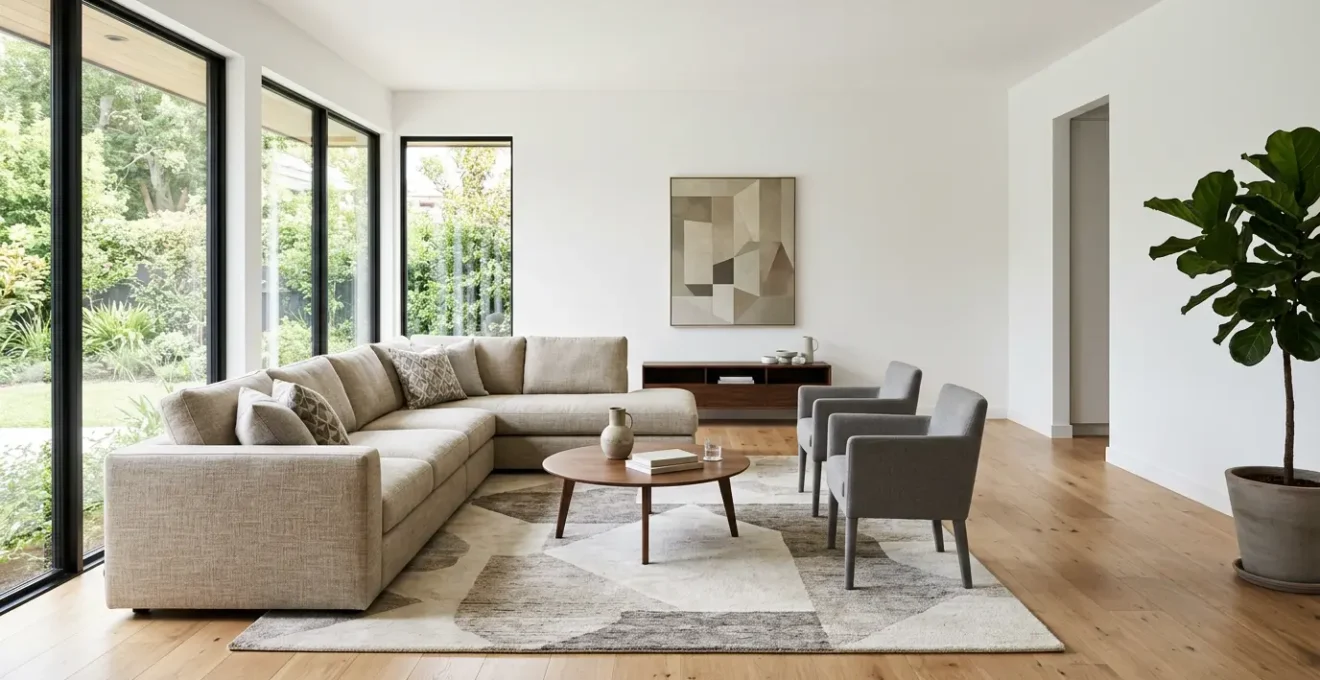
In summary:
- Treat your sectional as an architectural tool to define zones, not just as a piece of furniture to place against a wall.
- Master orientation (Left-Arm vs. Right-Arm Facing) to align with your room’s traffic flow and focal points.
- Use visual tricks like elevated legs, textural layering with pillows, and monochromatic colors to reduce the sofa’s perceived bulk.
- Prioritize function and safety by ensuring your layout does not obstruct airflow from vents or radiators.
- Measure your entire delivery path—not just the room—to avoid the costly mistake of a sofa that won’t fit through the door.
The sectional sofa presents a beautiful paradox. For homeowners with large families or dedicated movie buffs, it represents the pinnacle of communal comfort—a sprawling, inviting hub for relaxation and connection. Yet, this very same piece of furniture can quickly become a dominant, room-shrinking monolith if not handled with intention. The common advice often stops at “measure your space” or “float it off the wall,” but these tips only scratch the surface of a much deeper spatial puzzle.
True mastery of a sectional isn’t about where you put it, but how you use it to engineer the feeling of your living space. It’s a game of sightlines, traffic patterns, and perceived volume. The secret lies in shifting your mindset: stop seeing a bulky object and start seeing an architectural tool. This guide moves beyond simple placement to explore the dimensional strategies that transform a massive sofa from an obstacle into the very element that defines your room’s comfort and flow.
We will deconstruct the process, moving from foundational choices that prevent spatial dominance to the finessed details of styling and function. By understanding the principles of visual mass, orientation, and layering, you can unlock your sectional’s true potential, ensuring it delivers that coveted lounge experience without sacrificing the harmony of your home.
Summary: Mastering Your Sectional Sofa for Space and Comfort
- Why sectional sofas often dominate small rooms and how to avoid it?
- How to break up the “mass” of a giant sofa with throws and pillows?
- Left-arm vs. Right-arm facing: how to choose the correct orientation for your room?
- The risk of blocking radiators or vents with a solid base sectional
- How to measure your delivery path to ensure the sectional actually fits through the door?
- U-shape vs. Pit sectional: which configuration suits your movie night best?
- How to integrate toy storage so the lounge becomes adult-only after 8 PM?
- 24-inch vs. 20-inch: in what order should you layer pillow sizes on a sofa?
Why sectional sofas often dominate small rooms and how to avoid it?
A sectional’s generous size is its greatest asset and its biggest challenge. In a smaller room, its large, unbroken form can absorb all the visual and physical space, making the area feel cramped and unbalanced. This happens because the sofa creates a solid “block” that stops the eye, unlike smaller, separate pieces of furniture that allow sightlines to travel through and around them. The result is often a room that feels like it’s all sofa. In fact, recent furniture retailer data shows that for apartments under 700 square feet, 23% of sectional sofa returns cited ‘too large for the space’ as the main reason.
Avoiding this “visual domination” is about creating an illusion of lightness and space. The first step is to choose your sectional wisely. Look for models with visible legs at least 6 inches high. This elevates the sofa’s mass off the floor, allowing light and air to flow underneath and creating a sense of openness. A low-profile design, with a back height under 31 inches, also helps preserve sightlines across the room, preventing the sofa from feeling like a wall.
Placement is the next critical factor. Resist the urge to push the sectional tightly into a corner. By pulling it even 4-6 inches away from the walls, you create “breathing room” that makes the entire space feel larger. Finally, consider color. A sectional in a light, neutral fabric or one that closely matches your wall color will visually recede, minimizing its perceived size and bulk. This monochromatic effect helps the large piece blend into the room rather than stand out against it.
How to break up the “mass” of a giant sofa with throws and pillows?
Once your sectional is positioned, the next step in your spatial engineering task is to tackle its “visual mass.” A large, single-color sofa can look like an undifferentiated monolith. The key is to introduce layers of texture, color, and pattern to create smaller, distinct visual zones that break up the large surface. This is where throws and pillows become powerful design tools, not just cozy accessories.
Think of this process as dimensional layering. Start with a foundation of larger pillows, then add smaller ones in contrasting or complementary fabrics. The interplay between different materials is crucial. A chunky knit throw draped asymmetrically over one corner can instantly soften a sharp edge. Pairing a smooth velvet cushion next to one made of coarse linen creates tactile and visual interest that draws the eye and makes the sofa feel more dynamic and less static.
This technique allows you to create visual “chapters” across the sofa. One end might feature a cool, serene palette with smooth textures, while the other might use warmer tones and plusher materials. This not only adds personality but also cleverly tricks the eye into seeing a collection of curated zones rather than one single, massive object. By mixing patterns, sizes, and fabrics, you transform the sofa from a simple seating block into a rich, layered landscape.
As you can see in this example, the combination of a knit throw, a tufted pillow, and a woven cushion creates a deep textural field. Each element contributes a different feel, effectively dissecting the visual weight of the furniture and adding a sophisticated, comfortable dimension to the overall design.
Left-arm vs. Right-arm facing: how to choose the correct orientation for your room?
Choosing between a Left-Arm Facing (LAF) and a Right-Arm Facing (RAF) sectional is one of the most critical decisions in spatial planning, yet it’s often misunderstood. This choice dictates the entire flow of your room. Getting it wrong can create an awkward barrier, while getting it right establishes a welcoming and intuitive path. The naming convention itself can be confusing, but the rule is simple. As the design team at Room & Board clarifies:
A left or right arm refers to the sofa as you’re looking at it, not as you’re sitting on it. If you want your sofa to extend out at the right side, choose a sofa with a right-arm chaise. Choose a sofa with a left-arm chaise for it to extend out from the left.
– Room & Board Design Team, Room & Board Sectional Selection Guide
To make the right choice, you must analyze your room’s “traffic arteries.” Where is the main entry point? Where are the primary pathways to other rooms or features like a balcony? The open side of the sectional (the side without the chaise or return) should ideally face the main entry, creating an open, inviting gesture. If people primarily enter your living room from the left, a RAF sectional will keep the path clear. Conversely, if the main traffic flow comes from the right, a LAF configuration is superior. This simple decision determines whether your sofa acts as a welcoming embrace or an inconvenient roadblock.
The following table from a comprehensive sectional guide breaks down the decision-making process based on various room factors.
| Factor | Left-Arm Facing | Right-Arm Facing |
|---|---|---|
| Traffic Flow | Best when main pathway is on right side of room | Best when main pathway is on left side of room |
| TV Placement | Ideal if TV is mounted on right wall | Ideal if TV is mounted on left wall |
| Window Views | Chaise faces left windows for lounging with view | Chaise faces right windows for lounging with view |
| Room Entry | Open side greets guests entering from right | Open side greets guests entering from left |
| Future Flexibility | Consider reversible chaise for rental properties | Consider modular options for potential moves |
The risk of blocking radiators or vents with a solid base sectional
In the excitement of arranging a new sectional for maximum comfort, a critical and often-overlooked factor is the room’s infrastructure: its heating, ventilation, and air conditioning (HVAC) system. Placing a large, solid-base sectional directly over a floor vent or against a baseboard radiator is not just inefficient; it can be hazardous and costly. Blocking a vent disrupts the room’s intended airflow, leading to uneven temperatures, reduced air quality, and forcing your HVAC system to work harder, which can increase energy bills. In the case of radiators, blocking them poses a fire risk and can damage the sofa’s frame and upholstery over time.
A sectional with legs provides a natural solution by allowing air to circulate underneath, but even then, maintaining proper clearance is essential. Indeed, furniture placement experts warn that obstructing airflow and natural light sources can degrade a room’s environment. Before your sofa even arrives, you should conduct a thorough thermal and airflow audit of your space. This proactive step ensures your layout promotes both comfort and safety.
This isn’t just about avoiding blockages; it’s about optimizing your home’s performance. An unobstructed system ensures a comfortable ambient temperature year-round and maintains healthy air circulation. Taking ten minutes to map out these crucial elements is a small investment that pays significant dividends in comfort, safety, and energy efficiency.
Your Pre-Placement Airflow Audit Checklist
- Map all HVAC vents, radiators, and floor outlets in your room.
- Measure clearance: Ensure a minimum of 12 inches of open space from all heat sources.
- Check for return air vents that must remain completely unobstructed for your HVAC system to function properly.
- Test natural cross-breeze patterns from windows to ensure your layout doesn’t create stagnant air zones.
- Consider seasonal changes in airflow and sunlight to ensure year-round comfort.
How to measure your delivery path to ensure the sectional actually fits through the door?
The single most heartbreaking moment in acquiring new furniture is the realization that it won’t fit through the door. For a sectional, which often arrives in several large, rigid pieces, this is a common and costly disaster. A successful delivery requires measuring far more than just the spot where the sofa will sit. You must meticulously measure the entire delivery path, from the curb to your living room.
This includes the width and height of all exterior and interior doorways, the width of hallways at their narrowest points, and the clearance at any tight corners or stairwell landings. A critical measurement often forgotten is the diagonal height of the doorway; sometimes, a piece can be tilted to pass through an opening it wouldn’t clear horizontally. If you live in an apartment building, measure the elevator’s interior dimensions (height, width, and depth) and the clearance of its door.
A brilliant, low-tech way to ensure success is to create a template. Using cardboard, cut out a two-dimensional shape that matches the dimensions (length and depth) of the largest piece of your sectional. Then, physically walk this template through the entire delivery path. This simple test will immediately reveal any potential bottlenecks or impossible pivot points that a tape measure alone might miss. It’s a dress rehearsal for your delivery, giving you peace of mind and saving you from the logistical nightmare of a return.
This proactive measurement process is the final checkpoint before purchase. It transforms a moment of high anxiety into a confident and smooth delivery day, ensuring your dream sofa actually makes it into your home without a scratch.
U-shape vs. Pit sectional: which configuration suits your movie night best?
For the dedicated movie buff, the sectional isn’t just seating; it’s a private cinema. The configuration you choose directly impacts the viewing experience. Two popular choices for creating an immersive lounge are the U-shape and the pit sectional, and each serves a different social dynamic. A U-shaped sectional is fantastic for a large living room and for hosts who enjoy conversational cinema. As the design team at Watson’s notes, this arrangement “provides ample seating and encourages conversation, as people can face each other,” making it ideal for gatherings where the movie is part of a larger social event.
A pit sectional, by contrast, is engineered for pure, uninterrupted immersion. Composed of modular pieces that form a large, cushioned rectangle or square, it’s essentially a “communal nest.” It prioritizes individual sprawling comfort over conversation. In a pit sectional, almost every seat has a direct, optimal viewing angle to the screen, eliminating the neck-craning required from the side seats of a U-shape. However, its enclosed nature can make it difficult for people in the middle to get in and out without disturbing others.
The choice between them comes down to your primary use case. Is your movie night a social, talkative affair, or a silent, serious marathon? The following table from a comparative guide on sectional arrangements highlights the key differences to help you design your ultimate entertainment space.
| Feature | U-Shape Sectional | Pit Sectional |
|---|---|---|
| Social Dynamic | Conversational Cinema – encourages interaction | Communal Nest – individual comfort priority |
| Viewing Angles | Side seats require head turning to TV | More direct viewing angles for all seats |
| Seating Capacity | 5-7 people typically | 6-10 people can sprawl comfortably |
| Access/Egress | Clear entry/exit points | Can trap middle sitters |
| Best For | Families who talk during movies | Serious movie marathons |
How to integrate toy storage so the lounge becomes adult-only after 8 PM?
For families, the living room is a multi-purpose battlefield of daytime play and evening relaxation. A large sectional is the perfect fort, racetrack, and reading nook for children, but come 8 PM, it needs to transform back into a serene adult space. The key to this rapid transition is integrated, stylish storage that doesn’t scream “toy box.” The goal is to have storage solutions that are part of the room’s aesthetic, allowing for a quick, 10-minute tidy-up ritual.
The sectional itself can be your greatest ally. If you have a “floating” sectional (placed away from the walls), position a low, sleek credenza behind it. This provides a vast amount of hidden storage that is completely out of sight from the main seating area. Storage ottomans that match your sectional’s fabric are another brilliant solution, offering a place to stash toys while also serving as a footrest or extra seating. Decorative trunks can serve a similar dual purpose, acting as a unique coffee table while hiding a multitude of plastic treasures.
To make the system work, think in zones. Instead of one giant toy chest, use multiple, smaller solutions that blend into the decor.
- Beautiful woven baskets can be tucked into corners or beside the sofa, adding texture to the room.
- Wall-mounted cubbies installed above the typical eye-level of a child (around 60-72 inches high) can hold books and smaller items, keeping them accessible to adults but out of the immediate play zone.
- Modular storage units can be configured to fit perfectly into an unused nook, creating a designated home for everything.
This strategy allows the living space to be a shared domain where the evidence of daytime fun can be elegantly concealed, reclaiming the lounge for peaceful, adult-only evenings.
Key takeaways
- Think Architecturally: Use your sectional’s position to define pathways and create functional zones within a larger room.
- Respect the Infrastructure: Always map out vents and radiators before deciding on a final placement to ensure safety and efficiency.
- Break Up the Bulk: Employ varied textures, colors, and sizes in pillows and throws to deconstruct the sofa’s visual weight and add personality.
24-inch vs. 20-inch: in what order should you layer pillow sizes on a sofa?
The final touch in mastering your sectional is the art of pillow arrangement. It’s a detail that can elevate the entire look from merely functional to professionally styled. The key principle is layering from back to front, largest to smallest. This creates visual depth and a sense of plush, inviting comfort. The specific sizes you choose, like 24-inch versus 20-inch, depend on the scale of your sofa, but the order remains constant.
Start with your largest pillows, typically 24×24 inch or 22×22 inch squares. These form the foundation of your arrangement. Place them in the corners of the sectional and, if it’s a particularly long sofa, one in the center of the longest back section. They should stand upright against the back cushions, providing support and a solid backdrop of color or texture. They are your anchor.
Next, layer in your mid-sized pillows, which are often 20×20 inch or 18×18 inch squares. Place these directly in front of the larger foundation pillows. This is your opportunity to introduce a contrasting fabric, a complementary pattern, or a bolder color. The slight difference in size allows the back pillow to frame the front one, creating that desirable layered effect. For a balanced look, a good rule of thumb is to use pillows in odd numbers—three or five for a standard sofa section—as it feels more dynamic and less rigid than even numbers.
Finally, add your accent pillow. This is usually a smaller, uniquely shaped cushion, such as a lumbar pillow (e.g., 12×20 inches) or a small round pillow. Place this in the very front of one of your pillow groupings. This is your “statement piece,” the final flourish that ties the entire color scheme and textural story together. By following this simple largest-to-smallest formula, you create a sophisticated, dimensional arrangement that looks effortlessly chic.