
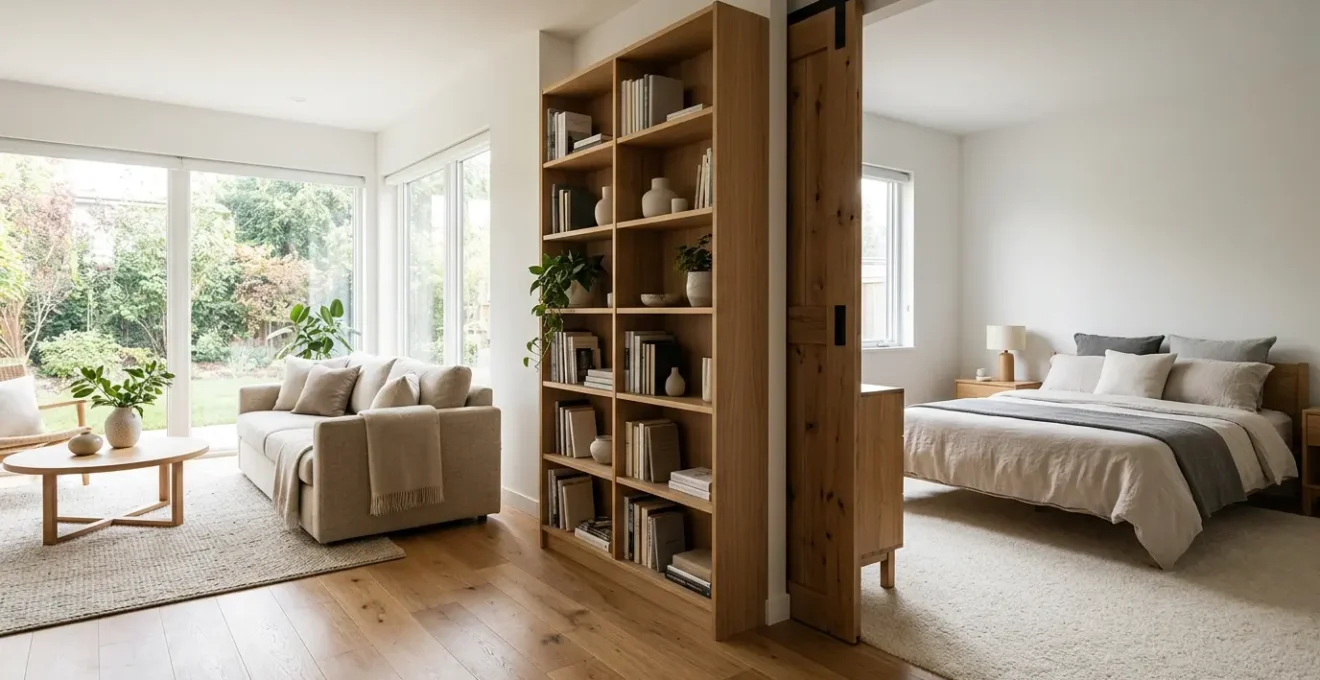
True bedroom privacy in an open-plan home is not achieved with decorative screens, but through architectural interventions that control sound and sight lines.
- The primary failure point for acoustic privacy is the combination of direct pathways for sound and lightweight construction materials, especially hollow-core doors.
- Effective soundproofing relies on two principles: adding mass to block sound waves and meticulously sealing air gaps where sound travels.
Recommendation: Shift your focus from temporary fixes to strategically upgrading key structural elements and redesigning transitional spaces to create a genuine sanctuary.
The modern open-plan home promises connection, light, and a sense of expansive freedom. Yet, for many couples and families, this architectural ideal comes at a hidden cost: the erosion of personal sanctuary. When the sounds of late-night television, early-morning kitchen activity, or lively conversations bleed effortlessly into the master suite, the bedroom ceases to be a space for rest and intimacy. The very openness that fosters social connection can inadvertently sabotage our fundamental need for quiet and restorative privacy.
Conventional advice often suggests superficial fixes: strategically placed bookshelves, folding screens, or heavy curtains. While these elements can offer a degree of visual separation, they fail to address the core issue from an architectural standpoint. They are decorative bandages on a structural problem. The real culprit is the physics of sound and the psychology of space, issues that are often overlooked in the pursuit of uninterrupted sight lines and cost-effective construction.
But what if the solution wasn’t about hiding, but about intelligent design? This guide departs from temporary fixes to offer an architect’s perspective on creating true separation. The key lies not in erecting more walls, but in understanding how sound travels and how our minds perceive privacy. We will explore how to manipulate acoustic pathways, correct common floor plan errors, and design psychological “buffer zones” that signal a transition from public to private life. This is about reclaiming your bedroom not just as a room, but as a restorative sanctuary.
To achieve this, we will deconstruct the problem from its foundations. This article provides a structured approach, from understanding the source of noise transmission to implementing advanced design strategies for a truly peaceful master suite.
Summary: Architecting Privacy in Your Open-Concept Home
- Why sound travels so easily into your bedroom in modern builds?
- How to soundproof existing bedroom doors without replacing them?
- Solid core vs. hollow core doors: is the privacy difference worth the cost?
- The floor plan error that exposes your bedroom directly to the living room
- How to create a psychological “buffer zone” before entering the master suite?
- Why placing your bed facing the door reduces subconscious anxiety?
- How much can heavy vinyl wallpaper reduce echo in a hollow room?
- Master Suite Design: Creating a Restorative Sanctuary That Improves Sleep Quality
Why sound travels so easily into your bedroom in modern builds?
In an open-concept home, sound behaves like water: it flows unimpeded until it hits a barrier, and even then, it will exploit the smallest crack. The primary reason your bedroom isn’t the quiet refuge it should be is a combination of architectural layout and material choices. Open floor plans, by definition, have fewer walls to absorb and deflect sound waves. As Bar Zakheim, CEO of Better Place Design & Build, notes, “Since they have fewer walls, doors, and other structural elements, they are easier to make,” which often means acoustic performance is a secondary concern to aesthetics and cost.
This creates a direct acoustic path from the noisiest social zones—the kitchen and living room—to your private space. The main barrier standing in the way, the bedroom door, is often the weakest link. Most modern homes are built with hollow-core doors, which are essentially two thin skins of wood or composite stretched over a cardboard honeycomb frame. These doors offer minimal mass to block sound energy.
The effectiveness of a material at blocking sound is measured by its Sound Transmission Class (STC) rating. A higher number indicates better sound insulation. While a wall might have an STC rating of 35-45, studies show that typical hollow core doors have an STC rating of only 20-25. At this level, normal conversation can be easily understood right through the door, rendering it little more than a visual screen.
Therefore, the issue isn’t just that your home is “open”; it’s that the key buffer between public and private zones is often acoustically transparent by design.
How to soundproof existing bedroom doors without replacing them?
Replacing a door is a significant undertaking. Fortunately, you can dramatically improve the acoustic performance of an existing hollow-core door by focusing on two core architectural principles: adding mass and sealing air gaps. Sound energy requires mass to stop it, and it will travel through any available air path. Addressing both is non-negotiable for effective soundproofing.
Adding mass involves increasing the density of the door itself. One of the most effective materials for this is Mass-Loaded Vinyl (MLV). This is a heavy, flexible, rubber-like material specifically engineered for sound blocking. Applying a layer of MLV to the interior face of the door adds substantial weight, which vibrates less and therefore transmits less sound. While it’s an industrial material, it can be painted or covered with a thin veneer to match your decor.
However, adding mass is pointless if air gaps remain. Sound will flank the door, bypassing your improvements. The most critical gaps are around the door frame and underneath the door. Sealing these requires a systematic approach. The following steps provide a clear plan for retrofitting your existing door for acoustic privacy.
Your action plan: Sealing and fortifying your bedroom door
- Install high-quality foam or rubber weatherstripping around the entire door jamb and stop to create an airtight seal when the door is closed.
- Add an automatic door bottom or a heavy-duty door sweep to block the significant gap between the door and the floor.
- Apply a layer of Mass-Loaded Vinyl (MLV) directly to the door’s surface to add critical sound-blocking density.
- Use acoustic caulk to seal any cracks or gaps between the door frame and the wall, preventing sound from flanking the structure.
- As a final layer, hang a heavy soundproof curtain or acoustic blanket on a track behind the door for additional sound absorption.
This multi-layered approach transforms a flimsy door into a formidable acoustic barrier, often for a fraction of the cost and effort of a full replacement.
Solid core vs. hollow core doors: is the privacy difference worth the cost?
While retrofitting can be effective, the most robust long-term solution for acoustic privacy is to address the problem at its source: the door itself. The debate between hollow-core and solid-core doors is not merely about feel or quality; it is a fundamental choice about the level of sanctuary you want to create. From an acoustic architect’s perspective, the difference is night and day, and the data proves it.
A solid-core door is constructed from a solid block of composite material (like MDF) or solid wood. This sheer density provides the mass needed to effectively block sound waves. While a hollow-core door weighs around 20-30 pounds, a solid-core equivalent can weigh 60-100 pounds. This mass is directly correlated to its STC rating and its real-world performance in dampening the sounds of a busy household.
The decision ultimately comes down to a cost-benefit analysis. Is the significant increase in acoustic performance worth the higher price point? For anyone who has been woken up by noise from a living area, the answer is often a resounding yes. The investment translates directly into improved sleep quality, reduced stress, and the restoration of a true private-to-public boundary within the home.
To make an informed decision, it’s essential to compare the options not just on price, but on their proven acoustic capabilities. A recent comparative analysis of interior doors provides clear metrics.
| Door Type | STC Rating | Weight | Cost per Slab | Sound Reality |
|---|---|---|---|---|
| Hollow Core | 20-25 | 20-30 lbs | $50-$80 | Normal speech easily heard |
| Solid Core MDF | 30-35 | 60-80 lbs | $150-$250 | Loud speech muffled, normal TV dampened |
| Solid Wood | 28-32 | 80-100 lbs | $300-$600 | Similar to solid core but more expensive |
Investing in a solid-core door is not a luxury; it is an architectural upgrade that fundamentally alters the acoustic character of your private space, delivering a level of peace that retrofitting alone may struggle to achieve.
The floor plan error that exposes your bedroom directly to the living room
Even with a perfectly soundproofed door, your bedroom’s privacy can be compromised by a fundamental architectural flaw common in open-plan designs: the direct line of sight. This occurs when a bedroom door opens directly onto a primary social space like the living room or kitchen, with no transitional area. This layout creates an immediate and jarring connection between the most public and most private zones of the home.
This design isn’t just an acoustic problem; it’s a psychological one. It eliminates any sense of arrival or departure from the personal sanctuary. A sliver of light under the door at night, a direct view into the bedroom if the door is ajar, or the feeling of being “on display” the moment you step out creates a low-level but persistent sense of exposure. It breaks the illusion of retreat that is essential for a master suite.
This layout error often stems from maximizing usable square footage and minimizing construction costs associated with hallways and alcoves. The result is a highly efficient floor plan that sacrifices the subtle, yet crucial, elements of privacy. However, you don’t have to be stuck with this problem. As many modern home designs demonstrate, you don’t have to choose between an open floor plan and privacy. Clever layouts can provide the best of both worlds.
Correcting this flaw involves creating a “buffer,” a transitional space that breaks the direct line of sight and sound, allowing for a more graceful and private connection between the social and sleeping quarters.
How to create a psychological “buffer zone” before entering the master suite?
Where a physical hallway is absent, you must create a psychological buffer zone. This is an architectural concept that uses visual and sensory cues to signal a transition from a public, high-energy space to a private, low-energy one. It’s about crafting a ritual of entry and exit that re-establishes the bedroom’s status as a sanctuary, even without a formal corridor. This can be achieved by subtly defining the area immediately outside the bedroom door.
Start by using flooring to delineate the space. A plush, high-pile area rug placed in front of the bedroom door can instantly change the underfoot texture and absorb sound, creating a distinct “pre-entry” zone. Next, use lighting. A dedicated, low-wattage floor lamp or a small, warm-toned pendant light in this area, separate from the main living room lighting, creates a pool of calm. This change in light level signals to the brain that it is entering a different kind of environment.
Finally, use vertical elements to gently screen the view. This doesn’t require a solid wall. A tall, slender plant like a fiddle-leaf fig, a narrow console table with a piece of art, or a decorative slatted wood screen can break the direct line of sight without closing off the space. These elements force a slight change in direction to approach the door, creating a pause and reinforcing the sense of transition. The goal is to create a moment of decompression before crossing the threshold.
This curated entryway becomes more than just a path; it’s a psychological airlock, allowing you to shed the energy of the social areas before entering your private retreat.
Why placing your bed facing the door reduces subconscious anxiety?
Once inside the sanctuary, the arrangement of the room itself plays a critical role in promoting rest. The placement of the bed, in particular, has a profound impact on our subconscious sense of security. The optimal position, known in environmental psychology as the “command position,” involves placing the bed so that you can see the door without being in a direct line with it. This layout is a direct application of Prospect-Refuge Theory.
This theory posits that humans have an innate preference for environments where they can observe their surroundings (prospect) from a position of safety and concealment (refuge). Having a clear view of the entrance to the room fulfills this deep-seated need for security, reducing subconscious anxiety and hyper-vigilance that can disrupt sleep. As one research paper notes:
The ability to see what is happening around us empowers us to make informed decisions and to anticipate potential events. This feeling of agency is a fundamental human need.
– Environmental Psychology Research, Prospect-Refuge Theory in Sustainable Living
This isn’t just a feeling; it has measurable physiological effects. When we feel secure, our bodies can more easily enter a state of rest and recovery. In fact, research shows that refuge spaces with clear views can result in lower heart rate and blood pressure. Placing your bed in a position where the door is visible but you are not directly exposed provides this ideal balance of prospect and refuge.
By aligning your bedroom layout with this fundamental human instinct, you are designing not just for comfort, but for a deeper, more primal sense of peace.
How much can heavy vinyl wallpaper reduce echo in a hollow room?
In the quest for a quieter room, many people turn to wall treatments, hoping that a thick or “heavy” wallpaper will absorb sound. It’s a common misconception that adding any layer to a wall will improve its acoustics. From an architect’s perspective, it’s crucial to distinguish between sound blocking (mass) and sound absorption (porosity). Heavy vinyl wallpaper fails on both counts.
Sound absorption is measured by a material’s Noise Reduction Coefficient (NRC), a scale from 0 to 1, where 0 is perfectly reflective (like glass) and 1 is perfectly absorptive. To reduce echo (reverberation) within a room, you need materials with a high NRC. These materials are typically soft and porous, like acoustic panels, thick carpets, or heavy drapes, which trap sound waves.
Vinyl wallpaper, despite being “heavy,” is non-porous and reflective. Its surface is hard and smooth, causing sound waves to bounce off it, which can actually worsen echo in a room with many hard surfaces. The data is clear: according to industry tests, standard vinyl wallpaper has a very low noise reduction coefficient of approximately 0.05. This means it absorbs only 5% of the sound that hits it, reflecting the other 95% back into the room.
While textured wallpapers like grasscloth can offer slightly better performance by diffusing sound, for true echo reduction, one must turn to dedicated acoustic materials like fabric-wrapped panels, cork, or felt, which have meaningfully high NRC ratings.
Key takeaways
- True acoustic privacy is architectural, not decorative. It depends on adding mass and sealing air gaps, starting with the weakest points like hollow-core doors.
- A home’s layout is critical. A bedroom door opening directly onto a social space is a fundamental flaw that compromises both acoustic and psychological privacy.
- Creating “buffer zones” and arranging the bedroom according to Prospect-Refuge theory addresses the psychological need for security and transition, which is as vital as physical soundproofing for a restorative sanctuary.
Master Suite Design: Creating a Restorative Sanctuary That Improves Sleep Quality
Achieving a truly restorative master suite involves synthesizing all these principles—acoustic integrity, psychological security, and thoughtful layout. The final layer is to infuse the space with elements that actively promote well-being. This is the realm of biophilic design, an architectural approach that incorporates natural materials, light, and patterns to create a calming, human-centered environment.
Our connection to nature is deeply ingrained. Introducing natural elements into the bedroom has been shown to have profound effects on our mental and physical state. A 2022 review of studies found that biophilic features directly correlate with improved mood and better recovery from stress. Even simple additions, like indoor plants, can improve air quality and support cognitive restoration, creating an atmosphere conducive to deep sleep.
This goes beyond simply adding a potted plant. It involves a holistic material and color palette. Using natural materials like solid wood for furniture, linen or organic cotton for bedding, and wool for rugs provides tactile comfort and reduces exposure to synthetic compounds. A color scheme based on earth tones—sage greens, sandy beiges, soft sky blues—can subconsciously evoke the serenity of a natural landscape, lowering stress levels. Maximizing natural daylight during the day and ensuring complete darkness at night also helps regulate the body’s natural circadian rhythms, which is fundamental to sleep quality.
By applying these architectural and biophilic principles, you transform your master suite from a mere room into an integrated system designed for one purpose: to provide deep, uninterrupted rest and restore your well-being. To begin this transformation, start by assessing your own space through the lens of an acoustic architect, identifying the weak points and opportunities for creating a true sanctuary.
Frequently Asked Questions on a private quarters in an open floor plan home
What’s the difference between vinyl wallpaper and acoustic panels for echo reduction?
Vinyl wallpaper reflects 95% of sound with minimal absorption, while dedicated fabric-wrapped acoustic panels can achieve NRC ratings of 0.85-1.0, absorbing most sound energy.
Which materials work better than vinyl for reducing echo?
Cork tiles, felt panels, and slatted wood with acoustic backing provide superior sound absorption compared to vinyl, with NRC ratings typically between 0.30-0.70.
Can textured wallpapers improve acoustic performance?
Yes, grasscloth and other porous, textured wallpapers offer better sound diffusion than smooth vinyl, though they still provide limited absorption compared to dedicated acoustic materials.