
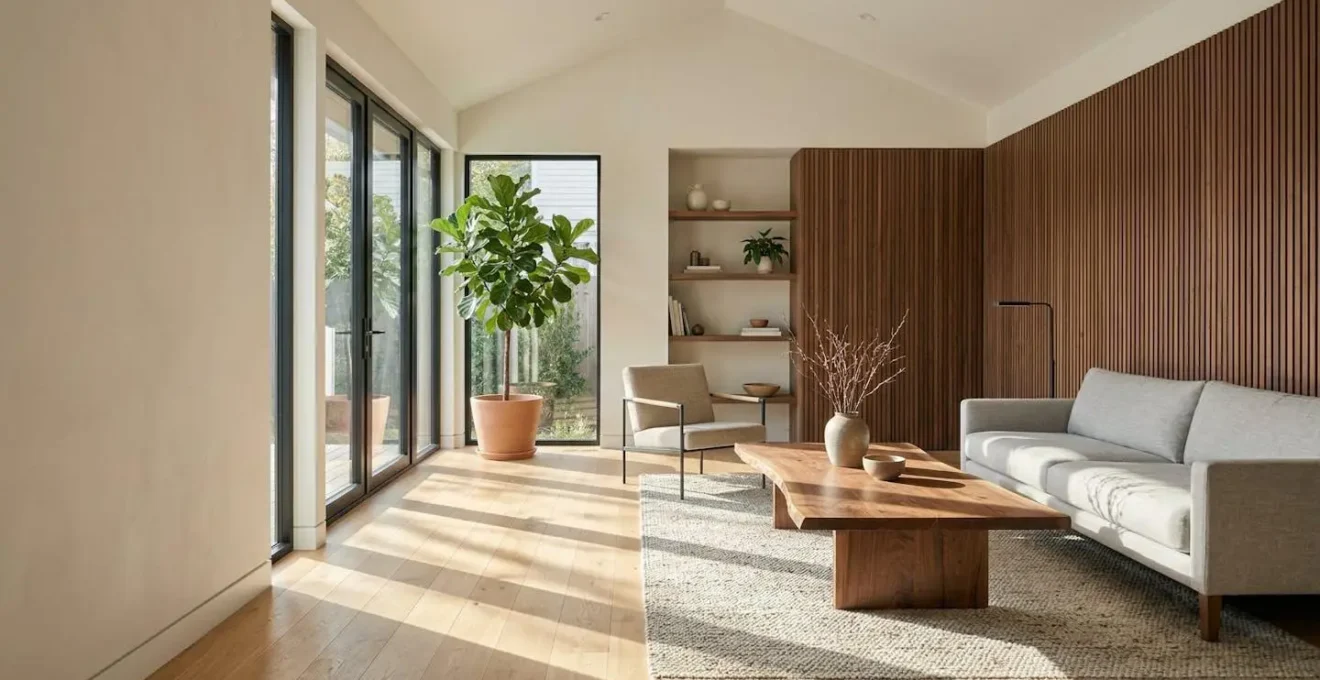
The true power of wood in modern design isn’t its color or style; it’s the scientifically-proven ability to lower stress and create warmth through a deep, sensory connection to nature.
- Mixing different woods successfully relies on a simple formula based on shared undertones, not random selection.
- The right finish is a choice between a “living patina” that deepens your connection and flawless, invisible protection.
Recommendation: Start by focusing on “sensory touchpoints”—placing wood not just where you see it, but where you will physically interact with it daily.
In the clean lines and minimalist palettes of many modern urban homes, a subtle feeling of coldness can creep in. We try to combat it with soft throws or a new coat of paint, but the space can still feel disconnected, lacking a certain soul. The common advice is to “add wood”—an oak floor, a walnut table. While well-intentioned, this advice often misses the point. It treats wood as just another decorative material, a color swatch to be matched.
But what if the profound warmth wood brings has less to do with its honeyed tones and more to do with a deep, primal response hardwired into our biology? The secret to truly transforming an interior lies in understanding wood not as a static object, but as a biophilic bridge to the natural world. It’s about engaging our senses through haptic connection—the feel of the grain under our fingertips—and recognizing the biophilic resonance in its organic patterns.
This guide moves beyond simple decoration. We will explore the science of why natural wood calms our nervous system. We will provide a clear framework for mixing different wood species without creating chaos, delve into the critical choice between finishes that preserve a raw feel versus those that offer perfect protection, and examine how to make sustainable choices that align with a truly organic ethos. It’s time to stop just looking at wood and start feeling it.
This article provides a comprehensive roadmap for integrating wood with intention. Explore the sections below to master the art and science of creating a warmer, more connected home.
Summary: A Guide to Integrating Natural Wood Elements
- Why touching natural wood lowers blood pressure in home environments?
- How to mix oak, walnut, and pine without your room looking chaotic?
- Oil vs. Varnish: which finish keeps the “raw” feel but protects against stains?
- The humidity mistake that causes new wood floors to buckle in winter
- FSC certified vs. Reclaimed: which wood choice has a lower carbon footprint?
- Oak vs. Walnut: which wood species withstands family life better?
- How to introduce raw wood elements without overpowering the room?
- Muted Color Schemes: Using Low-Saturation Tones to Reduce Household Stress
Why touching natural wood lowers blood pressure in home environments?
The calming influence of wood is not a mere design cliché; it is a measurable physiological phenomenon rooted in biophilia—our innate human tendency to connect with nature. When we are in a room with natural elements, our bodies respond. This is explained by two key psychological frameworks: Stress Recovery Theory (SRT) and Attention Restoration Theory (ART). SRT suggests that exposure to unthreatening natural environments triggers a positive emotional response, reducing stress. As confirmed by studies on biophilic interventions, this leads to lower heart rates, blood pressure, and cortisol levels.
The effect is amplified through touch. The intricate, non-repeating patterns in wood grain are a form of natural fractal, which our brains are wired to process with ease, inducing a state of relaxed awareness. This visual and haptic connection to a living material grounds us. The image below shows the complex, fractal-like structures within wood grain, which are key to this calming effect.
As you can see, the texture is not uniform but a rich tapestry of lines and pores. This sensory input is profoundly different from the sterile uniformity of plastic or metal. Research from the University of British Columbia quantifies this, showing that having as little as 45% of wooden surfaces in a room can boost comfort perceptions and measurably lower blood pressure. By incorporating wood, we are not just decorating; we are crafting a therapeutic environment.
How to mix oak, walnut, and pine without your room looking chaotic?
The fear of creating a “log cabin” look or a chaotic clash of tones prevents many from embracing multiple wood types. The secret to harmony is not to limit yourself to one species, but to follow a structured approach based on two principles: dominant undertone and a clear hierarchy. Every wood has a primary color cast—warm (yellow, red, orange), cool (grey, purple-brown), or neutral. Successful mixing involves choosing woods that share the same undertone, even if their colors are different.
For example, a golden oak (warm), a rich cherry (warm), and a honey-toned pine (warm) will feel cohesive. Conversely, mixing a cool-toned walnut with a reddish cherry can feel discordant unless they are bridged by a neutral element. To avoid visual clutter, use a system like the 60-30-10 rule, typically applied to color, but perfectly adapted for materials. This provides a clear hierarchy that guides the eye and creates a sense of intentionality rather than randomness.
Your Action Plan: Harmonizing Different Woods
- Choose Your Dominant Wood (60%): Select one wood to cover the largest surface area, typically the flooring or major wall paneling. Neutral, versatile species like oak are an excellent foundation.
- Select a Secondary Wood (30%): Pick a second wood for main furniture pieces, like tables, credenzas, or bed frames. This is your chance to introduce contrast, such as pairing dark walnut with light oak.
- Add an Accent Wood (10%): Use a third wood for smaller decorative objects, chair legs, or picture frames. Pine or other texturally interesting woods work well here.
- Identify the Shared Undertone: Look at all three selections under natural light. Confirm they all lean toward a common warm yellow, cool grey, or reddish hue. This is the invisible thread that ties them together.
- Introduce a Bridge Material: Unify the entire palette with a consistent non-wood material. Matte black metal, brushed brass, or natural linen textiles can act as a neutral “bridge” that connects the different wood tones.
Oil vs. Varnish: which finish keeps the “raw” feel but protects against stains?
The finish on a piece of wood dictates the haptic dialogue you have with it. It’s a critical choice that balances two competing desires: preserving the raw, tactile feel of the grain and protecting the surface from the realities of daily life. The two main paths, oil and varnish (polyurethane), offer fundamentally different experiences.
Traditional varnishes create a film of plastic on top of the wood. While modern ultra-matte, water-based polyurethanes can be virtually invisible and offer superior, maintenance-free protection against stains and scratches, they sever the direct physical connection to the wood fibers. You are touching the finish, not the wood. For high-traffic surfaces like a kitchen table or family-room floor, this level of protection is often a practical necessity.
Penetrating oil finishes, such as hardwax-oils, work differently. They soak into the wood fibers and harden from within, rather than forming a surface layer. This approach preserves the natural texture and feel of the wood, allowing you to trace the grain with your finger. While more susceptible to staining and requiring periodic re-application, oil finishes offer a unique advantage: they are spot-repairable. A scratch or a stain can be lightly sanded and re-oiled, blending seamlessly into the original finish. This creates what many designers call a “living patina,” where the object ages and tells a story. As the Thermory Wood Design Team notes:
The beauty of oil is in its repairability, allowing the owner to engage in a ‘care ritual’ that deepens their connection to the object.
– Thermory Wood Design Team, Contemporary Interior Design with Wood
The choice is not about right or wrong, but about intention. Do you prioritize flawless, invisible protection, or a deeper, evolving sensory relationship with the material?
The humidity mistake that causes new wood floors to buckle in winter
Wood is a hygroscopic material, meaning it naturally absorbs and releases moisture to balance itself with its surrounding environment. This living, breathing quality is part of its charm, but it’s also the source of the most common and costly mistake in homes with wood elements: ignoring indoor humidity. When wood absorbs moisture, it expands. When it loses moisture, it shrinks. This movement is a non-negotiable law of physics.
The biggest problem occurs in winter in colder climates. Central heating systems run constantly, drying out the air inside. This causes the relative humidity to plummet. Your wood flooring, which was installed at a higher ambient humidity, begins to release its moisture into the dry air. As it shrinks, gaps can appear between the planks. In more extreme cases, if the wood dries too quickly or unevenly, the internal stresses can cause planks to warp, cup, or “buckle.” The same is true for solid wood furniture, which can develop cracks.
The key to stability is maintaining a consistent indoor environment. Wood flooring and furniture experts recommend maintaining a relative humidity level between 30% and 50% year-round. This range represents a stable Equilibrium Moisture Content (EMC) for the wood, minimizing its expansion and contraction. Using a simple hygrometer to monitor indoor humidity and running a humidifier during dry winter months is not a luxury; it’s essential maintenance for protecting your investment and ensuring the longevity of the natural elements in your home.
FSC certified vs. Reclaimed: which wood choice has a lower carbon footprint?
Integrating wood into our homes connects us to nature, but that connection is only authentic if the wood is sourced responsibly. The two most prominent sustainable choices are Forest Stewardship Council (FSC) certified wood and reclaimed wood. While both are vast improvements over irresponsibly harvested timber, they have different environmental profiles.
FSC Certified wood comes from forests managed to meet strict environmental and social standards. It ensures that the harvest of trees is balanced with the forest’s natural lifecycle, protecting biodiversity and indigenous rights. Its primary carbon cost comes from the felling of a new tree and the energy used in transportation and milling. Reclaimed wood, salvaged from old barns, warehouses, or factories, has a “carbon debt” of zero for the tree itself, as it was harvested long ago. Its environmental impact comes from the energy-intensive process of de-nailing, re-milling, and often long-distance transportation to bring it to market. As sustainably sourced wood products become more integral to design, understanding these nuances is key.
A third, often overlooked option—local salvaged wood from storm-fallen or urban-cleared trees—frequently has the lowest footprint of all, minimizing both processing and transportation. The following table provides a simplified comparison:
| Factor | FSC Certified | Reclaimed Wood | Local Salvaged |
|---|---|---|---|
| Carbon Debt | New tree harvest | Zero (already harvested) | Zero (storm/cleared trees) |
| Processing Energy | Standard milling | High (de-nailing, re-milling) | Minimal |
| Transportation | Variable | Often long-distance | Minimal (local) |
| Overall Footprint | Medium | Low-Medium | Lowest |
This wall, featuring mixed reclaimed planks, visually tells the story of sustainable design and the beauty of wood’s second life.
Ultimately, the “best” choice depends on your project’s specific needs and location. Prioritizing locally sourced, whether it’s FSC-certified or salvaged, is almost always the most impactful decision for reducing your home’s carbon footprint.
Oak vs. Walnut: which wood species withstands family life better?
When selecting wood for a home with children, pets, and the beautiful chaos of family life, durability becomes as important as aesthetics. Oak and Walnut are two of the most popular choices for modern interiors, but they offer very different performance characteristics. While both are hardwoods, they are not created equal in their ability to withstand daily wear and tear.
The primary measure of wood’s resistance to denting and wear is the Janka hardness test. On this scale, Oak (particularly Red and White Oak) scores significantly higher than Walnut, making it inherently more resistant to dents from dropped toys or shifting furniture. Beyond pure hardness, the grain pattern plays a crucial role in hiding minor imperfections. Oak’s prominent, wild grain is exceptionally forgiving, camouflaging small scratches and dings within its natural texture. Walnut’s finer, straighter grain, while elegant, tends to show scratches more readily.
Cost and refinishing are also practical considerations. Oak is generally more abundant and affordable than the premium-priced Walnut. When the time comes to refinish a floor or tabletop after years of use, Oak’s consistent coloring makes it easier to sand and re-stain evenly. Walnut’s rich, deep tones can be more challenging to match and blend perfectly during a repair. The following comparison breaks down the key factors for a family-focused decision.
This data, highlighted in a comparative analysis by wood specialists, makes the choice clear for high-traffic areas.
| Factor | Oak | Walnut | Winner for Families |
|---|---|---|---|
| Janka Hardness | 1290-1360 | 1010 | Oak |
| Scratch Visibility | Low (wild grain camouflages) | High (fine grain shows marks) | Oak |
| UV Aging | Darkens/yellows attractively | Lightens to golden-brown | Tie |
| Refinishing Ease | Easy color matching | Challenging to blend | Oak |
| Cost | Moderate | Premium | Oak |
For most family applications where durability is the top priority, Oak emerges as the clear winner. Walnut remains a stunning choice for lower-traffic applications or homes where its luxurious appearance outweighs the need for maximum resilience.
How to introduce raw wood elements without overpowering the room?
The goal of biophilic design is to weave nature into a space, not dominate it. A heavy-handed approach can make a room feel dark, dated, or visually saturated. The key to subtle, impactful integration is to be strategic, focusing on quality of placement over quantity of material. Instead of thinking about large surfaces, start by considering where the human body will most often interact with the environment.
This leads to the “Sensory Touchpoint” strategy. By concentrating wood on high-contact areas, you maximize its biophilic and haptic benefits without overwhelming the room’s aesthetic. A smooth wooden handrail on a staircase, solid wood door handles, or the warm edge of a wooden countertop create daily moments of connection to nature that are far more powerful than a distant wood-paneled wall. This approach ensures the material is felt, not just seen.
Another effective technique is to use “Wood as a Grounding Frame.” Deep, solid wood window sills create a beautiful frame for the view outside, physically connecting the interior to the exterior. A low, wide platform base for a bed or sofa, crafted from solid wood, can anchor the furniture and provide a grounding element in the room. These strategies allow the wood to add warmth and character while maintaining a light, airy feel. For a successful integration, consider these tactical placements:
- Apply the ‘Sensory Touchpoint’ strategy: Focus wood on high-contact areas like stair railings, door handles, and countertop edges where the grain can be felt.
- Use ‘Wood as a Grounding Frame’: Install deep wooden window sills or low platform bases for beds and sofas to anchor the space.
- Install acoustic slatted panels: These add architectural interest and texture while maintaining visual lightness and improving room acoustics.
- Limit wood to 30% of visible surfaces: This general guideline helps prevent visual saturation and keeps the space feeling balanced and modern.
- Choose lighter wood tones for small spaces: In compact rooms, woods like maple, ash, or light oak can add warmth without visually shrinking the space.
Key takeaways
- The calming effect of wood is a scientific, biophilic response; it’s more than just aesthetics.
- Harmoniously mixing different woods depends on a system of shared undertones and a clear 60-30-10 hierarchy.
- The ideal wood choice balances tactile feel (oil finish), family-life durability (like Oak), and a low carbon footprint (local salvaged or FSC).
Muted Color Schemes: Using Low-Saturation Tones to Reduce Household Stress
The calming effect of natural wood is powerful, but it doesn’t exist in a vacuum. The colors that surround it can either amplify or diminish its stress-reducing properties. Bright, high-saturation colors can be energizing and stimulating, but they can also create visual noise that competes with the subtle, organic texture of wood. To create a truly serene and restorative environment, pairing wood with muted, low-saturation color schemes is the most effective strategy.
Muted colors—such as sage green, slate blue, greige, terracotta, and dusty rose—have a lower chroma, meaning they are less intense. This allows the natural warmth, color, and grain of the wood to become the focal point. Instead of competing for attention, the wall color becomes a soft, supportive backdrop that enhances the wood’s character. This synergy creates a cohesive and peaceful atmosphere, which is a cornerstone of biophilic design. A workplace wellness study revealed that 82% of workers exposed to 8+ wooden surfaces reported higher job satisfaction, an effect amplified by a calm surrounding palette.
The best approach is to adopt a “Wood-First” color selection process. Start with your chosen wood species and identify its primary undertone (cool, warm, or neutral). Then, select complementary muted colors that share or harmonize with that undertone. This ensures the entire room works together to create a unified, stress-reducing effect. The following guide provides a starting point for building a wood-centric palette.
| Wood Type | Undertone | Complementary Muted Colors | Stress Reduction Effect |
|---|---|---|---|
| Fumed Oak | Cool Grey | Slate Blue, Greige, Sage | Calming, Professional |
| Cherry | Warm Red | Terracotta, Cream, Dusty Rose | Cozy, Nurturing |
| Bleached Pine | Pale White | Soft Grey, Linen, Pale Blue | Spacious, Peaceful |
Begin today by identifying one high-contact area in your home—a doorknob, a countertop edge, a railing—and consider how introducing a natural wood element there can begin to transform your space into a warmer, more sensory, and restorative environment.
Frequently asked questions about Natural Wood Elements
What are Hardwax-Oils and how do they differ from traditional finishes?
Hardwax-Oils like Osmo and Rubio Monocoat use molecular bonding technology to penetrate and bond with wood fibers instead of forming a plastic film on top, preserving natural texture while offering robust, spot-repairable protection.
Can modern varnishes maintain a raw wood appearance?
Yes, ultra-matte water-based polyurethanes have virtually zero sheen, mimicking raw wood while providing superior, maintenance-free protection against stains and abrasion.
Is the development of patina a defect with oil finishes?
No, with oil finishes, minor stains and wear are part of developing a unique, living patina that adds character and tells the story of the wood’s life in your home.