
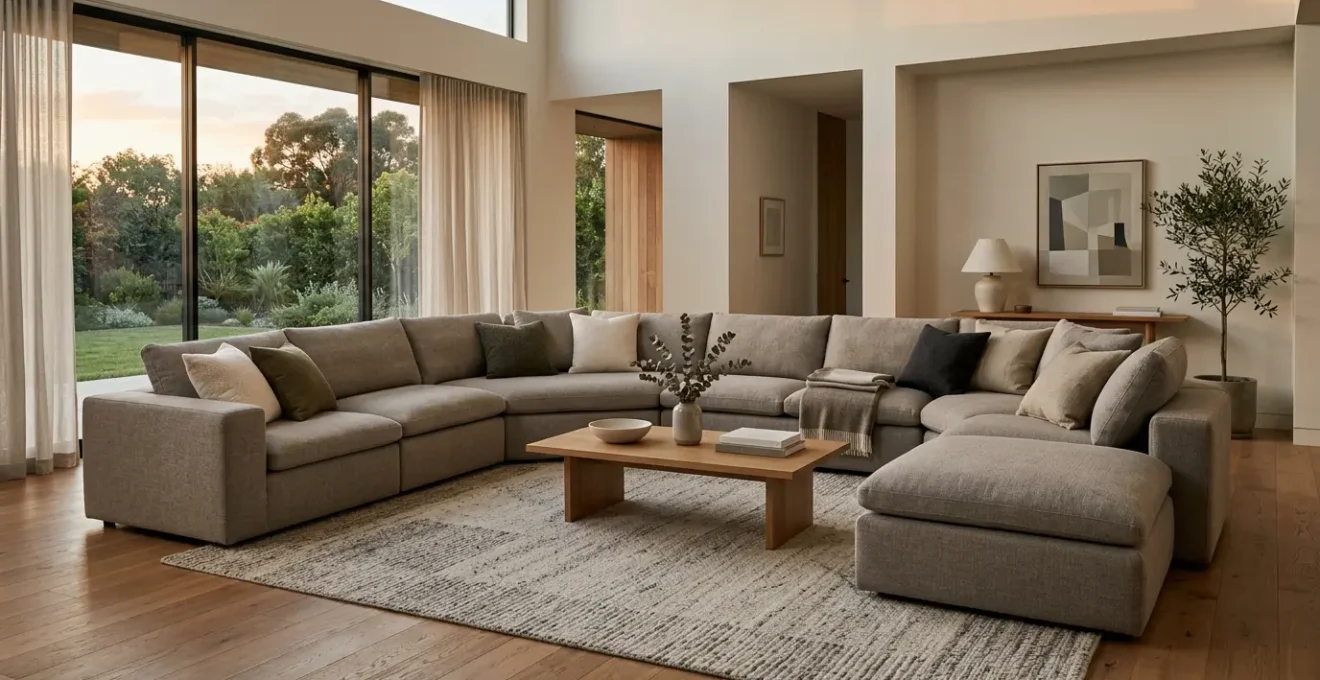
The secret to a perfect family living room isn’t finding a ‘flexible’ sofa, it’s mastering the art of ‘furniture choreography’—actively adapting your seating to your life’s daily rhythm.
- Static, one-size-fits-all sofas fail to meet the dynamic needs of growing families and social entertainers.
- Strategic reconfiguration can transform your space from a movie-night “pit” to an intimate “campfire” for conversation.
- Choosing the right performance fabrics and securing mechanisms are non-negotiable for a long-lasting, frustration-free experience.
Recommendation: Stop thinking of your sofa as a single object and start treating its modules as a dynamic toolkit to build the perfect setting for any occasion.
Your living room is the heart of your home, but for active families, it often feels more like a chaotic battlefield. One minute it’s a fortress of cushions for a kids’ movie marathon, the next it needs to be a sophisticated space for adult conversation. The traditional three-seater sofa, a static monument in the middle of this whirlwind, simply can’t keep up. It’s a relic from an era of quiet, predictable living. Many believe the solution is a modular sofa, and while they’re on the right track, simply buying one isn’t the whole answer. The real magic isn’t in the furniture itself, but in how you wield its power.
While often used interchangeably, it’s useful to know that while all modular sofas are sectionals, not all sectionals are modular. A classic sectional might have two or three large pieces that connect in one fixed way. A true modular sofa, however, consists of multiple individual pieces (modules) like armless chairs, corners, and ottomans that can be rearranged in countless configurations. But the common advice to “just be flexible” with your modules is where most people stop, leaving untapped potential in their living rooms. What if the key wasn’t just having flexible furniture, but mastering the art of furniture choreography?
This guide moves beyond the obvious. We’re not just going to show you layouts; we’re going to teach you a new philosophy. You’ll learn to treat your sofa not as a passive object, but as an active participant in your home’s story. We will explore why static sofas fail, how to create specific “zones” for conversation and entertainment, and how to solve the most common frustrations. It’s time to become the director of your living space and make your furniture truly work for you.
This article provides a complete roadmap for transforming your living space. Discover how to choose, configure, and maintain a modular sofa that truly adapts to your family’s ever-changing lifestyle.
Summary: Your Guide to Mastering the Adaptable Sofa
- Why static 3-seater sofas fail active families with changing needs?
- How to reconfigure your modular sofa to encourage better conversation?
- U-shape vs. Pit sectional: which configuration suits your movie night best?
- The annoyance of modular pieces sliding apart and how to stop it forever
- When is the right time to add new modules to your existing setup?
- Why sectional sofas often dominate small rooms and how to avoid it?
- How to select performance fabrics that resist juice spills and muddy paws?
- Left-arm vs. Right-arm facing: how to choose the correct orientation for your room?
Why static 3-seater sofas fail active families with changing needs?
The classic three-seater sofa is designed for a world that no longer exists for most young families. It assumes a single, primary function: sitting politely. But modern family life is a fluid, multi-act play. A static sofa forces you to build your life around it, when your furniture should be adapting to you. This mismatch is precisely why the global modular furniture market, which represents an USD 81.3 billion valuation in 2023, is booming. Families are voting with their wallets for adaptability.
A static sofa is a one-trick pony. It offers a single seating arrangement, which is often awkward for group conversations and inefficient for sprawling out during a movie. For a growing family, its limitations become painfully clear. There’s no safe, soft-cornered play zone for a toddler, no way to create separate nooks for a child doing homework and a parent reading, and no flexibility to host a teenager’s entire friend group without half of them ending up on the floor. It’s a piece of furniture that creates problems instead of solving them.
A truly adaptable living space follows a sofa lifecycle that mirrors your family’s growth. During the toddler phase (ages 0-5), you can add ottomans to create soft, enclosed play areas. As children enter school age (6-12), you can separate modules to form a designated homework corner away from the main TV zone. Finally, in the teen years, the same pieces can be reconfigured into multiple “conversation pods” for social gatherings. Systems like the highly customizable Albany Park Kova sectional are designed for this journey, allowing you to add storage consoles or new seats as your needs evolve, ensuring the sofa grows with you, not against you.
How to reconfigure your modular sofa to encourage better conversation?
One of the biggest failings of a standard sofa is its inability to foster genuine connection. A long, straight line of seating forces everyone to look in the same direction—usually at a screen. This is fine for watching a film, but terrible for conversation, where eye contact and proximity are everything. The goal of furniture choreography here is to break the line and create intimacy. Stop thinking of your sofa as one entity and start thinking of its modules as building blocks for human connection.
The most effective strategy is the “campfire” configuration. Imagine how people gather around a fire; they turn inward, creating a circle of warmth and focus. You can achieve this by breaking up your modular sofa into two or more smaller clusters that face each other. Placing a central coffee table or a large, round ottoman in the middle serves as the “fire,” giving people a shared focal point. This naturally encourages guests to turn towards one another, making conversation flow more easily and organically. It transforms a passive viewing space into an active social arena.
This setup doesn’t have to be symmetrical. You could have a two-seater module facing two single-chair modules, creating different dynamics within the same space. The key is creating “seating zones” that are oriented for interaction. Even with a smaller modular, simply pulling an ottoman away from the main sofa and placing it opposite creates an instant conversational dyad. It’s a simple act of re-positioning that completely changes the social energy of the room from a lecture hall to a lively café.
U-shape vs. Pit sectional: which configuration suits your movie night best?
When it comes to creating the ultimate home cinema experience, two modular configurations reign supreme: the U-shape and the Pit. While both offer ample space for lounging, they cater to slightly different movie-night personalities. Choosing the right one is a crucial piece of furniture choreography that can make or break your viewing party. The U-shape is the social entertainer’s choice, while the Pit is the purist’s cocoon.
A U-shaped configuration is fantastic for a mixed audience. As a case study from Koala points out, it’s perfect for “big movie nights or board game showdowns, where there’s enough room for everyone to see each other and the screen.” The open end of the ‘U’ is ideal for accommodating a large television and allows for better sound dispersal from a surround sound system. It also offers more varied seating postures; some can recline fully in the corners while others can sit more upright on the central piece, making it comfortable for longer viewing periods and for guests of different ages.
The Pit sectional, on the other hand, is the pinnacle of casual, intimate lounging. Created by arranging modules to form a large, enclosed square or rectangle, it’s essentially a giant, plush playpen for all ages. It’s unrivaled for maximum cuddle capacity and creating a cozy, immersive den. However, it has its trade-offs: snack access can be tricky without long-reach tables, and the deep, uniform slouch position might not be comfortable for everyone over a two-hour film. It can also absorb sound, potentially muffling your carefully calibrated audio.
To help you decide, this direct comparison breaks down the key differences based on a detailed analysis of entertainment setups.
| Feature | U-Shape Configuration | Pit Sectional |
|---|---|---|
| Sound Quality | Open end enhances surround sound | Deep cushions absorb sound |
| Snack Access | Easy side table placement | Limited table access in center |
| Seating Capacity | 6-8 people comfortably | 8-10 people in close quarters |
| Posture Support | Varied support options | Uniform deep slouch position |
| Best For | Mixed age groups, longer viewing | Intimate gatherings, casual lounging |
The annoyance of modular pieces sliding apart and how to stop it forever
There is no greater buzzkill in the world of modular comfort than “the gap”—that slow, inevitable drift of one module away from another, creating a treacherous chasm just waiting to swallow a remote control, a phone, or an unsuspecting elbow. This constant sliding is the single biggest complaint from modular sofa owners and can turn a dream setup into a daily frustration. As the Castlery Design Team notes in their guide, this is a known issue with an otherwise perfect system.
Without proper connecting systems, modular sofas can easily separate. Additionally, the more obvious seams between each module may not appeal to those who love a sleek and clean look.
– Castlery Design Team, Castlery Modular Sofa Guide
This “gap problem” isn’t a sign of a faulty sofa; it’s a physics challenge waiting for a clever solution. Fortunately, there are several ways to lock your configuration in place, ranging from quick fixes to permanent installations. Before you blame the sofa, however, a pro tip is to use a level tool to check your floors. An almost imperceptible slope can be the true culprit behind the continental drift in your living room. The solution you choose will depend on your floor type, budget, and how often you plan to reconfigure your setup.
Here is a tiered system of solutions to banish the gap forever:
- Good (Instant Fix): Non-slip furniture pads placed under the legs of each module are the fastest and cheapest solution, especially for hardwood or tile floors. For a $20-30 investment, they provide enough grip to prevent minor shifting during normal use.
- Better (Semi-Permanent): For a more robust connection, use universal connector straps or alligator-style clips that clamp onto the underside of the module frames. Costing between $50-100, they physically lock the pieces together, making them ideal for a configuration you plan to keep for a few months at a time.
- Best (Invisible Solution): The most elegant and effective method is to place a custom-cut, non-slip rug pad underneath your entire sofa configuration. This creates a high-friction surface that holds everything in place without any visible hardware. While a larger investment ($100-200), it’s the ultimate set-it-and-forget-it solution for your primary layout.
When is the right time to add new modules to your existing setup?
One of the most beautiful aspects of a modular sofa is that it’s never truly “finished.” It’s a living piece of furniture that can evolve with your family’s story. But the question of *when* to expand your setup can be tricky. Adding modules isn’t just about needing more seats; it’s a strategic decision tied to specific life milestones and changing spatial needs. Recognizing the trigger points for expansion is the final act in mastering your furniture choreography.
The most common catalysts for adding new modules are major life events. A new baby might prompt the addition of a soft ottoman to create a safer play area. A child moving out to college could mean you finally have space for that chaise lounge you’ve always wanted. Moving to a new home with a larger living room is perhaps the most obvious reason to expand. Instead of buying a whole new sofa, you can simply add a corner piece and an extra armless chair to perfectly fit your new dimensions. This “grow-as-you-go” approach is not only cost-effective but also incredibly sustainable.
Beyond major events, listen to the subtle cues from your everyday life. Are family movie nights getting a little too crowded? Is there a constant, low-grade argument over who gets the corner seat? These are clear signs that your current setup is causing friction. If you find yourself frequently wishing for a dedicated reading nook or a place to put your feet up, an additional chaise or ottoman module could dramatically improve your quality of life. The right time to add on is when your sofa stops effortlessly accommodating your lifestyle and starts creating minor but persistent inconveniences.
Why sectional sofas often dominate small rooms and how to avoid it?
It’s a common design myth: sectionals and small spaces don’t mix. The fear is that a large, multi-piece sofa will swallow a compact living room, leaving it feeling cramped and claustrophobic. While a poorly chosen sectional can certainly do that, a well-choreographed modular sofa can actually be a small space’s greatest ally. The key is to leverage its adaptability to create the *illusion* of more space, rather than letting its bulk dominate.
The biggest mistake people make is treating the modular sofa as a permanent, immovable fixture pushed against the walls. This instantly shrinks the room’s visual footprint. The secret to avoiding this is to embrace two core principles: creating “breathing room” and practicing “module migration.” By floating the sofa—positioning it 12-18 inches away from the walls—you create a walkway behind it, making the room feel wider and more airy. Choosing modules with tall, slender legs (6-8 inches high) also helps, as it reveals more floor space and adds to the sense of openness.
The most transformative technique for small spaces is what I call the “Ghost Module” method. This involves strategically removing one or two modules from your main living room configuration for daily use. An armless chair module can become a chic bedroom bench or a cozy reading chair in a home office. An ottoman can live in a walk-in closet. This “module migration” frees up valuable floor space for everyday life. Then, when you’re hosting guests and need maximum seating, you simply recall your “ghost modules” and reassemble the full configuration. As one design guide notes, a modular sofa’s ability to “hug corners or split into smaller pieces” is its superpower in a tight spot.
How to select performance fabrics that resist juice spills and muddy paws?
For a family with young children or pets, the sofa fabric isn’t a design choice—it’s the first line of defense. A beautiful modular sofa can be ruined in an instant by a spilled cup of juice, a muddy paw print, or the surprisingly sharp claws of a cat. This is where performance fabrics become non-negotiable. These are textiles engineered at a molecular level to resist stains, moisture, and abrasion, ensuring your investment looks great for years, not just until the next snack time.
The term “performance fabric” covers a wide range of materials, each with unique strengths. Brands like Crypton and Sunbrella are famous for their exceptional stain resistance; liquids simply bead up on the surface, waiting to be wiped away. Others, like Performance Velvet, offer a luxurious feel but may require more careful spot cleaning. The latest generation of Polylinen and Chenille fabrics provide incredible durability and texture while often being machine washable, a game-changer for busy households. As the Lovesac product team highlights, some fabrics offer multiple benefits: “Chenille: Liquid beads up before soaking through, and its texture helps hide scratches.”
Choosing the right one is a balance of four factors: stain resistance, texture/feel, maintenance requirements, and pet-friendliness. A house with a large dog that sheds will have different needs than a house with a toddler prone to spilling. The table below offers a clear comparison of some of the most popular options to help you make an informed decision for your specific lifestyle.
| Fabric Type | Stain Resistance | Texture/Feel | Maintenance Cost | Pet-Friendly |
|---|---|---|---|---|
| Crypton | Excellent | Soft, natural feel | Low – home cleaning | Yes |
| Sunbrella | Excellent | Canvas-like, durable | Low – bleach cleanable | Yes |
| Performance Velvet | Good | Luxurious, plush | Medium – spot clean only | Moderate |
| Polylinen | Very Good | Linen-like texture | Low – machine washable | Yes |
| Chenille | Good | Textured, hides scratches | Low – liquid beads up | Excellent |
Key Takeaways
- Furniture Choreography: Treat your sofa as a dynamic system to be actively arranged for different life events, not a static object.
- Configuration is King: Use “campfire” layouts for conversation and choose between U-shape (social) and Pit (cozy) for movie nights.
- Practicality Matters: Solve the “gap problem” with connectors and choose performance fabrics to protect your sofa from spills and pets.
Left-arm vs. Right-arm facing: how to choose the correct orientation for your room?
You’ve done it. You’ve choreographed the perfect layout, selected a bomb-proof fabric, and you’re ready to order. But then comes the final, terrifying question: “Do you want Left-Arm Facing (LAF) or Right-Arm Facing (RAF)?” Choosing the wrong orientation is one of the most expensive and frustrating mistakes you can make. It can block a major walkway, make the room feel off-balance, or awkwardly obstruct a window. The “facing” in LAF/RAF refers to the side the arm is on as you look at the sofa, not as you’re sitting on it. Getting this right is the final, critical step in your design process.
Forget guesswork and visualization. The only way to be 100% certain is to physically map it out in your space. The most reliable method is using painter’s tape to outline the exact footprint of your desired sofa configuration directly on your floor. This low-cost trick allows you to see precisely how the sofa will interact with your room’s architecture. You can test traffic flow, check viewing angles to the TV, and see how the placement affects natural light from windows.
This physical mock-up is your moment of truth. Walk your daily routes: from the doorway to the kitchen, from the sofa to the balcony. Does the arm of the chaise create an annoying bottleneck? Does the corner piece make it hard to open a cabinet? Live with the tape on your floor for a day or two. This process removes all ambiguity and ensures your final order is made with complete confidence. It’s the dress rehearsal for your living room’s grand performance.
Your Pre-Purchase Orientation Checklist
- Measure your room: Record the total dimensions, paying close attention to the locations of doorways, windows, and major walkways.
- Map the footprint: Use painter’s tape on the floor to mark the exact length and depth of your proposed modular configuration.
- Test traffic flow: Walk your most common paths around the taped-off area to identify any potential obstructions or tight squeezes.
- Check sightlines: Sit inside the taped area to test viewing angles to your television and to ensure the sofa doesn’t block a prized view outside.
- Test both options: Mock up both the Left-Arm and Right-Arm Facing configurations with your tape to definitively see which one best fits the room’s flow and function before you place your order.
Now that you have the tools and philosophy of furniture choreography, you’re ready to transform your living space. The next step is to start envisioning how these principles apply to your own home, turning your static room into a dynamic stage for your family’s life.