
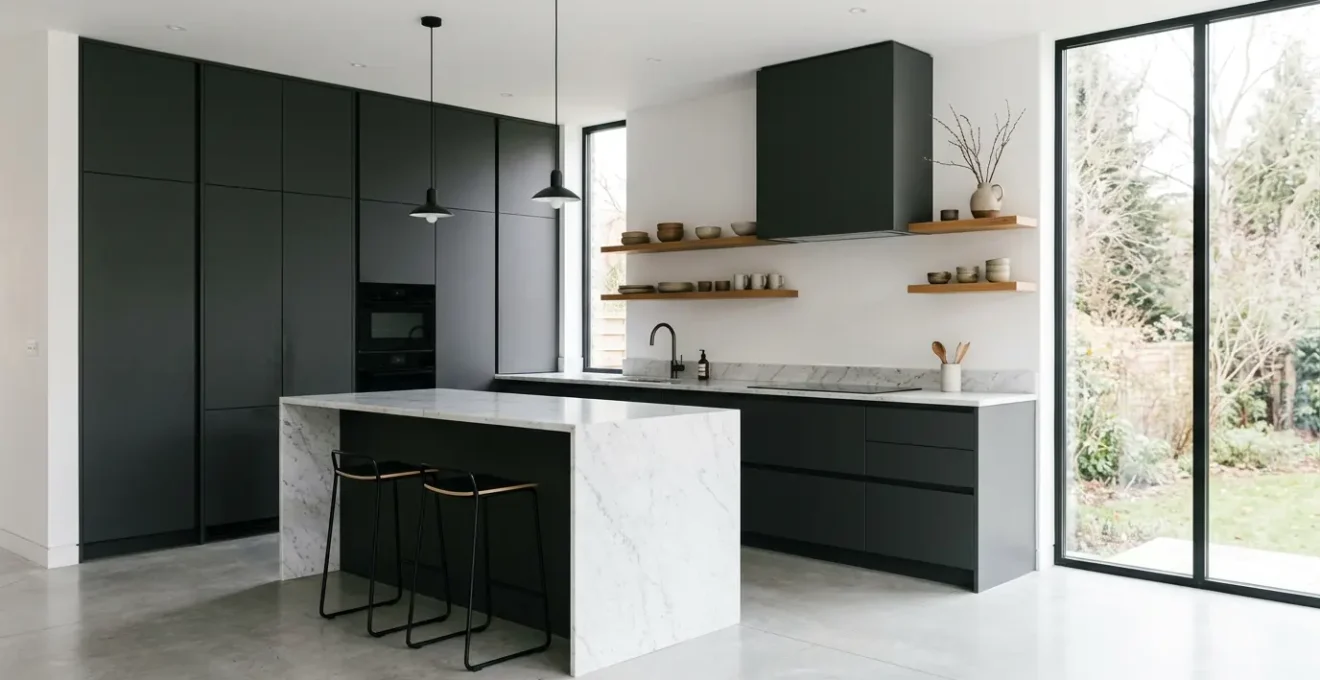
The ultimate modern chef’s kitchen achieves ‘Seamless Functionality’, where high-performance tools and ergonomic workflows are invisibly integrated into a flawless aesthetic.
- Minimalism is achieved not by sacrificing tools, but by intelligently concealing them behind advanced cabinetry and paneling.
- Ergonomic intelligence—designing for your body’s natural movements—is more critical than adhering to rigid, outdated rules like the “work triangle.”
Recommendation: Shift your focus from a purely visual style to a system of “workstation zones,” planning your layout, storage, and electrical needs around specific tasks.
For the discerning home cook, the dream kitchen presents a paradox. You crave the clean lines, uncluttered surfaces, and minimalist beauty seen in architectural magazines. Yet, you also demand the robust, accessible, and hyper-functional environment of a professional culinary workspace. The common advice often forces a choice: style or substance. Many designs achieve a sleek look by hiding everything away, creating a space that’s beautiful but impractical for the messy, dynamic reality of cooking. Others pack in commercial-grade equipment, resulting in a cluttered, industrial feel that lacks residential grace.
This approach is flawed. It treats aesthetics and functionality as opposing forces that must be compromised. But what if the true essence of modern luxury kitchen design lies not in compromise, but in synthesis? The key is to move beyond surface-level looks and embrace the concept of Seamless Functionality. This design philosophy is built on the belief that the most beautiful kitchen is also the most intuitive to use—a space where every tool is at hand but never in the way, and where the workflow is so natural that the design itself becomes invisible, allowing the chef to focus purely on the craft of cooking.
This guide will deconstruct the principles of achieving that seamless integration. We will explore how to create a visually serene space that secretly houses a powerhouse of culinary tools. We’ll move beyond outdated layout rules to embrace modern, efficient workflows and delve into the ergonomic intelligence that makes a kitchen a joy, not a chore, to work in. Prepare to design a kitchen that works as beautifully as it looks.
This article breaks down the essential strategies for designing a kitchen that delivers both a pristine aesthetic and chef-grade performance. The following sections will guide you through key decisions, from layout and appliance integration to ergonomics and long-term value.
Summary: Building the Ultimate Modern Chef’s Kitchen
- Myth: does a modern kitchen have to look cold and clinical to be stylish?
- How to hide appliances behind cabinetry for a seamless minimalist look?
- Handleless cabinets vs. hardware: which is easier to keep clean while cooking?
- The design error of sacrificing comfortable heights for sleek lines
- In what sequence should you plan outlets for small appliances during design?
- Which contemporary kitchen features actually add value to your home resale?
- L-shape vs. U-shape kitchen: which layout maximizes efficiency for your square footage?
- The Work Triangle: Is This Classic Kitchen Rule Still Relevant in 2024?
Myth: does a modern kitchen have to look cold and clinical to be stylish?
A persistent myth in modern design is that a sleek, functional kitchen must be sterile and cold—a landscape of stark white, grey, and polished metal. This misconception arises from a narrow interpretation of minimalism that prioritizes the absence of detail over the quality of sensory experience. A true chef’s kitchen, however, must be an inspiring and comfortable space, not just a clinical laboratory. The secret to achieving warmth without sacrificing a modern edge lies in layering textures and considering the room’s sensory profile, particularly its acoustics.
Hard surfaces like quartz countertops, glass backsplashes, and polished concrete floors are hallmarks of modern design, but they create an acoustically harsh environment where every clang of a pot and chop of a knife echoes. Introducing Acoustic Warmth is a sophisticated strategy to counteract this. This involves integrating materials that absorb sound, which often have rich, natural textures. Think of slatted wood wall panels with felt backing, cork flooring in high-traffic areas, or even upholstered bar stools. These elements disrupt sound waves, creating a calmer, more focused atmosphere while adding visual depth and tactile appeal.
Biophilic design—the integration of natural elements—also plays a crucial role. A wall of preserved moss, an indoor herb garden, or cabinets with a natural wood grain finish can break up monolithic surfaces and connect the space to the outside world. This adds organic warmth and life, proving that a high-functioning, modern kitchen can and should be an inviting, multi-sensory environment. The ultimate style is not cold, but calm and controlled.
How to hide appliances behind cabinetry for a seamless minimalist look?
The core of a seamless kitchen aesthetic is the artful concealment of its powerful machinery. The goal is not just to hide appliances, but to integrate them so perfectly that the kitchen presents as a unified wall of clean, architectural lines. This requires more than standard cabinet doors; it demands specialized mechanisms and meticulous planning to ensure function isn’t sacrificed for form. A professional chef’s hidden kitchen design often features secondary cooktops or warming drawers that are completely concealed when not in use, maintaining a flawless facade.
Achieving this involves choosing the right concealment mechanism for each appliance. Vertical lift doors are ideal for creating “appliance garages” for coffee stations and toasters, while pocket doors that slide back into the cabinet walls are perfect for concealing larger areas like a breakfast pantry or microwave station. For major appliances like refrigerators and dishwashers, fully integrated panel-ready models are essential. They are designed to be fitted with custom cabinet fronts, making them indistinguishable from the surrounding storage. Push-to-open or channel-pull systems complete the handleless illusion.
However, true integration goes beyond the visible. Proper ventilation is critical. Designers must incorporate hidden airflow solutions, such as toe-kick vents for dishwashers and refrigerators or shadow gaps between panels, to allow heat to escape without disrupting the seamless look. Furthermore, for frequently accessed items, heavy-duty hardware is non-negotiable. Deep drawers for pots and pans must have robust, full-extension slides that can handle significant weight while operating smoothly, preserving both the minimalist exterior and the effortless functionality within.
Choosing the correct hardware is crucial for balancing aesthetics with longevity. This table compares common mechanisms used to conceal appliances.
| Mechanism Type | Best For | Durability (Years) | Maintenance |
|---|---|---|---|
| Vertical Lift Doors | Coffee stations, small appliances | 10-15 | Annual hinge adjustment |
| Pocket Doors | Pantry areas, microwave stations | 15-20 | Track cleaning quarterly |
| Tambour Doors | Appliance garages, mixers | 8-12 | Monthly track lubrication |
| Push-to-Open | Refrigerators, dishwashers | 5-8 | Latch replacement needed |
Handleless cabinets vs. hardware: which is easier to keep clean while cooking?
The choice between handleless cabinets and traditional hardware is a critical decision in a chef’s kitchen, pitting a purely minimalist aesthetic against everyday practicality. While handles can act as “jewelry” for cabinetry, they are also dirt traps, accumulating grease, flour, and grime in their crevices, requiring meticulous cleaning. From a purely hygienic standpoint, a flat, unbroken surface is superior. This has led to the rise of handleless designs, but not all are created equal in a high-use cooking environment.
Integrated “J-pull” or channel systems, where a recessed groove is part of the door or drawer front, offer an excellent compromise. They maintain a sleek, handle-free look while being easy to wipe down in a single pass. However, the most hygienic and functional solution for a serious cook is an electronic, touch-free system. Mechanisms like SERVO-DRIVE allow you to open cabinets and drawers with a simple nudge from a knee or hip. This is invaluable when your hands are covered in dough or carrying a hot pan, preventing cross-contamination and keeping surfaces pristine. While push-to-open latches are also handle-free, they still require hand contact, leaving fingerprints and smudges on high-gloss finishes.
While traditional hardware has a longer mechanical lifespan, its cleaning demands create functional friction. For a chef who values efficiency and sanitation, the hierarchy is clear: touch-free electronic systems offer the best performance, followed by well-designed integrated channels. The ultimate choice depends on balancing budget, desired aesthetic, and how you prioritize a truly touch-free workflow during intense cooking sessions.
Data from professional kitchen designers shows a clear preference for systems that minimize hand contact, prioritizing hygiene and ease of use during cooking.
| System Type | Hygiene Rating | Mechanical Lifespan | Chef Preference % |
|---|---|---|---|
| SERVO-DRIVE (knee/hip activated) | Excellent – No hand contact | 10+ years | 78% |
| J-Pull integrated channels | Good – Easy wipe-down | Indefinite | 65% |
| Traditional hardware | Moderate – Requires cleaning | 20+ years | 45% |
| Push-to-open latches | Good – Minimal contact | 5-7 years | 52% |
The design error of sacrificing comfortable heights for sleek lines
One of the most common yet detrimental errors in modern kitchen design is enforcing uniform countertop heights for the sake of a single, unbroken horizontal line. While visually appealing, this ignores a fundamental principle of Ergonomic Intelligence: different tasks require different working heights for optimal comfort and efficiency. A single-height counter means you are either hunching over to chop vegetables or raising your shoulders uncomfortably to knead dough. This creates physical strain and reduces the joy of cooking.
A truly functional chef’s kitchen embraces multi-level surfaces tailored to specific tasks. The standard countertop height (around 36 inches or 92 cm) is fine for general prep. However, a lower section, around 30-32 inches (76-82 cm), is ideal for baking tasks like rolling dough, as it allows you to use your body weight more effectively. Conversely, the sink area can be raised slightly to reduce bending when washing dishes. Similarly, ergonomic research shows that placing wall ovens at chest height eliminates the need for constant bending and lifting, a crucial consideration for heavy cast-iron cookware.
These varied heights don’t have to compromise a sleek aesthetic. A multi-level island can become a stunning architectural feature. The transition between heights can be managed with different materials—for example, a butcher block for the lower baking station and quartz for the main prep area. The goal is to design a kitchen that fits your body and workflow, not to force your body to adapt to a rigid, albeit beautiful, design. This is the essence of a space that is truly luxurious because it is effortlessly comfortable.
Your Ergonomic Kitchen Audit: The 5-Point Check
- Find Your Base Height: Stand straight and bend your forearm 90°. Measure from the floor to your elbow. Subtract 10-15 cm to find your ideal general prep height.
- Verify Prep Surface: Check if your main countertop is approximately 10-15 cm below your bent elbow. If not, consider a thick, custom chopping board to adjust.
- Assess Cooktop Visibility: A slightly lower hob level improves your view into pots and pans, preventing neck strain. Evaluate if your current setup allows for easy monitoring.
- Analyze Sink Depth vs. Height: An extra-deep sink bowl is great but can cause back strain if the counter is too low. Ensure the sink height allows you to reach the bottom without hunching.
- Plan for Multiple Users: If there are significant height differences between cooks, plan for an extra-high chopping board or a dedicated taller workstation to create a comfortable balance for everyone.
In what sequence should you plan outlets for small appliances during design?
In a chef’s kitchen, electrical planning is not an afterthought; it is a foundational element of the design, dictated by workflow. The traditional approach of scattering a few outlets along the backsplash is inadequate for a space that relies on a host of small, powerful appliances. The correct sequence for planning outlets is to first define the kitchen’s “workstation zones” (prep, baking, coffee, etc.) and then design the electrical infrastructure to serve those specific zones. This ensures that power is exactly where you need it, when you need it, without a tangle of extension cords.
The first step is a workstation audit. Map out your cooking process. Where will you use the stand mixer? Where does the sous-vide circulator live? The island, often a primary prep zone, needs dedicated outlets. This could include pop-up outlets that sit flush with the countertop when not in use or outlets integrated into the side of the island. An “appliance garage” for your blender and food processor needs its own outlets inside the cabinet. A dedicated coffee station requires power for the grinder and espresso machine.
Once zones are defined, you must plan the electrical load. A high-performance kitchen has significant power demands. According to industry standards, a modern kitchen requires 6-8 dedicated circuits for major appliances. Crucially, each primary workstation should be on its own 20-amp circuit. This prevents the circuit breaker from tripping when you’re running a stand mixer and an immersion blender simultaneously. This zone-based, load-aware approach is the professional secret to a kitchen that is not only sleek but also powerfully and safely functional.
Which contemporary kitchen features actually add value to your home resale?
When investing in a high-end kitchen, it’s wise to consider which features provide not only personal enjoyment but also a tangible return on investment. Not all trends have lasting value. Buyers are increasingly savvy, looking for features that signal smart design, superior functionality, and efficient use of space. The features that consistently add the most value are those that solve common storage problems and elevate the home’s entertaining capabilities.
First and foremost, maximized and intelligent storage is a top value-add. Specifically, recent real estate market analysis shows that floor-to-ceiling cabinetry and full-pantry units significantly increase perceived value. These solutions utilize every inch of vertical space, offering vastly more storage than standard upper and lower cabinets. This not only creates a clean, architectural look but also provides the practical benefit of reducing clutter, a major selling point for any prospective buyer. This design choice also leaves more open wall space for art or decorative lighting, adding to the room’s high-end feel.
Second, dedicated “lifestyle” zones are becoming powerful selling features. According to the National Kitchen and Bath Association (NKBA), a dedicated beverage center is a high-value addition that resonates strongly with buyers. This can range from a simple coffee bar with a built-in espresso machine to a full-fledged station with a wine fridge, under-counter beverage cooler, and specialized glassware storage. These zones transform the kitchen from a purely utilitarian space into a hub for entertaining and everyday luxury, demonstrating a level of design thoughtfulness that commands a higher price.
L-shape vs. U-shape kitchen: which layout maximizes efficiency for your square footage?
The classic debate between L-shaped and U-shaped kitchens often centers on maximizing corner space and fitting into different room dimensions. An L-shape is versatile for open-plan spaces, while a U-shape offers extensive counter and storage space if the square footage allows. However, for a chef focused on pure cooking efficiency, the question itself might be misdirected. While both layouts can be functional, many professional chefs bypass them in favor of a different configuration: the Galley layout.
The Galley kitchen, consisting of two parallel counters with a walkway in between, is designed for maximum efficiency by minimizing movement. As highlighted in a study by professional chefs, this linear layout keeps the primary work zones—prep, cooking, and cleaning—within a few steps of each other. Everything is positioned within arm’s reach, creating a smooth, streamlined workflow ideal for high-intensity cooking. There is no “lost” corner space to contend with, and the tight, logical arrangement prevents unnecessary steps, saving precious time and energy during meal preparation.
This doesn’t mean L- and U-shapes are obsolete. A U-shape can function as a “three-sided galley” if the space is not too wide, keeping the main stations close. An L-shape can be highly efficient if paired with a large, functional island that acts as the parallel counter, effectively creating a galley-style workflow within a more open design. The key takeaway is that efficiency is less about the letter-shape of the layout and more about the distance and flow between your most-used stations. For peak performance, the answer is always the layout that requires the fewest steps.
Key takeaways
- True kitchen luxury lies in ‘Seamless Functionality’, where aesthetics and performance are one and the same.
- Embrace ‘Ergonomic Intelligence’ with multi-level counters and strategically placed appliances to design a kitchen that fits your body.
- Ditch the outdated “work triangle” in favor of a modern “workstation zone” system for a more logical and efficient workflow, especially with multiple cooks.
The Work Triangle: Is This Classic Kitchen Rule Still Relevant in 2024?
The “work triangle” is perhaps the most famous rule in kitchen design, a concept that dictates the refrigerator, sink, and stove should form a triangle for efficient movement. This rule dates back to the mid-20th century, a time when kitchens were small, closed-off spaces typically used by one person. In today’s world of open-plan living, larger kitchens, and multiple family members cooking together, the rigid geometry of the work triangle is not just outdated—it can be a hindrance.
The modern, more effective approach is to think in terms of Workstation Zoning. Instead of connecting three single points, this system organizes your kitchen into logical zones based on activity. As design experts note, the concept of the work triangle is outdated because modern families have multiple people in the kitchen. A zone-based layout accommodates this reality, preventing traffic jams and creating a more intuitive flow. This system clusters all items and tools needed for a specific task in one dedicated area.
The primary zones include:
- Consumables Zone: Refrigerator, freezer, and pantry grouped together for easy access to all food items.
- Preparation Zone: The main sink, alongside ample counter space, cutting boards, knives, and compost bins.
- Cooking Zone: The stove, oven, microwave, and small cooking appliances, with nearby storage for pots and spices.
- Cleaning Zone: The dishwasher, located next to the main sink and dish/glassware storage for efficient unloading.
- Non-Consumables Zone: Storage for everyday dishes, glasses, and flatware, ideally located near the dining area for easy table setting.
This zoning system creates a logical progression for tasks (e.g., from consumables to prep to cooking) and allows multiple people to work in different zones simultaneously without getting in each other’s way. It transforms the kitchen from a simple path between three points into a dynamic, multi-functional workspace fit for the 21st century.
By moving beyond outdated rules and focusing on an integrated system of ergonomic intelligence, seamless concealment, and logical workstation zones, you can create a kitchen that truly performs. The ultimate goal is a space that is not only visually stunning in its minimalism but is also an effortless and powerful extension of your culinary passion. Begin designing your space today by auditing your personal workflow and mapping out the zones that will best serve your cooking style.