
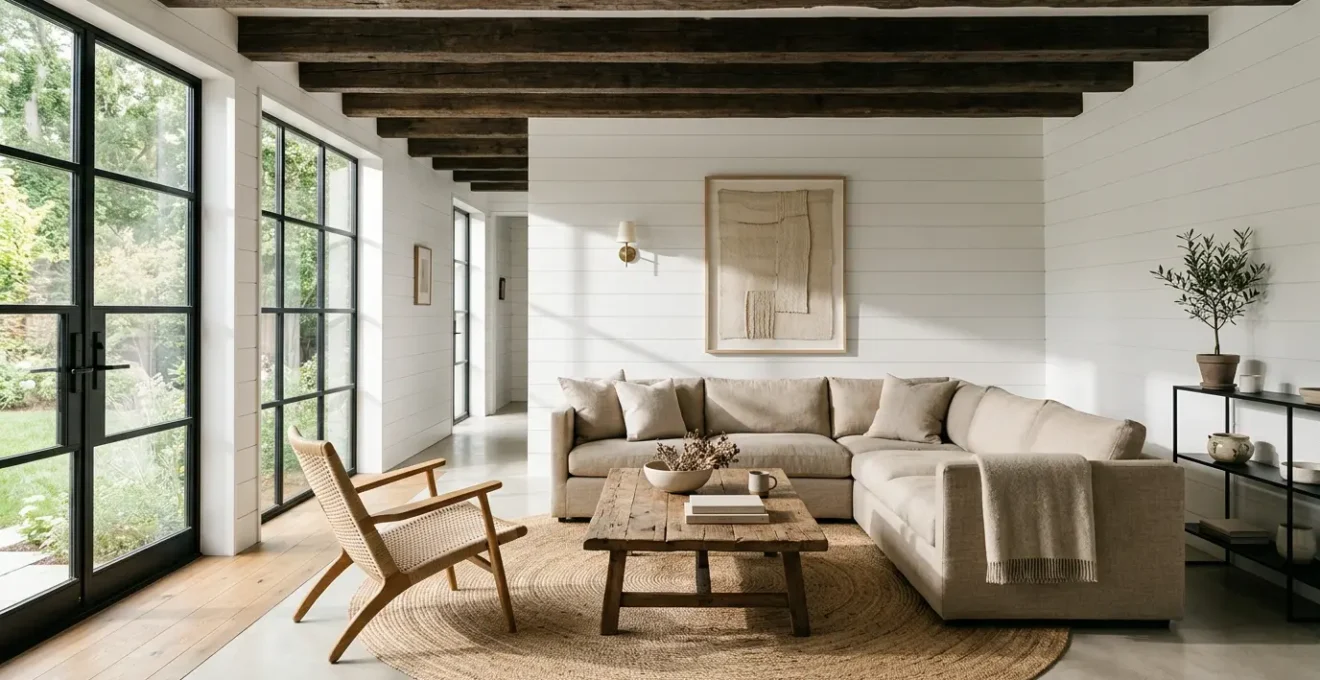
Achieving true modern farmhouse warmth isn’t about collecting rustic items; it’s about creating a deliberate tension between raw texture and clean design.
- Architectural soul can be created in any home, you don’t need a historic barn to achieve the look.
- Timeless wall finishes like plaster and curated art offer more long-term value than fleeting trends.
Recommendation: Prioritize authentic materials and meaningful art over generic decor to build a space with lasting, sophisticated character.
The modern farmhouse aesthetic continues to capture the hearts of homeowners for good reason. It promises a return to simplicity, warmth, and a connection to craftsmanship. Yet, there’s a fine line between creating a cozy, sophisticated retreat and falling into a cluttered pastiche of rustic clichés. Many homeowners, aiming for the serene charm of a country home, end up with a space that feels more like a themed decor store than a personal sanctuary. This happens when the focus is on accumulating farmhouse *items*—the barn doors, the shiplap walls, the ubiquitous word art—rather than understanding the core principle of the style.
The distinction between traditional farmhouse and its modern counterpart lies in this very principle: curation over collection. While a classic farmhouse is often an eclectic accumulation over generations, the modern interpretation is intentional. It’s a style born from a careful edit, where the raw, organic honesty of rustic elements is given space to breathe against a backdrop of clean, contemporary minimalism. It’s not about how many rustic elements you can fit in a room, but about how powerfully each one resonates.
But what if the key to unlocking this sophisticated warmth wasn’t in finding the perfect antique or installing wall-to-wall shiplap? What if it was about mastering the textural hierarchy of your space? This guide moves beyond the superficial trends to explore the foundational strategies for balancing rustic charm with contemporary lines. We’ll deconstruct the myths, provide actionable frameworks for material selection, and show you how to build an aesthetic that is both timeless and deeply personal, ensuring your home feels grounded, not generic.
To help you navigate this transformation, this article is structured to address the most critical decisions you’ll face. From foundational myths to finishing details, each section provides a clear path toward a more authentic and refined modern farmhouse style.
Summary: A Guide to Balancing Rustic and Modern Design
- Myth: do you really need a historic barn to achieve the farmhouse look?
- How to introduce raw wood elements without overpowering the room?
- Shiplap vs. plaster: which wall finish offers better long-term value?
- The “live laugh love” sign error that cheapens your modern farmhouse aesthetic
- In what order should you update finishes to shift from traditional to modern farmhouse?
- How to mix oak, walnut, and pine without your room looking chaotic?
- Why original architectural features increase your property value significantly?
- In what order should you update finishes to shift from traditional to modern farmhouse?
Myth: do you really need a historic barn to achieve the farmhouse look?
One of the most persistent myths surrounding the farmhouse aesthetic is the belief that its soul can only be found within the walls of a historic structure. While a converted barn offers undeniable character, this romantic notion is both limiting and financially impractical for most. The truth is, the essence of farmhouse style—its volume, texture, and structural honesty—can be masterfully recreated in any suburban home. In fact, focusing on a new build or renovation can be far more strategic; modern farmhouse new builds can achieve the same aesthetic for 40-60% less than the cost and complexity of a full barn conversion.
The key isn’t possessing a historical artifact, but understanding how to create what we call “architectural soul.” This is achieved by introducing elements that suggest a story and a sense of permanence. It’s about referencing the traditional barn framework and patina of age through deliberate design choices, rather than relying on an existing structure. You can build character from the ground up by focusing on finishes and forms that evoke a sense of history and craftsmanship.
Your Action Plan: Creating Architectural Soul from Scratch
- Install vertical shiplap to create visual height and barn-like volume.
- Add hand-scraped wood floors for instant patina and lived-in character.
- Apply limewash or Roman clay to walls for authentic, breathable texture without age.
- Expose existing joists or add faux structural beams to reference traditional barn framework.
- Incorporate ‘new heirlooms’—high-quality, timeless furniture pieces that will develop their own character over time.
Ultimately, a successful modern farmhouse is a testament to thoughtful design, not just architectural inheritance. By focusing on these foundational elements, you can create a space that feels both authentic and new.
How to introduce raw wood elements without overpowering the room?
Raw wood is the heart of the modern farmhouse, bringing in the warmth, texture, and connection to nature that defines the style. However, the line between “warm and rustic” and “heavy and dated” is thin. The mistake many make is using too many wood tones or finishes of the same scale, creating a visually cluttered and dark space. The secret to success lies in establishing a textural hierarchy and practicing restraint. Instead of a room full of rustic wood furniture, think of raw wood as a powerful accent that shines brightest when contrasted with clean, smooth surfaces.
This means selecting a few key moments for wood to be the hero. A rough-sawn wooden mantel, a set of exposed ceiling beams, or a live-edge dining table can each serve as a stunning focal point. The key is to then pull back and surround these pieces with visual breathing room—think smooth plaster walls, simple linen textiles, and clean-lined contemporary furniture. This contrast not only prevents the wood from feeling overwhelming but actually amplifies its natural beauty and texture.
As the image above illustrates, placing a raw, textured element like a wooden beam against a minimal, smooth surface creates a powerful design statement. It is this intentional dialogue between rustic and refined that elevates the entire space. As one interior stylist emphasizes, the right wood pieces are an investment in character.
When it comes to furniture, wood is your best friend. It’s timeless, it’s rustic, and it instantly brings that farm charm to your space. The beauty of wooden furniture is that it gets better with age — the more worn, the more character it has.
– Interior Stylist, Castlery
By treating wood as a prized feature rather than a default material for every surface, you ensure it adds warmth and soul without dragging your modern home into a log-cabin cliché.
Shiplap vs. plaster: which wall finish offers better long-term value?
The choice of wall finish is one of the most impactful decisions in defining your modern farmhouse aesthetic, setting the entire backdrop for your design. For years, shiplap has been the go-to choice, synonymous with the style’s rustic origins. Its horizontal lines add texture and a casual, coastal-meets-country vibe. However, as the trend matures, design experts and discerning homeowners are looking towards finishes with greater longevity and sophistication. The primary contender is plaster, particularly traditional plaster, limewash, or Roman clay finishes.
While shiplap provides instant textural interest, its strong association with a specific trend means it can date a home quickly. Furthermore, the grooves can be difficult to clean and can make a room feel busy if overused. Plaster, on the other hand, offers a subtle, organic texture that feels both ancient and completely modern. It provides a soft, luminous quality that enhances natural light and serves as a quiet, elegant canvas for your rustic wood elements and contemporary furniture to stand out. While potentially having a higher initial cost, its timeless appeal provides superior long-term value, as it’s unlikely to ever fall out of fashion. A direct comparison highlights the trade-offs between trendiness and timelessness.
| Factor | Shiplap | Plaster |
|---|---|---|
| Initial Cost | $3-7 per sq ft | $5-10 per sq ft |
| Style Longevity | May date quickly (5-10 years) | Timeless (20+ years) |
| Acoustic Properties | Absorbs sound, creates cozier feel | Reflects sound, brighter atmosphere |
| Resale Impact | Appeals to farmhouse buyers only | Universally appealing |
| Maintenance | Dust collection in grooves | Easy to clean and repaint |
Ultimately, if your goal is a space that feels authentic, elevated, and built to last, plaster offers a more durable and sophisticated foundation. It aligns with the modern farmhouse principle of investing in quality, timeless materials over fleeting trends.
The “live laugh love” sign error that cheapens your modern farmhouse aesthetic
Nothing undermines a sophisticated modern farmhouse interior faster than generic, mass-produced word art. Signs proclaiming “Gather,” “Blessed,” or the infamous “Live, Laugh, Love” have become a caricature of the style, instantly signaling a lack of originality and personal depth. The goal of modern farmhouse is to create a space that feels authentic and curated; these signs do the exact opposite. They are the decorative equivalent of a platitude, filling a space without adding any real meaning or soul.
The solution isn’t to banish text from your walls entirely, but to approach it with the same intentionality you apply to your furniture and finishes. Curated authenticity should be your guide. Instead of buying a pre-made sentiment, invest in art and objects that tell a personal story or showcase genuine craftsmanship. This shift in mindset—from passive consumer to active curator—is what separates a home with character from one that looks like a catalog page. The goal is to evoke a feeling, not just state it literally on a piece of painted wood.
Here are some sophisticated alternatives to generic word art:
- Replace generic signs with framed vintage book pages featuring beautiful typography or meaningful passages.
- Commission a piece of custom calligraphy with a family quote, a line from a poem, or a meaningful date.
- Display oversized single letters or numbers—perhaps a family initial or house number—in a clean, sculptural font.
- Frame architectural blueprints of your home or antique maps of a significant place.
- Invest in original abstract art that evokes the emotions of warmth and gathering without using literal words.
This approach invites conversation and adds a layer of personal history to your walls, turning your decor into a genuine reflection of who you are, rather than a collection of trendy slogans.
In what order should you update finishes to shift from traditional to modern farmhouse?
Transitioning a home from a traditional or builder-grade style to a modern farmhouse look can feel overwhelming. The key is to approach it in strategic phases, prioritizing updates based on a balance of impact versus invasiveness. You don’t need to gut your entire home at once. A phased approach allows you to manage your budget and enjoy the transformation process, building momentum with each step. Start with the changes that deliver the biggest aesthetic return for the lowest cost and effort, then move towards more significant investments.
A logical progression starts with the most flexible and high-impact elements and gradually moves to the more permanent and costly ones. This allows you to live in the space and refine your vision as you go. Think of it as building your design in layers, from the easiest cosmetic changes to the more structural updates.
Here is a practical, phased approach to guide your updates:
- Phase 1 (Low Cost, High Impact): This is about immediate gratification. Start by updating all of your lighting fixtures to matte black or warm brass models. Simultaneously, swap out textiles like pillows, throws, and curtains for those in neutral tones and natural materials like linen, cotton, and wool.
- Phase 2 (Medium Investment): Once the accessories are in place, tackle the walls. A fresh coat of paint in a warm white, greige, or mushroom is one of the most transformative changes you can make. During this phase, replace all cabinet and door hardware with simple, modern matte black or brass pulls and knobs.
- Phase 3 (Major Investment): Now, focus on the foundational surfaces. Installing wide-plank flooring in a light oak or a character-rich wood is a significant investment that anchors the entire aesthetic. This is also the time to update millwork like baseboards and window trim to simpler, more substantial profiles.
- Phase 4 (The “Hero Piece” Strategy): Before undertaking major structural work, invest in one statement piece that will act as the style anchor for your main living area. This could be a large, reclaimed wood dining table or a comfortable, clean-lined modern sectional sofa.
This methodical process ensures that each step builds logically on the last, creating a cohesive and beautifully realized modern farmhouse space without the stress and expense of a full-scale, single-shot renovation.
How to mix oak, walnut, and pine without your room looking chaotic?
Mixing different wood tones is essential for creating a layered, authentic modern farmhouse interior, but it’s a technique that intimidates many. The fear of creating a chaotic, mismatched look is real. The secret isn’t to perfectly match everything—that leads to a flat, one-dimensional space. Instead, success lies in a “cousins, not twins” approach, guided by two principles: identifying the dominant wood tone and understanding undertones.
First, choose one wood to be the anchor or dominant finish. This is typically the largest wood surface in the room, most often the flooring. Let’s say your floors are a warm, golden oak. This sets the primary tone. All other woods you introduce should complement this dominant tone. A good rule of thumb is to limit yourself to a maximum of three wood types per room to maintain a sense of cohesion. The second and third woods should be used in smaller doses, on furniture and accents.
Next, pay close attention to undertones (the subtle warm, cool, or neutral colors within the wood). To create a harmonious palette, you can either pair woods with similar undertones (e.g., warm oak with warm-leaning pine) or create a deliberate, balanced contrast (e.g., warm oak floors with cool walnut furniture). To prevent the different woods from clashing, use “buffer” materials like black metal, white textiles, or a neutral jute rug to create visual separation between them.
The following table provides a simple guide for pairing common wood types in a modern farmhouse setting.
| Wood Type | Undertone | Best Role | Pairs Well With |
|---|---|---|---|
| Oak | Warm yellow/gold | Anchor (floors) | Cool walnut, painted white |
| Walnut | Cool brown/gray | Bridge (furniture) | Warm oak, light pine |
| Pine | Light warm | Accent (frames, details) | Dark walnut, medium oak |
| Buffer Materials | Neutral | Visual separator | Black metal, white fabric, jute |
By being intentional about your wood choices and using these simple rules, you can create a room that feels rich, collected over time, and expertly designed, rather than accidentally mismatched.
Why original architectural features increase your property value significantly?
In a world of mass-produced homes and finishes, original architectural features have become a mark of true luxury and character. Elements like original hardwood floors, exposed brick walls, vintage millwork, or structural ceiling beams are more than just design details; they represent what is known as a “scarcity premium.” They are irreplaceable. You can replicate the look, but you can never replicate the authentic history and craftsmanship embedded in these features. This scarcity is precisely why they add so much value to a property.
Real estate market analysis consistently shows that buyers are willing to pay more for a home with a story. In fact, on average, homes with well-preserved original architectural features can command 15-25% higher sale prices compared to similar homes without them. These elements provide an immediate sense of quality and permanence that new construction often struggles to achieve. For a buyer, it’s the difference between purchasing a house and investing in a home with soul.
This value is not just monetary; it’s also aesthetic. Preserving and highlighting these features is the most effective way to anchor a modern farmhouse design in authenticity. They provide a direct link to the past that serves as the perfect counterpoint to clean, contemporary furnishings.
Case Study: The Scarcity Premium of Reclaimed Beams
In a recent new-build modern farmhouse project, the designer made a crucial decision to source and integrate fireplace mantel beams from a dismantled 1800s farmhouse. While the home was entirely new, this single element introduced a layer of history and character that could not be faked. The visible age, hand-hewn marks, and rich patina of the beams became a central talking point of the home, imbuing the new construction with an immediate sense of gravitas and authenticity that significantly elevated its perceived value.
Therefore, if you are lucky enough to have original features in your home, your first priority should be to preserve, restore, and celebrate them. They are your home’s greatest asset, both financially and aesthetically.
Key Takeaways
- The essence of modern farmhouse is the balance between raw texture and clean lines, not a checklist of items.
- Timeless finishes like plaster and authentic wood offer better long-term value than trendy shiplap.
- Create a sophisticated space by replacing generic word art with curated, personal, or abstract pieces that tell a story.
In what order should you update finishes to shift from traditional to modern farmhouse?
You’ve absorbed the principles, deconstructed the myths, and identified the key materials. Now comes the final, crucial step: applying this knowledge in a way that aligns with your real-world constraints. The journey to a modern farmhouse interior isn’t a race. It’s an evolution that should respect your budget, timeline, and lifestyle. The most successful transformations are those that are planned and phased, allowing for thoughtful decisions rather than rushed, costly mistakes.
The beauty of the modern farmhouse style is its understated and forgiving nature. Because the palette is generally muted and the focus is on a few high-impact elements, it’s a style that you can build over time. You don’t need a massive, all-or-nothing renovation. As design experts often advise, it’s about making a series of smart, incremental changes.
You can plan your modern farmhouse decor update to suit your budget and lifestyle. Tackle smaller, easier tasks first, and budget and save for bigger items. Since this style is very understated and muted in general, it’s also not a huge commitment to big changes.
– Brennan Corporation Design Team, Brennan Corp
This mindset frees you from the pressure of perfection. Start with what you can, whether it’s a can of paint and new cabinet hardware or a single, beautiful “hero piece” of furniture. Each change, no matter how small, is a step toward realizing your vision of a warm, sophisticated, and authentically modern home.
Begin by evaluating your own home with this new perspective and identify the first, most impactful step you can take today. Your journey toward creating a home with lasting warmth and character starts now.