
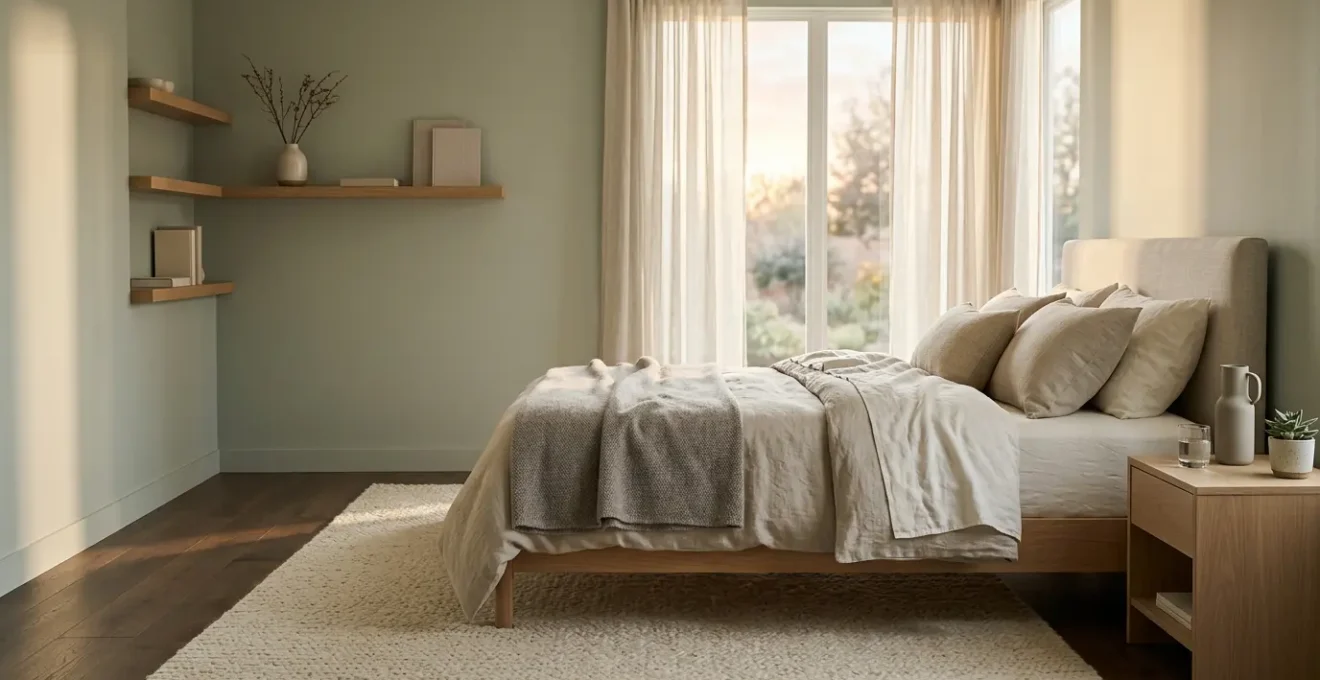
Transforming your master suite into a sleep sanctuary is not about decoration; it’s about neuro-architecture—designing a space that actively calms your nervous system and supports deep, restorative sleep.
- The layout, light, and level of “visual noise” in your bedroom directly impact stress hormones like cortisol and sleep hormones like melatonin.
- Strategic design can create psychological boundaries, reduce subconscious anxiety, and accommodate the differing schedules of a couple.
Recommendation: Start by addressing the most significant sensory input: reposition your bed to face the door to create a sense of subconscious security, the foundational layer of a true sanctuary.
For many couples, the master bedroom has slowly drifted from its purpose. It’s no longer a retreat for connection and rest but a functional space—a “sleeping storage unit” where the day’s clutter and stress accumulate. You close the door at night not to enter a sanctuary, but to hide from the rest of the house. The common advice—to declutter or pick a calming paint color—often misses the fundamental point. These are merely surface-level changes that don’t address the underlying psychological and physiological needs for true restoration.
What if the key to transformative sleep wasn’t just about what you do before bed, but about the very architecture of the space you do it in? This guide adopts the perspective of a sleep hygiene architect. We will move beyond simple decor tips to explore how your bedroom’s design is a powerful tool for hormonal hygiene and circadian alignment. It’s about consciously crafting an environment that speaks directly to your nervous system, signaling safety, calm, and a profound sense of peace. This is how you reclaim your master suite as a sanctuary.
This article will guide you through the core principles of designing this sanctuary. We will explore how to manage sensory inputs—from light and sound to visual information—to create a space that actively works to lower stress, deepen intimacy, and dramatically improve the quality of your shared rest.
Summary: Your Blueprint for a Restorative Master Suite
- Why placing your bed facing the door reduces subconscious anxiety?
- How to hide visual clutter to lower your cortisol before bed?
- Carpet vs. Hardwood: which floor choice keeps the master suite temperature stable?
- The “blue light” mistake: why charging phones near the bed destroys deep sleep
- How to design a layout that allows one partner to wake up early without waking the other?
- How to create a psychological “buffer zone” before entering the master suite?
- Why standard width curtains always leave light gaps at the edges?
- Muted Color Schemes: Using Low-Saturation Tones to Reduce Household Stress
Why placing your bed facing the door reduces subconscious anxiety?
The first principle of creating a sanctuary is establishing a feeling of subconscious security. Your brain’s most primitive wiring is constantly scanning for threats, even during sleep. If your bed is positioned where you cannot see the entrance to the room, your nervous system remains in a subtle state of hypervigilance. You are, in effect, sleeping with your back to a potential danger, which can prevent you from entering the deepest, most restorative stages of sleep. This isn’t a conscious fear, but a low-level, instinctual anxiety.
Placing your bed in the “commanding position”—where you can see the door without being directly in line with it—satisfies this primal need for safety. It sends a powerful signal to your limbic system that you are in control of your environment and can rest without threat. This simple change in layout is the architectural equivalent of a deep, calming breath, allowing your mind and body to fully surrender to sleep. It forms the foundational layer upon which all other elements of your sanctuary will be built.
How to hide visual clutter to lower your cortisol before bed?
What we casually call “clutter” is interpreted by the brain as visual noise. Every object in your field of vision—piles of laundry, stacks of books, tangled chargers—is a piece of data that your brain is forced to process. This constant, low-level sensory input signals that tasks are unfinished, which in turn triggers the release of the stress hormone, cortisol. High cortisol levels at night are the enemy of sleep, actively inhibiting the production of melatonin and keeping you in a state of wired alertness.
Hiding visual clutter is an act of hormonal hygiene. It’s not just about tidying up; it’s about creating a visually serene environment that tells your brain its work is done for the day. This is why organized, hidden storage is paramount. Nightstands with drawers are superior to open tables, and closed wardrobes are better than open racks. Even the simple act of making the bed, as one homeowner noted, can “really make our Master our sanctuary” because it replaces a chaotic visual with a smooth, orderly one. Adding natural elements can also help, as a sleep psychologist explains:
Plants have sleep-inducing benefits. They can help lower a person’s cortisol levels (stress hormones) by emitting oxygen at night that clears the mind and relaxes the body.
– Dr. Katherine Hall, Sleep psychologist study on bedroom plants
This minimalist approach to your bedside environment reduces the last-minute mental load, allowing your cortisol levels to naturally fall and making way for restful sleep.
The goal is to curate a space where your eyes can rest, signaling to your brain that it can, too. By intentionally reducing visual noise, you are directly engineering a hormonal state conducive to deep relaxation and sleep.
Carpet vs. Hardwood: which floor choice keeps the master suite temperature stable?
Your body’s core temperature needs to drop slightly to initiate and maintain sleep. This is a critical component of your circadian rhythm. The ideal ambient temperature for sleep is a key factor in this process, and scientific studies demonstrate that sleep was most efficient when nighttime ambient temperature ranged between 20-25°C (68-77°F). The choice between carpet and hardwood flooring plays a significant role in how well your master suite can maintain this optimal thermal environment.
Hardwood floors, especially when paired with area rugs, offer the best of both worlds for temperature regulation. Wood has a lower thermal mass than many other hard surfaces, meaning it doesn’t hold onto heat or cold as intensely. In warmer months, it helps dissipate heat. In cooler months, a plush area rug can be added to provide insulation and a warm surface for your feet. This adaptability is crucial, as a massive study reviewing 3.75 million nights of sleep data revealed that on nearly 69% of nights, bedrooms exceeded the optimal temperature, negatively impacting sleep quality.
Wall-to-wall carpeting, conversely, acts as a significant insulator. While cozy in winter, it can trap heat during warmer seasons, making it difficult for the room to cool down at night. This can interfere with your body’s natural thermoregulation process. For creating a year-round sleep sanctuary, hardwood with a well-chosen area rug provides superior thermal stability, giving you more control over one of the most critical environmental factors for restorative sleep.
The “blue light” mistake: why charging phones near the bed destroys deep sleep
The single most disruptive modern habit to our sleep is the proximity of our smartphones at night. The issue extends far beyond the temptation of a final scroll through social media. The screen’s blue light is a powerful signal to our brain, mimicking daylight and directly suppressing the production of melatonin, the key hormone that governs our sleep-wake cycle. Charging your phone on your nightstand exposes you to this disruptive light at the precise moment your body needs to be winding down.
Furthermore, the mere presence of the phone creates a state of “connected alertness.” Every notification, buzz, or blink is a potential interruption, keeping your nervous system on standby. To truly create a sanctuary, you must physically decouple your sleep space from your digital life. This means establishing a firm “digital sunset” ritual and creating a dedicated charging station outside the bedroom. By replacing your phone’s alarm with an analog clock or a sunrise simulator, you remove the primary justification for keeping it by your bed. This act creates a powerful psychological boundary, reinforcing the bedroom’s role as a space for rest and intimacy, not for work and communication.
Your Digital Sunset Action Plan: Reclaiming Your Nights
- Set up a dedicated charging station outside the bedroom, or at a minimum, more than 5 feet from your bed.
- Replace your smartphone’s alarm with a gentle-waking option like an analog or sunrise simulation clock.
- If you must use a device in the evening, enable a blue light blocking mode or app after 8 PM.
- Institute a “phone curfew” by putting your devices to bed at least one hour before your intended sleep time.
- Keep a simple notepad and pen by your bed to jot down any late-night thoughts or reminders instead of reaching for your phone.
By implementing these steps, sourced from expert advice on creating a sleep sanctuary, you are not just removing a distraction; you are performing essential maintenance on your circadian rhythm.
How to design a layout that allows one partner to wake up early without waking the other?
For couples, a master suite sanctuary must accommodate two individual rhythms. A common source of friction and disturbed sleep is when one partner is an early riser and the other is not. A thoughtfully designed layout can create distinct functional zones within the room, minimizing disruption and preserving the peace for the sleeping partner. The key is to think of the room not as one open space, but as a series of connected zones for sleeping, dressing, and transitioning.
By using furniture and rugs to delineate these areas, you can create a layout that absorbs activity. Place the bed furthest from the door and closet. Create a dedicated dressing zone near the wardrobe with its own small rug, a comfortable chair for putting on shoes, and ideally, its own soft, targeted light source (like a directional floor lamp) that won’t flood the room. This zoning strategy allows the early riser to get ready in a contained area, reducing noise and light spillover. The following example illustrates this principle perfectly.
The Two-Zone Sanctuary Layout
A highly effective layout strategy divides your space into two distinct zones: one dedicated purely to sleep and the other for quiet morning or evening activities. Position your bed and nightstands against one wall to create the “sleep zone.” Then, on the opposite side of the room or near the closet, set up a “lounging/dressing zone” with a small loveseat or a comfortable chair, a side table, and a dedicated lamp. This physical separation creates a functional and psychological buffer that allows one partner to read or prepare for the day without disturbing the other.
This multi-zone approach is a gesture of respect and care, transforming the master suite into a space that honors both shared rest and individual needs.
Ultimately, a well-designed layout acknowledges that a couple’s sanctuary must be both a shared haven and a space that gracefully handles individual routines.
How to create a psychological “buffer zone” before entering the master suite?
The transition from the demands of the day to the calm of your sanctuary should be a deliberate, multi-sensory experience. A psychological buffer zone is a ritualized threshold that signals to your mind and body that it’s time to let go of stress and prepare for rest. This isn’t necessarily a separate room, but a series of sensory cues located at the entrance to your master suite that trigger a state of relaxation. It’s the act of consciously crossing over from the “doing” world to the “being” world.
You can architect this transition using a few simple but powerful elements. A change in flooring, from a hard surface in the hallway to a soft, plush rug just inside the bedroom door, provides a tactile cue. A single, warm-toned sconce on a dimmer, separate from the main overhead light, can create a “welcome home” glow. Scent is also a potent tool; a ceramic diffuser with a calming lavender or chamomile scent near the entrance can trigger an immediate relaxation response. These small, intentional details work together to create a powerful entry ritual. As the BDI Furniture Sleep Design Team advises, you should “Create a bedtime routine that signals to your body that it’s time to wind down.” This physical buffer zone is the first step in that routine.
The goal is to make the act of entering your bedroom a mindful moment. By engaging your senses, you interrupt the stream of anxious thoughts and begin the process of unwinding before your head even hits the pillow. It transforms a simple doorway into a portal to your personal haven.
Why standard width curtains always leave light gaps at the edges?
Absolute darkness is a non-negotiable for optimal melatonin production. Even small amounts of light pollution from streetlights or the moon can disrupt your sleep cycle. The most common failure in achieving this is the “halo effect” created by standard curtains—those frustrating light gaps that bleed around the edges. This happens because a standard curtain rod holds the fabric a few inches away from the wall, allowing light to leak from the top, bottom, and sides.
To achieve a true blackout effect, you must go beyond standard hardware. A wrap-around curtain rod is an excellent solution; its curved ends allow the curtain to hug the wall, effectively sealing the side gaps. For even greater light control, a cornice board—a box-like wooden frame installed above the window—can block light from escaping at the top. When combined with floor-length blackout curtains that are significantly wider than the window frame, you can achieve near-total darkness. While more complex, these solutions are an investment in your sleep quality. The following comparison illustrates the difference in effectiveness.
| Solution | Light Blocking % | Installation Complexity | Cost Range |
|---|---|---|---|
| Standard curtains | 60-70% | Easy | $50-200 |
| Curtains with wrap-around rod | 85-90% | Moderate | $100-300 |
| Two-track system (blackout + sheer) | 95-98% | Complex | $300-600 |
| Cornice board + floor-length curtains | 98-100% | Professional | $400-800 |
As this comparative data on window treatments shows, investing in the right hardware is essential for eliminating light leaks and protecting the sanctity of your sleep environment.
Key Takeaways
- A true sleep sanctuary is designed to manage physiological responses, not just to look good.
- Minimizing sensory inputs—visual noise, blue light, and temperature fluctuations—is crucial for lowering stress hormones.
- The most effective master suite designs for couples create distinct zones to accommodate different schedules and needs.
Muted Color Schemes: Using Low-Saturation Tones to Reduce Household Stress
Color is not merely a decorative choice; it is a form of sensory information that has a direct psychological and physiological impact. Bright, highly saturated colors—like primary reds or electric blues—are stimulating. They command attention and can increase alertness, which is the exact opposite of the state you want to cultivate in a sleep sanctuary. To promote calm, you must turn down the “volume” of your color palette by focusing on low-saturation tones.
Muted colors are hues that have been softened with gray, white, or black. Think of sage green instead of lime, dusty rose instead of magenta, or slate blue instead of royal blue. These colors are less demanding on the eye and the brain, creating a feeling of soothing quiet. As Tash Bradley, a color psychologist, advises, it’s wise to “swap the electric blues, primary reds, and ‘brat’ greens for their more muted, softer counterparts.” An advanced technique to amplify this effect is “color drenching,” where the walls, trim, and even the ceiling are painted in the same or very similar muted shades. This immersive approach further reduces visual stimulation.
Using color drenching can bring a feeling of connectedness, can reduce stimulation and make us feel like we are surrounded by the harmony of difference, that is all the same at its root, creating an orchestra of one color that plays in tandem and in tune.
– Lee Chambers, Psychologist and Wellbeing Consultant
By choosing a palette of low-saturation colors, you are wrapping the room in a visual hush. It’s the final layer of sensory management, creating an environment that doesn’t shout for your attention but gently invites you to let go and rest.
Your journey to a restorative retreat begins with a single, intentional choice. Whether it’s clearing your nightstand, investing in a wrap-around curtain rod, or simply repositioning your bed, take one step this week to reclaim your master suite as the sanctuary you both deserve.