
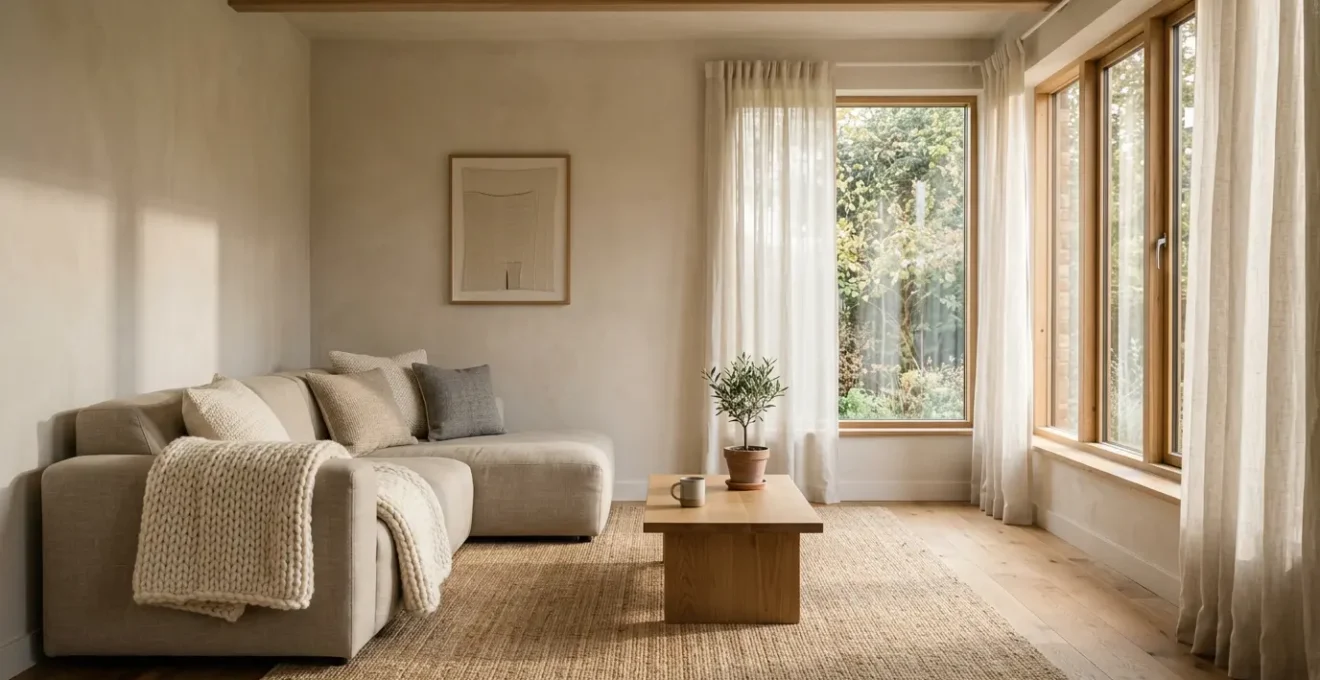
The key to a comfortable home isn’t just thermostats or decor; it’s mastering the sensory science of textiles. By strategically choosing and layering fabrics like wool, cotton, and linen, you can actively engineer your personal microclimate. This guide shows you how to use the inherent properties of fibers to manage temperature, humidity, and even allergens, transforming your space for optimal comfort in any season.
Does your living room feel stuffy and close in July, no matter how high the AC is cranked? Does a persistent chill seem to linger in your bedroom come January, even with the heating on full? Many of us instinctively reach for the thermostat, but the solution often lies much closer—woven into the very fabrics that furnish our lives. The common advice is to swap dark colors for light ones or simply change cushion covers. While these aesthetic shifts have their place, they barely scratch the surface of what’s possible.
What if the true key to seasonal comfort wasn’t about decoration, but about microclimate engineering? The secret lies in understanding that every textile has a unique personality. It breathes, insulates, and interacts with moisture and heat in distinct ways. The crisp, cool touch of linen on a summer evening is not an accident; it’s a result of its physical properties. The enveloping warmth of a wool throw is a testament to its natural insulating genius. This is the sensory science of textiles.
This article moves beyond simple styling tips to explore how you can consciously harness these properties. We will delve into why changing a single throw can alter your thermal comfort, how certain fibers can improve air quality for allergy sufferers, and how to layer textiles not just for a magazine-worthy look, but for a home that adapts and responds to your physical needs. It’s time to stop decorating and start curating your comfort.
To help you navigate this sensory world, this guide breaks down the essential choices and techniques. You’ll discover the science behind fabric performance, practical styling rules, and maintenance tips to make your textiles last, ensuring your home feels just right, all year round.
Summary: Mastering Your Home’s Climate with Textiles
- Wool vs. Cotton: Why Changing Throws Changes Your Thermal Comfort by 3 Degrees?
- Synthetics vs. Natural Fibers: Which Textiles Reduce Dust Mites for Allergy Sufferers?
- The “Rule of 3” for Layering Bed Textiles to Look Like a Magazine
- The Shrinkage Risk of Washing Linen Covers at the Wrong Temperature
- How to Use Textiles to Test a Bold Color Without Painting the Walls?
- Myth: Is Performance Velvet Actually More Durable Than Linen?
- 100% Linen vs. Linen-Blend: Is the Pure Fiber Worth Double the Price?
- Decorative Cushions: The Low-Cost High-Impact Room Refresh
Wool vs. Cotton: Why Changing Throws Changes Your Thermal Comfort by 3 Degrees?
The choice between a wool and a cotton throw is more than an aesthetic decision; it’s an act of climate control. The remarkable difference in thermal comfort they provide stems from their fundamentally different ways of interacting with moisture and air. Cotton, a plant-based fiber, is highly breathable. Its structure allows air to circulate freely, which helps dissipate body heat and moisture. This makes it the perfect companion for summer, offering a light, airy layer that provides comfort without trapping heat. In fact, a study on fabric blends found that 100% cotton had the lowest thermal resistance, making it ideal for warm conditions.
Wool, on the other hand, is a master of insulation and moisture management. Its fibers are naturally crimped, creating millions of tiny air pockets. This trapped air forms an incredibly efficient thermal barrier, slowing the transfer of heat away from your body and keeping you warm. Furthermore, wool has powerful hygroscopic properties. It can absorb a significant amount of moisture—a study shows that wool can adsorb up to 30% of its weight in water without feeling damp to the touch. In winter, this means it wicks moisture away from your skin, preventing the clammy, cold feeling that can occur with less breathable materials, thus keeping you dry and warm.
This difference in performance is what allows a simple swap of textiles to have such a profound impact on your perceived temperature. By choosing cotton in summer, you facilitate cooling. By choosing wool in winter, you optimize for insulation and dryness. You are actively managing your personal microclimate, potentially reducing your reliance on heating and cooling systems and enhancing your comfort through the sensory science of fabric.
Synthetics vs. Natural Fibers: Which Textiles Reduce Dust Mites for Allergy Sufferers?
For millions of allergy sufferers, the bedroom can be a battleground. Dust mites, microscopic creatures that thrive in warm, humid environments, are a primary trigger for indoor allergies. The choice of bedding textiles plays a crucial role in managing their populations. It is a common misconception that synthetic materials are inherently better for allergies. In reality, the opposite is often true. According to textile experts at Kearsley Home, the structure of many synthetic fills creates an ideal breeding ground for allergens.
Synthetic pillow and duvet fills are 8–10 times more hospitable to dust mites than breathable natural fibers like pure down or high-quality silk
– Kearsley Home, Kearsley Threads Blog
The key differentiator is breathability and moisture management. Natural fibers like wool, silk, and bamboo are excellent at wicking moisture away, creating a drier, less hospitable environment for dust mites. In contrast, many synthetic fibers like polyester trap moisture and body heat. This creates the warm, humid microclimate that dust mites love. However, the fabric’s weave is just as important as the fiber itself. Tightly woven fabrics, whether natural or synthetic, create a physical barrier that is difficult for mites to penetrate. This is why materials like microfiber and tightly woven organic cotton are often recommended.
The following table provides a clear comparison of common fabrics and their suitability for creating an allergy-friendlier sleep environment.
| Fabric Type | Dust Mite Resistance | Key Properties | Washing Temperature |
|---|---|---|---|
| Microfiber/Polyester | High | Tight weave, smooth fibers, quick drying | 60°C (140°F) |
| Bamboo | High | Moisture-wicking, naturally antimicrobial | 40-60°C |
| Organic Cotton | Medium | Breathable, requires tight weave | 60°C (140°F) |
| Wool | Low-Medium | Natural lanolin, but traps moisture | 30°C (cold) |
Ultimately, managing dust mites requires a two-pronged approach: choosing fabrics that create an inhospitable environment (dry and breathable) and maintaining a strict cleaning regimen. Washing bedding weekly in hot water (60°C/140°F) is critical for killing mites, but this must be balanced with the care instructions for your chosen fabric to prevent damage.
The “Rule of 3” for Layering Bed Textiles to Look Like a Magazine
Achieving that effortlessly chic, “pulled-from-a-magazine” bed look is less about having expensive linens and more about the art of sensory layering. The “Rule of 3” is a simple yet powerful design principle that balances visual appeal with practical comfort. It involves creating three distinct layers, each with a specific function and texture, to build depth, interest, and adaptability. This approach transforms the bed from a simple sleeping surface into the focal point of the room.
The three layers are the Foundation, the Functional, and the Flair.
- The Foundation Layer: This is your base for comfort. It consists of your fitted sheet, flat sheet, and primary duvet or comforter. Typically, these are kept in neutral, calming tones (whites, creams, soft grays) to create a serene canvas.
- The Functional Layer: Sandwiched between your flat sheet and duvet, this is usually a lightweight blanket or coverlet. Its purpose is practical: it provides an intermediate level of warmth, allowing you to easily adapt to temperature fluctuations during the night without having to wrestle with a heavy duvet.
- The Flair Layer: This is where you inject personality and style. It includes a decorative throw blanket artfully draped at the foot of the bed and a collection of 3 to 4 accent pillows. This layer is your opportunity to play with bold colors, rich patterns, and intriguing textures like chunky knits or plush velvet.
The magic of this rule lies in the textural contrast. By mixing different materials—for example, a crisp percale sheet (Foundation), a soft matte linen coverlet (Functional), and a chunky wool knit throw (Flair)—you create a rich visual and tactile experience that is both inviting and sophisticated. The image below perfectly illustrates how these three layers come together to create a cohesive and luxurious look.
This layering system is also inherently seasonal. In summer, you might remove the functional layer and opt for a lighter flair throw. In winter, a heavier quilt could become the functional layer, and a plush faux-fur throw could add the final touch of cozy flair. By mastering this simple rule, you gain a versatile tool for both style and comfort.
The Shrinkage Risk of Washing Linen Covers at the Wrong Temperature
Linen is celebrated for its effortless elegance, breathability, and durability. However, this natural fiber has a notorious characteristic: its propensity to shrink if not cared for properly. The primary culprit is heat. Washing linen covers in water that is too hot causes the fibers to contract, which can result in significant and often irreversible shrinkage. Understanding the type of linen you own and adhering to proper washing protocols is essential to preserving the fit and feel of your cherished textiles.
Not all linen is created equal when it comes to washing. The most important distinction is between “garment washed” (or pre-shrunk) linen and “loom state” linen. Pre-shrunk linen has already undergone a controlled shrinkage process during manufacturing, making it far more stable and forgiving during home laundry. Loom state linen, on the other hand, is raw fabric that has not been treated. It can shrink by as much as 10% on its first wash, a dramatic change that could render a duvet cover or slipcover unusable. Always check the product description for terms like “pre-washed” or “pre-shrunk” for peace of mind.
Even with pre-shrunk linen, caution is key. The golden rule is to always use cold water. A gentle cycle with a temperature of 30°C (86°F) or below is the safest bet. It’s also crucial to avoid overloading the washing machine, as excessive friction against other items can abrade the fibers and contribute to shrinkage. If a piece does shrink slightly, all is not lost. It can sometimes be restored by re-wetting the fabric, gently stretching it by hand back to its original shape while it’s still damp, and then using a steam iron to relax and lengthen the fibers.
Action Plan: How to Safely Wash and Maintain Linen
- Identify Your Linen: Check labels or product descriptions to determine if your linen is “pre-shrunk” or “loom state.” Treat loom state linen with extreme caution on its first wash.
- Prepare for Washing: Separate linens by color. Use a mild, liquid detergent and ensure you are not overloading the washing machine to reduce friction.
- Set the Right Cycle: Select a gentle or delicate cycle and, most importantly, set the water temperature to cold (30°C / 86°F or below). Never use hot water.
- Drying with Care: Tumble dry on a low heat or no-heat setting. Remove the linen while it is still slightly damp to prevent over-drying, which can make fibers brittle. Air drying is the safest method of all.
- Finishing Touches: Iron with steam while the linen is still damp to easily remove wrinkles and relax the fibers. Embrace the natural, slightly rumpled texture as part of its charm.
–
How to Use Textiles to Test a Bold Color Without Painting the Walls?
Introducing a bold new color into a room can be intimidating. The commitment of painting a wall—and the labor involved in repainting if you dislike the result—is often a major deterrent. Textiles offer a brilliant, low-risk solution: they allow you to “test drive” a color, live with it, and see how it interacts with your space and light before making a permanent change. By strategically layering textiles, you can gradually introduce a color and control its impact, a method we can call the Color Saturation Pyramid.
This strategy involves introducing your chosen color in escalating levels of scale and commitment. You start small and build up, giving yourself time at each stage to assess your comfort with the new hue. This approach is not only reversible but also budget-friendly. Here’s how to build your pyramid:
- Level 1 (Low Commitment): Begin with the smallest and most affordable items. Introduce two or three cushion covers in your chosen bold color. This adds small, concentrated pops of color that can be easily moved or swapped out.
- Level 2 (Medium Impact): If you’re feeling good about the cushions, add a throw blanket in the same color family. Draping it over a sofa or armchair instantly increases the color’s presence in the room.
- Level 3 (Higher Visibility): The next step is a statement area rug. This anchors the space and makes a much larger color statement, defining the room’s new palette.
- Level 4 (Maximum Impact): The final, most impactful step before paint is to hang curtains in your bold color. They frame the windows, control the light, and can dramatically transform the entire room’s atmosphere.
The key is to live with each level for at least a week or two. This allows you to see the color in different lighting conditions—bright morning sun, soft afternoon light, and artificial evening light—and to gauge your emotional response to it. The image below demonstrates how these graduated levels of color can be layered in a single space to create a powerful but cohesive look.
This textile-first approach de-risks the design process. If you decide after adding the throw blanket that emerald green isn’t for you, it’s a simple matter to return or repurpose it. You’ve experimented and learned about your own taste without ever picking up a paintbrush.
Myth: Is Performance Velvet Actually More Durable Than Linen?
When choosing upholstery, “durability” is a top concern, but it’s a word with multiple meanings. The debate between performance velvet and linen often hinges on this ambiguity. If durability means resistance to abrasion, snagging, and pilling, then performance velvet is the undisputed champion. If durability means longevity and the ability to age gracefully over decades, linen makes a powerful case. The truth is, they are durable in different ways.
The technical measure for abrasion resistance in fabrics is the Martindale test. This test involves a mechanical arm rubbing a piece of standard abrasive material against the fabric until two yarns break or the fabric shows significant wear. For general domestic use, a score of 15,000 to 25,000 rubs is considered good. As a benchmark, high-quality linen typically scores within this range. Performance velvets, which are usually made from tightly woven polyester, often score dramatically higher. It is common for performance velvets to withstand 40,000+ rubs in Martindale testing, placing them in the “heavy-duty” or even “commercial grade” category. This makes them an excellent choice for high-traffic furniture used by families with children or pets.
However, linen’s claim to durability is rooted in its history and its very nature. Linen is one of the oldest textiles known to humankind, with a legacy proving its exceptional longevity. The long fibers of the flax plant make the resulting fabric incredibly strong and resistant to stretching. Unlike many synthetic fabrics that can degrade over time, linen possesses a unique quality: it develops a patina. With each wash and use, it becomes softer, more lustrous, and more comfortable. It doesn’t just endure; it improves. So while a performance velvet sofa might look newer for longer by resisting scuffs, a linen slipcover could potentially last a lifetime, telling a story of use and comfort as it ages.
So, which is more durable? For resisting the daily wear and tear of a busy household, performance velvet has the technical edge. For timeless longevity and a character that deepens with age, linen is in a class of its own.
100% Linen vs. Linen-Blend: Is the Pure Fiber Worth Double the Price?
The allure of 100% linen is undeniable. It evokes images of breezy summer homes, rustic farmhouses, and an effortlessly sophisticated lifestyle. It’s known for its exceptional breathability, unique texture, and the beautiful way it ages. But this premium experience comes with a premium price tag. This leads to a practical question for many homeowners: are linen-blends a worthy compromise, or is pure linen worth the investment? The answer depends entirely on what properties you value most.
Pure, 100% linen is the purist’s choice. Its most cherished quality is its ability to develop a patina. Over time, with every wash, the fibers soften and the fabric gains a subtle luster, becoming more beautiful and comfortable. It has unparalleled breathability, making it feel cool and crisp in the summer. However, its famous flaw is its tendency to wrinkle. For linen lovers, this is not a bug but a feature—part of its relaxed, natural charm. Its durability is also exceptional, meaning a quality linen piece can be a lifetime investment.
Linen-blends are designed to mitigate linen’s “flaws” while making it more accessible.
- Linen-Cotton Blend: This is a very common blend. The cotton softens the fabric from the start and, most notably, significantly reduces the wrinkling factor. It maintains very good breathability and durability while coming in at a more moderate price point. It’s an excellent middle-ground for those who love the feel of linen but desire easier care.
- Linen-Polyester/Viscose Blend: Blending linen with synthetic fibers like polyester or semi-synthetics like viscose pushes the fabric further towards low maintenance. These blends are highly wrinkle-resistant and are often the most budget-friendly option. However, this comes at a cost to breathability and the fabric will not develop the rich patina of pure linen. It maintains its original state for longer, which can be a pro or a con depending on your aesthetic goals.
The following table, inspired by an analysis of home textile properties, breaks down the key differences to help you decide.
| Property | 100% Linen | Linen-Cotton Blend | Linen-Polyester Blend |
|---|---|---|---|
| Patina Development | Excellent – improves with every wash | Moderate – some softening | Minimal – maintains original state |
| Wrinkle Factor | High – embraces natural texture | Medium – reduced wrinkling | Low – stays smoother |
| Breathability | Excellent | Very Good | Good |
| Price Point | Premium ($$$) | Moderate ($$) | Budget ($) |
| Durability | Exceptional | Very Good | Good |
Ultimately, if you value the unique aging process, superior breathability, and timeless character of a natural fiber, and are prepared for the investment and the wrinkles, 100% linen is unmatched. If you seek a similar aesthetic with less wrinkling and a lower price point, a linen-cotton blend is a fantastic alternative.
Key Takeaways
- Textiles as Tools: Think of fabrics not as decoration, but as functional tools to actively manage your home’s temperature and humidity.
- Natural Fibers for Health: Breathable, moisture-wicking natural fibers like wool and silk are generally less hospitable to dust mites than synthetics.
- Layering is Key: Use the “Rule of 3” (Foundation, Functional, Flair) to create beds that are both stylish and adaptable to seasonal temperature changes.
Decorative Cushions: The Low-Cost High-Impact Room Refresh
In the world of interior design, few elements offer as much transformative power for such a low cost and effort as decorative cushions. They are the ultimate tool for a quick room refresh, allowing you to introduce new colors, textures, and patterns without any long-term commitment. Swapping out a few cushions can instantly shift a room’s mood, update it for a new season, or tie together a disparate color scheme. Mastering the art of cushion arrangement is a fundamental skill for any home enthusiast.
A successful arrangement relies on a simple formula that balances solids, patterns, and textures. A popular and effective method is the “Anchor, Medium, and Jewel” approach. You begin with two large, matching cushions in a solid, neutral color—these are your ‘Anchors,’ placed at either end of the sofa. Next, you add two slightly smaller, patterned cushions—the ‘Medium’—that pick up on other colors in the room. Finally, you place one unique, texture-rich cushion in the center—the ‘Jewel.’ This could be a cushion made of bouclé, velvet, or featuring detailed embroidery. This simple formula creates a look that is layered, intentional, and visually balanced.
Scale is another critical factor. A common mistake is using cushions that are too small for the furniture. As the Bare Home design team notes, “A king bed can handle three or four larger pillows (24×24 inches), while a queen looks better with medium-sized ones (20×20 inches).” The same logic applies to sofas; a large sectional can accommodate larger cushions and more of them, while a smaller loveseat requires a more restrained approach. Mixing sizes, such as combining 24-inch squares with 20-inch squares and a rectangular lumbar pillow, adds professional-level depth and dimension to your arrangement.
Don’t be afraid to think outside the sofa. Cushions can bring comfort and style to unexpected places. A stack of large floor cushions can create a cozy, informal seating area. A single, beautiful cushion can make a simple window seat or entryway bench far more inviting. By viewing cushions as versatile design assets, you unlock a world of low-effort, high-impact possibilities for refreshing your space season after season.
Frequently Asked Questions on Home Textiles
What’s the difference between ‘garment washed’ and ‘loom state’ linen?
Garment washed or pre-shrunk linen has already undergone a controlled shrinkage process during its manufacturing, which makes it much safer and more stable for home washing. Loom state linen has not been pre-treated and is essentially raw fabric; it can shrink by up to 10% on its first wash, so it requires much more careful handling.
What temperature should I wash linen to prevent shrinkage?
Always use cold water to wash linen. A gentle cycle with a temperature setting of 30°C (86°F) or below, combined with a mild detergent, is the safest method. You should also avoid overloading the washing machine, as the increased friction can worsen the risk of shrinkage.
Can shrunken linen be restored to its original size?
In cases of minor shrinkage, it is sometimes possible to reverse the effect. You can try re-wetting the fabric completely, then gently stretching it back into shape by hand while it is still damp. Following this by using a steam iron can help relax the fibers further and restore more of the original size.