
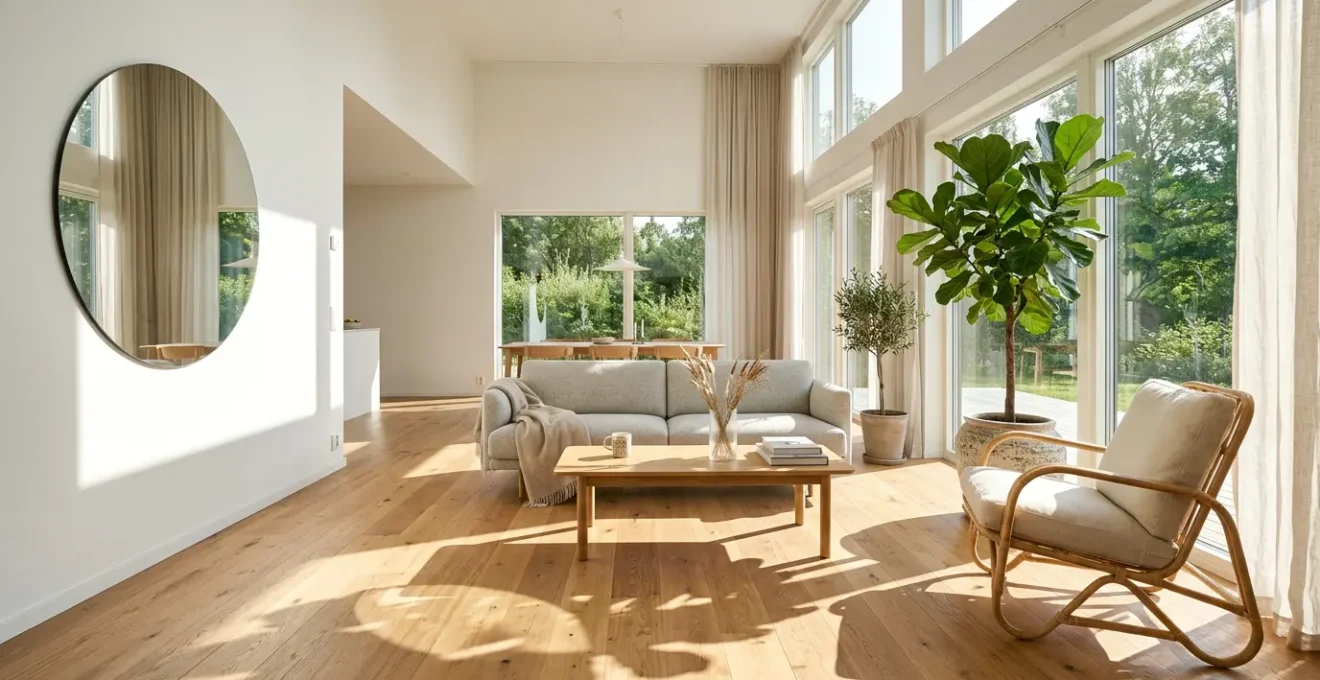
Rethinking your home’s relationship with the sun is the single most effective, no-cost way to improve both its energy efficiency and your daily well-being.
- Light is not random; it follows predictable geometric paths that can be mapped and manipulated with precision.
- Material science—from the Light Reflectance Value (LRV) of paint to the microstructure of fabrics—dictates how light behaves and feels in a room.
Recommendation: Stop treating light as a passive element and start designing with it as a primary architectural material to actively shape your environment.
Many homeowners feel they are at the mercy of their home’s orientation, battling rooms that are perpetually dim or grappling with surprisingly high energy bills. The conventional wisdom often involves simple fixes: painting walls white, adding a mirror, or cleaning the windows. While these steps offer marginal gains, they only scratch the surface of a much more powerful and scientific discipline: daylighting. This practice treats sunlight not as a random occurrence, but as a dynamic and controllable building material.
The true potential lies in understanding the physics of light and its psychological impact. It’s about more than just brightness; it’s about the quality, temperature, and movement of light throughout the day and seasons. The difference between a room that feels sterile and one that feels welcoming often comes down to the subtle interplay of reflection, diffusion, and shadow. This requires a shift in perspective, moving from merely letting light in to actively directing it.
But if the solution isn’t just about adding more lamps or choosing lighter colors, what is it? The key lies in a holistic approach that combines solar geometry, material science, and strategic interior design. It involves mapping the sun’s path to create a perfect reading nook, understanding how the fibers in linen diffuse a softer glow than polyester, and recognizing the UV risks that silently degrade your cherished belongings. This guide will provide the technical framework to transform your home from a passive recipient of light into an active partner with the sun.
This article will guide you through the principles of daylighting, from correcting challenging north-facing rooms to choosing sculptural fixtures that complement natural light. We’ll explore the science behind light interaction and provide actionable strategies to create a home that is not only brighter and more energy-efficient but also profoundly more uplifting.
Summary: A Technical Guide to Harnessing Sunlight in Your Home
- Why North-facing rooms feel cold and how to correct it with decor?
- How to position mirrors to double the natural light in deep rooms?
- Sheer curtains vs. blinds: which maximizes light while keeping privacy?
- The UV damage risk that fades your furniture and floors unnoticed
- How to track sun angles to plan your reading nook for winter afternoons?
- Why reliance on overhead lights kills the intimate atmosphere of a room?
- Why linen creates a more flattering room glow than polyester?
- Light Fixtures: Choosing Sculptural Pieces That Define Your Room’s Style
Why North-facing rooms feel cold and how to correct it with decor?
Rooms with a northern exposure receive consistent, indirect sunlight throughout the day. This light is cool, bluish, and soft, which can be excellent for artists’ studios as it renders colors accurately without harsh glare. However, for everyday living spaces, this same quality can make a room feel cold, flat, and unwelcoming. The primary challenge is to counteract this cool tone and amplify the limited brightness without resorting to constant artificial lighting. The solution lies in a scientific approach to surface selection and layering textures.
The first principle is to maximize light reflection. This is where the Light Reflectance Value (LRV) of your paint becomes a critical tool. LRV measures the percentage of light a color reflects. For a north-facing room, you must choose colors that work *with* the cool light, not against it. While pure white might seem logical, it can appear gray and stark in a northern exposure. Instead, a warm off-white, a creamy beige, or a soft gray with yellow or pink undertones will absorb the coldness and reflect a warmer, more inviting glow. As a technical guideline, interior design experts recommend paint colors with a Light Reflectance Value of 60+ to ensure the space feels as bright as possible.
Beyond paint, the key is to introduce visual and tactile warmth through materials. This is where strategic decor can fundamentally alter the room’s atmosphere. Swap out cool, smooth surfaces like metal and glass for warm, textured ones. Think of layers: a chunky knit throw, velvet cushions, a high-pile wool rug, and warm-toned wood furniture. These materials not only add physical comfort but their textured surfaces catch and scatter light in multiple directions, creating a sense of depth and preventing the light from feeling flat.
As the illustration demonstrates, the combination of rich textiles and targeted artificial light creates pockets of warmth that balance the cool, ambient daylight. Finally, ensure window treatments are minimal. Heavy drapes will swallow what little light you have. Opt for light, airy sheers or leave windows bare if privacy allows, ensuring every available photon can enter and contribute to the room’s luminance.
How to position mirrors to double the natural light in deep rooms?
The common advice to “hang a mirror” to brighten a room is deceptively simple. In reality, effective mirror placement is a game of angles and strategic light redirection, not just reflection. Placing a mirror directly opposite a window can often be counterproductive, creating harsh glare or simply bouncing precious light straight back outside. The expert approach treats mirrors as a series of lenses or periscopes, designed to capture light and channel it precisely where it’s needed most: into the dark, recessed corners of a room.
The most effective strategy is to place a large mirror on a wall adjacent (perpendicular) to the window. This positioning catches the light as it streams in sideways and projects it deeper into the room, illuminating areas the direct light cannot reach. To determine the optimal angle, think like a physicist. Observe where the sunlight lands at different times of the day and position the mirror to intercept that path and redirect it toward a specific dark target, like a gloomy hallway entrance or a shadowed corner. This creates a “periscope effect” that can dramatically extend the reach of natural light.
For particularly long, narrow, or L-shaped rooms, a single mirror may not be enough. Here, a “mirror relay” system can be employed. This involves using multiple smaller mirrors to bounce light progressively along a path. The first mirror catches the light from the window, a second mirror down the hall catches that reflection and sends it further, and so on. This technique is especially useful for bringing light around corners. The type of mirror also plays a significant role in the quality of the reflected light, as different finishes produce different effects.
This comparative analysis shows how different mirror types can be used to achieve specific lighting goals, moving beyond a one-size-fits-all approach.
| Mirror Type | Light Effect | Best Use Case | Visual Impact |
|---|---|---|---|
| Flat Standard Mirror | Creates bright, direct reflection | Small spaces needing maximum brightness | Can create harsh glare |
| Antiqued Mirror | Diffuses light softly | Creating atmospheric glow | Softer, more romantic lighting |
| Convex Mirror | Spreads light wider | Narrow hallways or corners | Creates interesting light patterns |
| Multiple Small Mirrors | Creates light relay effect | L-shaped or very deep rooms | Dynamic light movement |
Sheer curtains vs. blinds: which maximizes light while keeping privacy?
Choosing a window treatment is a classic design dilemma, forcing a trade-off between maximizing natural light and maintaining privacy. The ideal solution doesn’t just cover a window; it actively manages the light that passes through it. Sheer curtains and blinds are not simply interchangeable options; they represent two distinct philosophies of light control. Sheers work by diffusing light, while blinds work by directing it.
Sheer curtains, particularly those made from natural fibers like linen, excel at creating a soft, ethereal glow. The natural irregularities and slubs in the fabric scatter incoming light in countless directions, reducing glare and bathing the room in a gentle, flattering luminance. They are perfect for rooms where privacy is not the primary concern or for north-facing windows that don’t receive harsh, direct sun. However, their major drawback is at night; when the interior is lit, they become almost transparent from the outside, offering minimal privacy.
Blinds, on the other hand, offer a more engineered and precise level of control. Venetian blinds allow you to angle the slats to direct light towards the ceiling, which helps it bounce deeper into the room while blocking the direct line of sight from the outside. A more advanced and highly effective solution is the top-down/bottom-up shade. As Erica Bail, Executive Creative Director at Graber Window Treatments, points out, this design is uniquely versatile. She states, “Top-down/bottom-up shades allow natural light to enter from the top of the window while preserving privacy below. This technique spreads light more evenly throughout a space and draws the eye upward, helping rooms feel taller and brighter.” This system provides the best of both worlds: you can flood the room with light from above while keeping the lower portion of the window covered at eye level, which is ideal for street-facing rooms.
Ultimately, the superior solution is often a dual-layer system. This combines the soft, decorative diffusion of a sheer curtain for daytime use with an opaque roller blind or blackout curtain that can be drawn at night for complete privacy and light-blocking. This layered approach offers maximum flexibility, allowing you to tailor your light control and privacy levels to the exact time of day and the specific needs of the space, especially for west-facing windows where controlling afternoon heat and glare is paramount.
The UV damage risk that fades your furniture and floors unnoticed
While we covet homes filled with beautiful, streaming sunlight, this daily flood of light carries an invisible threat: ultraviolet (UV) radiation. Just as UV rays can damage our skin, they are the primary culprit behind the slow, irreversible fading of furniture, textiles, artwork, and hardwood floors. This process, known as photodegradation, happens so gradually that it often goes unnoticed until the day you move a rug and discover a stark outline of the floor’s original color. Managing this risk is a crucial component of advanced daylighting design.
The sun emits energy across a spectrum, and while visible light is what we see, it’s the high-energy UV-A and UV-B rays that break down the chemical bonds in dyes and finishes. Different materials have varying levels of resistance to this assault. For instance, natural fibers like cotton and linen are highly susceptible to fading, whereas solution-dyed acrylics are far more robust. Similarly, delicate woods like cherry and walnut will fade and change color much faster than dense, oily woods like teak or ipe. Understanding this material hierarchy is the first step in protecting your investments.
The most effective defense is a multi-layered strategy. The first line of defense is external. Strategically planting deciduous trees outside south- or west-facing windows can provide natural shade during the intense summer months while allowing warming passive solar gain in the winter when their leaves have fallen. Retractable awnings or a permanent brise-soleil (an architectural sun-shading structure) can also be highly effective. Internally, the most powerful solution is advanced window glazing. Modern windows with a Low-E (low-emissivity) coating can block up to 99% of UV radiation while remaining virtually clear, allowing visible light to pass through. Though an investment, this is the single best way to protect your interiors without sacrificing brightness. Proper daylighting design isn’t just about maximizing light; it’s also about saving energy. In fact, thoughtful window placement and shading strategies can significantly cut down on the need for artificial lighting, as household electricity usage from lighting can be reduced by up to 10% through effective design.
For a practical approach, homeowners can adopt a “sacrificial surfaces” strategy by placing less valuable or more UV-resistant items in the direct path of the sun to shield more precious pieces. Combining these methods provides robust protection against the silent damage of UV light.
Action Plan: Your UV Protection Audit
- Material Inventory: Identify your most vulnerable items. Prioritize protecting delicate woods (cherry, walnut), natural fabrics (silk, cotton), and valuable artwork.
- Fabric Resistance Check: When buying new textiles, check the material. Solution-dyed acrylic and polyester offer the best resistance. Cotton and linen are the least resistant.
- Glazing Assessment: Investigate your windows. If they are older single-pane glass, consider upgrading to windows with a Low-E coating for near-total UV protection.
- Exterior Shading Strategy: Evaluate your home’s exterior. Could a retractable awning or a strategically planted deciduous tree block the harshest summer sun on your most exposed windows?
- Adopt Sacrificial Surfaces: Place a durable, UV-resistant rug or a less-precious piece of furniture in the sunniest spot to absorb the brunt of the UV rays, protecting the floor or more valuable items behind it.
How to track sun angles to plan your reading nook for winter afternoons?
Creating the perfect reading nook is an exercise in applied solar geometry. It’s not about finding a cozy corner, but about predicting where a comfortable patch of warm, non-glaring light will be on a cold winter afternoon. The sun’s path across the sky changes dramatically between seasons. In the summer, the sun is high, casting short shadows. In the winter, it travels a much lower arc across the sky, sending long fingers of light deep into your home. Harnessing this low-angled winter sun is the key to designing a truly functional and mood-boosting space.
The first step is light path mapping. The traditional method is wonderfully simple: on the winter solstice (the day with the lowest sun path), use painter’s tape to mark on the floor and walls where the sunlight falls throughout the afternoon. Repeat this on the summer solstice. These marks will give you a tangible map of your home’s “light real estate” for the entire year, showing you the ideal zone for a winter nook that won’t be scorched in the summer. For a more precise, modern approach, augmented reality (AR) apps like Sun Surveyor or Lumos allow you to visualize the exact position and path of the sun for any time of day, on any day of the year, directly through your phone’s camera.
Once you’ve identified the location, consider the quality of the light. For reading, you need task lighting, which should ideally come from over your shoulder to illuminate the page without casting a shadow or causing glare. A napping spot, by contrast, needs warm, diffuse light that warms the body. You must also ensure a clear light path; a tall bookcase or plant placed between the window and your nook can completely block those precious winter rays.
There’s also a scientific rule of thumb for how far daylight can effectively penetrate a room. According to research on daylighting design, a standard window can effectively illuminate a distance of about 1.5 times the height of the window head from the task surface. For example, if the top of your window is at 6.5 feet and your reading chair’s armrest (the task surface) is at 2.5 feet, the effective daylight zone only extends 6 feet into the room (1.5 x a 4-foot difference). This formula helps you place furniture with scientific precision, ensuring your chosen spot will actually be well-lit.
Why reliance on overhead lights kills the intimate atmosphere of a room?
The single, central ceiling fixture—often dubbed the “builder’s special”—is the greatest enemy of atmosphere. While functional for general illumination, this type of lighting creates a flat, uniform wash that eliminates shadows and depth. This is what psychologists call “public light.” It mimics the lighting of functional, impersonal spaces like offices, supermarkets, and train stations. It signals to our subconscious that we are in a space for activity, not for relaxation or connection. An intimate, cozy, and secure atmosphere, by contrast, is built from shadow and light, from pockets of warmth and areas of quiet darkness.
This psychological response to light is deeply ingrained. As experts at Lawrence-Mayer Interior Design note in their study on lighting psychology, there’s a clear environmental cue at play. They explain, “High, central light sources are associated with public, functional spaces… Multiple, lower, warmer light sources are associated with private, safe spaces like homes and intimate restaurants.” Relying solely on an overhead light is essentially telling our brains we are in a public-facing, functional environment, making it difficult to unwind and feel truly at ease. It casts unflattering downward shadows on people’s faces and creates a sterile, one-dimensional feeling in the room.
The solution is to create lighting layers. This is a classic interior design strategy that involves using three distinct types of light to build a rich, flexible, and inviting environment.
- Ambient Light: This is the general, foundational layer. Your overhead fixture can serve this purpose, but it should always be on a dimmer switch to allow you to reduce its intensity from functional brightness to a soft evening glow.
- Task Light: This is focused, directional light for specific activities. This includes reading lamps by a chair, under-cabinet lighting in the kitchen, or a desk lamp in an office nook.
- Accent Light: This is the atmospheric layer. It’s used to highlight architectural features, artwork, or plants. Think of a picture light, an uplight behind a large plant, or track lighting aimed to “wash” a textured wall.
By combining these three layers, you create a dynamic, three-dimensional space. You can use only the accent and task lights in the evening to create a warm, intimate setting, while having the option of full ambient brightness when needed for cleaning or other functional activities. This layered approach gives you control over the room’s mood, transforming it from a static, publicly-lit box into a private, welcoming sanctuary.
Why linen creates a more flattering room glow than polyester?
The choice of fabric for your sheer curtains has a profound and scientifically measurable impact on the quality of light entering your room. While two sheer fabrics may look similar on the bolt, the way they interact with sunlight at a microscopic level is fundamentally different. Linen, a natural fiber, creates a soft, complex, and flattering diffusion of light, while polyester, a synthetic, often produces a flatter, harsher, or more synthetic-looking glare. This difference is not a matter of opinion; it’s a matter of fiber physics.
The magic of linen lies in its microstructure. As a natural material derived from the flax plant, linen fibers are inherently irregular. They are hollow and feature a textured surface with tiny, random thick-and-thin spots known as “slubs.” When sunlight passes through a linen sheer, these slubs and hollow cores act as millions of tiny, imperfect lenses. They scatter the light multi-directionally, breaking up the harshness of a direct sunbeam and diffusing it into a soft, complex glow that mimics the gentle, full-spectrum light of a bright, overcast day. This is the quality of light that artists and photographers seek because it’s flattering to skin tones and renders colors beautifully.
Polyester, in stark contrast, is an extruded plastic filament. Its fibers are engineered to be perfectly smooth, solid, and uniform. When light hits these smooth surfaces, it reflects more like a mirror, in a more singular direction. This can result in a flatter, less dimensional quality of light and can even create a synthetic-looking sheen or glare. While a tightly woven synthetic voile can offer more privacy, it will not achieve the same rich, natural diffusion as linen. The difference is palpable; a room lit through linen feels alive and vibrant, while one lit through polyester can feel static and sterile.
You can perform a simple sensory test yourself. Hold a fabric sample up to a lightbulb. If you see a soft, blurry halo of light around the bulb, the fabric has good diffusion properties. If you see a sharp, well-defined spot of light, its diffusion is poor. Layering is also a powerful strategy; combining a sheer linen for daytime diffusion with heavier blackout layers for nighttime gives you ultimate control over both the quality of light and your privacy.
Key Takeaways
- Mastering light is a science of angles and materials, not just a matter of adding lamps or painting walls white.
- Every material choice, from paint LRV to curtain fabric, directly impacts the quality and feel of the light in your space.
- A layered lighting plan (Ambient, Task, Accent) is essential for creating an intimate atmosphere and moving beyond sterile overhead lighting.
Light Fixtures: Choosing Sculptural Pieces That Define Your Room’s Style
When the sun sets, your home’s lighting strategy transitions from managing natural light to creating it. In this context, light fixtures are not merely functional objects; they are the primary sculptural elements of a room’s evening identity. A truly great fixture must succeed on two distinct fronts: its physical form as a static object in daylight, and the atmosphere and patterns it creates when illuminated at night. Choosing a fixture is therefore an act of curating both sculpture and shadow.
As Kori Chan of Proscenium Architecture + Interiors Inc. wisely notes, “A sculptural fixture must be evaluated on two merits: Its form and presence as a static sculpture in daylight, and the atmosphere and light patterns it creates when illuminated at night. A successful piece excels at both.” This dual nature is critical. During the day, a fixture in a room filled with natural light acts as a piece of art. A wireframe pendant might add an airy, graphic element without obstructing a view, while a large, multi-armed chandelier becomes an elegant focal point. Its material, finish, and form contribute to the room’s style just as much as a sofa or a piece of art.
At night, its second life begins. A perforated metal sphere, which might look like a simple geometric sculpture by day, can cast a galaxy of starlike patterns across the walls and ceiling, creating a magical, ambient effect perfect for a dining room. A fabric drum shade, subtle by day, will produce a soft, even, and warm downlight that fosters intimacy in a bedroom. The fixture’s design dictates the shape and quality of the light itself. It can pool light, diffuse it, or project it in dramatic patterns, fundamentally changing the perception and mood of the space.
Therefore, selecting a fixture requires you to visualize its two states. Don’t just consider how it looks in the showroom. Ask yourself: What will this look like when it’s off, in the middle of a sunny afternoon? And more importantly, what kind of world will it create in this room when it is the only source of light? The right sculptural piece does more than just illuminate; it defines the very character of your space, day and night.
By applying these principles of daylighting and layered lighting, you can begin to actively sculpt your home’s environment, turning it into a space that is not only more energy-efficient but also a true sanctuary that supports your well-being.