
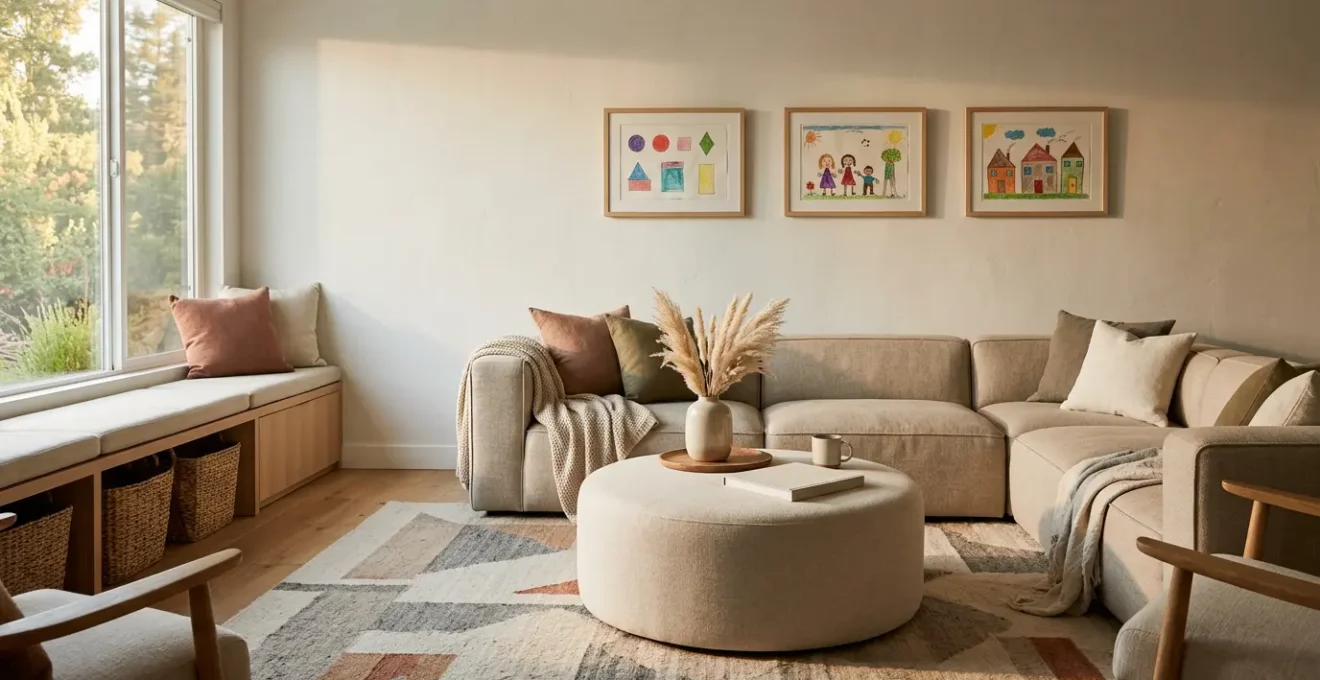
The common belief that you must sacrifice a beautiful home until the kids move out is a myth.
- True durability comes from strategic, “offensive design” choices, not just defensive slipcovers.
- Investing in “lifecycle furniture” and understanding “material intelligence” allows your living room to evolve with your family.
Recommendation: Instead of buying disposable furniture, focus on high-performance materials and modular pieces that embrace the chaos of family life gracefully and stylishly.
There’s a quiet dread that settles in for many parents and pet owners. You look at your once-pristine living room, now a battlefield of juice box stains, rogue marker art, and a fine dusting of pet hair, and you sigh. The prevailing wisdom says to surrender. Cover everything in drab, industrial-grade fabrics, buy cheap furniture you won’t cry over, and wait. Just wait 18 years, and then, maybe, you can have nice things again. This approach is not only depressing; it’s a design fallacy. The conventional wisdom is to play defense—to hide, to cover, to compromise.
But what if the key wasn’t defense, but a smart offense? A truly ‘bombproof’ family living room isn’t about sacrificing style for durability; it’s about making strategic design choices that embrace chaos gracefully. It’s about selecting materials that don’t just survive abuse but develop a beautiful, lived-in character—a “graceful patina.” It’s about investing in “lifecycle furniture” that adapts from toddler play-pen to teenage hangout zone. This guide will dismantle the myth that you have to choose between your family and your taste. We will explore how to select indestructible-yet-chic materials, outsmart common household dangers, and reclaim your living room as an adult sanctuary after the kids are in bed.
This article provides a complete roadmap for creating a living space that is both stunning and resilient. Follow along as we break down the essential strategies, from fabric selection to furniture layout, ensuring your lounge can withstand the rigors of family life without looking like a fortified bunker.
Summary: A Guide to Creating a Stylish, Indestructible Family Lounge
- Myth: do you really have to wait until kids move out to have nice furniture?
- How to select performance fabrics that resist juice spills and muddy paws?
- Leather vs. microfiber: which withstands cat claws and toddler markers best?
- The sharp edge danger on coffee tables that most new parents overlook
- How to integrate toy storage so the lounge becomes adult-only after 8 PM?
- Why static 3-seater sofas fail active families with changing needs?
- Myth: is performance velvet actually more durable than linen?
- Sectional Sofas: How to Position Large Seating for Maximum Comfort and Flow?
Myth: do you really have to wait until kids move out to have nice furniture?
Absolutely not. This is perhaps the most pervasive and soul-crushing myth in family home design. The idea of living in a temporary, style-less void for two decades is a recipe for misery. The solution isn’t to delay your life, but to invest smarter. As interior designer Emily Henderson proved through her own family room evolution, high-quality, well-chosen pieces can not only survive but thrive in a busy home. Her real-world test showed that investment furniture like her vintage coffee table and a leather chair didn’t just endure her two young children; they developed a beautiful patina, a story of a life well-lived, rather than showing signs of damage.
The key is shifting your mindset from “disposable” to “durable.” Instead of buying cheap particle board that will disintegrate at the first sign of a spilled drink, you opt for solid wood. Instead of a delicate fabric you have to shrink-wrap, you choose a material designed for the front lines of family life. It’s an approach of proactive, offensive design rather than constant, reactive defense. It requires a bit more thought upfront but pays dividends in longevity, style, and your own sanity. You don’t have to live in a showroom, but you also don’t have to live in a padded cell.
Your 5-Layer Furniture Defense Plan
- Core Durability: Start by choosing inherently durable materials as your foundation, such as performance fabrics or robust top-grain leather.
- Surface Protection: Before first use, apply a professional-grade fabric protector spray to all upholstery to create an invisible shield.
- Removable Defense: Layer on stylish, washable throws or even tailored slipcovers that act as the first line of defense and can be easily cleaned.
- Strategic Placement: Position more delicate or cherished pieces away from the main “danger zones” and high-traffic pathways.
- Immediate Maintenance: Establish a quick-response cleaning routine to tackle spills and marks the moment they happen, preventing them from setting.
How to select performance fabrics that resist juice spills and muddy paws?
Walking into a fabric showroom can feel overwhelming. The secret to choosing a “bombproof” fabric lies in understanding the technology behind the term “performance fabric.” It’s not just a marketing buzzword; it refers to materials specifically engineered to resist stains, repel liquids, and withstand abrasion. Brands like Crypton and Sunbrella (which produces many solution-dyed acrylics) have built their reputations on this technology. These fabrics often have their protective qualities built into the fibers themselves, rather than being a simple surface treatment that can wear off.
When selecting a fabric, look beyond the color and texture. Ask about its ‘cleanability code’ (W, S, W/S, or X) which tells you how it can be cleaned. For a family home, a ‘W’ (water-based cleaner) is the most user-friendly. Another key piece of “material intelligence” is the abrasion rating, often measured in “double rubs.” A fabric rated for 15,000 double rubs is considered suitable for heavy residential use, but many performance fabrics boast ratings of 50,000 or even 100,000, making them virtually indestructible for home life. These materials ensure that a spilled glass of grape juice is a minor inconvenience, not a permanent catastrophe.
As this close-up view demonstrates, the tight weave and specialized fibers of performance fabrics create a barrier that prevents liquids from penetrating. Instead of soaking in, spills bead up on the surface, giving you precious time to blot them away. This built-in resistance is what separates true performance materials from their more vulnerable counterparts, making them a non-negotiable for a stylish, stress-free family lounge.
Leather vs. microfiber: which withstands cat claws and toddler markers best?
This is the ultimate cage match in the world of durable upholstery. Both leather and microfiber are touted as family-friendly champions, but they have distinctly different strengths and weaknesses, especially when facing the twin terrors of pet claws and creative toddlers. While many sources, like the experts at HGTV, suggest slipcovers as a universal fix, the base material still matters greatly for what lies beneath.
Microfiber’s biggest selling point is its incredible stain resistance and cleanability. Because it’s a synthetic material with a very tight weave, liquids tend to sit on the surface, and most water-based stains—including those from washable markers—can be scrubbed out with relative ease. However, its Achilles’ heel is punctures and pulls. Cat claws can easily snag the fibers, creating loops and pulls that are virtually impossible to repair, leaving a permanent, fuzzy scar. While it cleans well, it can look worn out quickly in a home with pets.
Leather, on the other hand, plays a long game. A high-quality, top-grain or full-grain leather is exceptionally durable. It can be wiped clean from most spills and can even handle marker if treated quickly. Its true advantage against pets is that claws tend to cause a surface scratch rather than a pull in a weave. On a good quality “distressed” or “pull-up” leather, these minor scratches become part of the material’s “graceful patina,” adding character over time. Unlike a pull in microfiber, a scratch on leather can often be minimized with leather conditioner. For the ultimate combination of kid-and-pet-proof living, leather generally wins for long-term resilience and repairability.
The sharp edge danger on coffee tables that most new parents overlook
When you have a toddler learning to walk, your home transforms into a landscape of potential hazards. One of the most common culprits for bumps, bruises, and even stitches is the sharp corner of a traditional coffee table, which is often at the perfect height to meet a wobbly toddler’s head. The standard solution of applying foam corner guards is a functional but aesthetically displeasing fix. A more “offensive design” approach involves rethinking the coffee table entirely.
Instead of one large, hazardous rectangle, consider a “Lifecycle Furniture” strategy that evolves with your child. For the toddler years (0-3), ditch the hard table altogether in favor of a large, upholstered storage ottoman or a cluster of soft poufs. This provides a soft landing spot and doubles as hidden toy storage. As your child grows into the preschool age (4-6), you can transition to a round wooden or metal table with no sharp corners. By the time they are older, you can reintroduce more structured furniture with confidence.
A brilliant designer solution is the “Clustering Concept,” championed by professionals like interior designer Marie Flanigan. This involves using several smaller pieces—like drum tables, nesting tables, or a mix of poufs and small side tables—instead of one monolithic coffee table. This approach breaks up the hard surface area, provides incredible flexibility for play and entertaining, and, as Flanigan’s clients report, can significantly reduce accidents. It’s a strategy that prioritizes both safety and sophisticated, dynamic design.
How to integrate toy storage so the lounge becomes adult-only after 8 PM?
The “8 PM Transformation” is a sacred ritual for parents: the moment the living room shifts from a chaotic play zone back into a serene adult sanctuary. This transformation is impossible if your primary storage solution is a series of brightly colored plastic bins overflowing in the corner. The key to successful toy integration is stealth. The best storage is the storage you don’t see.
This means choosing furniture that leads a double life. A stylish, tufted ottoman isn’t just a place to put your feet up; its top lifts to reveal a cavernous space for legions of LEGOs. A handsome media console should have solid doors to hide gaming systems, mismatched controllers, and stacks of DVDs. One of the most effective solutions is investing in floor-to-ceiling built-ins with a mix of open shelving (for beautiful books and decor) and closed cabinetry (for the toy-related chaos). This draws the eye upward and makes the storage feel like an intentional, architectural element of the room.
To make the evening cleanup manageable, create a system. Use categorized bins *inside* your hidden storage for quick sorting. Establish a “closing ceremony” ritual with your kids each evening, making the 10-minute tidy-up a predictable part of the day. This combination of clever furniture and consistent habits is what allows your living room to have a dual identity, serving both your children’s need for play and your need for peace.
Why static 3-seater sofas fail active families with changing needs?
The traditional three-seater sofa, facing a loveseat, is a classic living room layout. It’s formal, balanced, and completely wrong for most active families. This static arrangement is rigid and fails to adapt to the dynamic, ever-changing needs of a household with children. One moment you need a sprawling surface for a family movie night, the next you need two separate conversation zones for a teen’s party, and the day after you need an open floor for building an epic fort.
This is where “Lifecycle Furniture” becomes essential, and no piece embodies this principle better than the modular sectional sofa. A modular sofa is the ultimate design chameleon. Composed of multiple independent pieces (corner units, armless chairs, chaises, and ottomans), it can be reconfigured at will. You can create a massive L-shape for lounging, split it into two smaller sofas for conversation, or even pull the pieces apart to create a “play pit” in the center of the room. It’s furniture that works for you, not the other way around.
Modular Sofa Success Story
The power of modularity is best shown in practice. As documented by the design team at Decorilla, one family’s modular sofa seamlessly evolved over five years to meet their changing needs. It started as an L-shape for family movie nights when the kids were young. As they became teenagers, it was split into two separate conversation areas for parties. During the toddler years, it was even arranged in a “play pit” configuration for maximum safety and fun. By adapting the same furniture to different life stages, the family was able to maintain style and functionality, saving an estimated $8,000 in potential replacement costs.
Myth: is performance velvet actually more durable than linen?
Linen has a beautiful, relaxed, and natural aesthetic that many homeowners covet. Velvet, on the other hand, is often seen as luxurious but fussy and delicate. In the world of performance fabrics, however, these stereotypes are completely upended. When comparing a standard linen to a modern performance velvet, the velvet wins on nearly every durability metric—and it’s not even close.
The primary measure of a fabric’s durability is its abrasion resistance, measured in Martindale “rubs.” A typical residential linen might withstand 15,000 to 25,000 rubs before showing wear. A high-quality performance velvet, however, can often exceed 100,000 rubs, putting it in the category of commercial-grade upholstery. Furthermore, linen is notoriously prone to wrinkling and pilling, and it absorbs stains easily unless it has been heavily treated. Performance velvet, with its flat, dense pile, has excellent resistance to pilling and snagging, and its synthetic composition means it naturally repels stains. It also happens to be fantastic at hiding pet hair.
| Performance Metric | Performance Velvet | Linen |
|---|---|---|
| Abrasion Resistance (Martindale) | 100,000+ rubs | 15,000-25,000 rubs |
| Pilling Resistance | Excellent | Moderate to Poor |
| Stain Resistance | Excellent | Poor (unless treated) |
This doesn’t mean you have to abandon the aesthetic of linen. A smart “Best of Both Worlds” design strategy uses materials according to risk. Use the ultra-durable performance velvet for the high-impact sofa frame and seat cushions, and incorporate linen through lower-risk, easily washable elements like decorative pillows or curtains. This gives you the desired visual texture without sacrificing the core durability of your main investment pieces.
Key Takeaways
- Stop waiting for “someday”: Smart, durable design choices make stylish living possible with kids and pets right now.
- Invest in “Lifecycle Furniture” like modular sofas that adapt to your family’s changing needs over time.
- Master “Material Intelligence” by prioritizing high-performance fabrics like performance velvet and top-grain leather over aesthetically pleasing but fragile options.
Sectional Sofas: How to Position Large Seating for Maximum Comfort and Flow?
You’ve invested in a large, comfortable sectional—the perfect command center for your family. But plopping it against a wall can make a room feel lopsided and kill the flow. The key to positioning large seating is to use it to define zones and guide movement, not just to line the perimeter. One of the most effective strategies is to “float” the sectional away from the walls, using its back to create a natural and soft boundary between the living area and a dining space or walkway.
To prevent a floating sectional from looking like it’s adrift in the middle of the room, you must anchor it. As many designers will attest, the single most important tool for this is a large area rug. The rug should be substantial enough that at least the front legs of all seating pieces are on it. This visually unifies the furniture, creating a cohesive and intentional “conversation zone.” Once the rug and sectional are placed, you can build out the rest of the room, adding side tables, lighting, and accent chairs around this central anchor.
Pay close attention to traffic flow. Ensure there are clear, comfortable pathways (at least 30-36 inches wide) around the main seating arrangement so no one has to awkwardly shuffle past. The goal is a layout that feels both expansive and intimate, encouraging both family snuggles and easy movement. As a final touch of expert advice, James Thurstan Waterworth notes the importance of this foundational step.
When working with less spacious family rooms, we recommend a considered curation of essential pieces – spreading a large rug as an anchor for the scheme and then building out from there.
– James Thurstan Waterworth, Founder, Thurstan
Stop waiting for ‘someday’ and start designing your stylish, durable family lounge today. The next step is to assess your own living room, identify the biggest point of friction—be it storage, seating, or material wear—and apply one of these offensive design strategies. Your beautiful, livable home is waiting.