
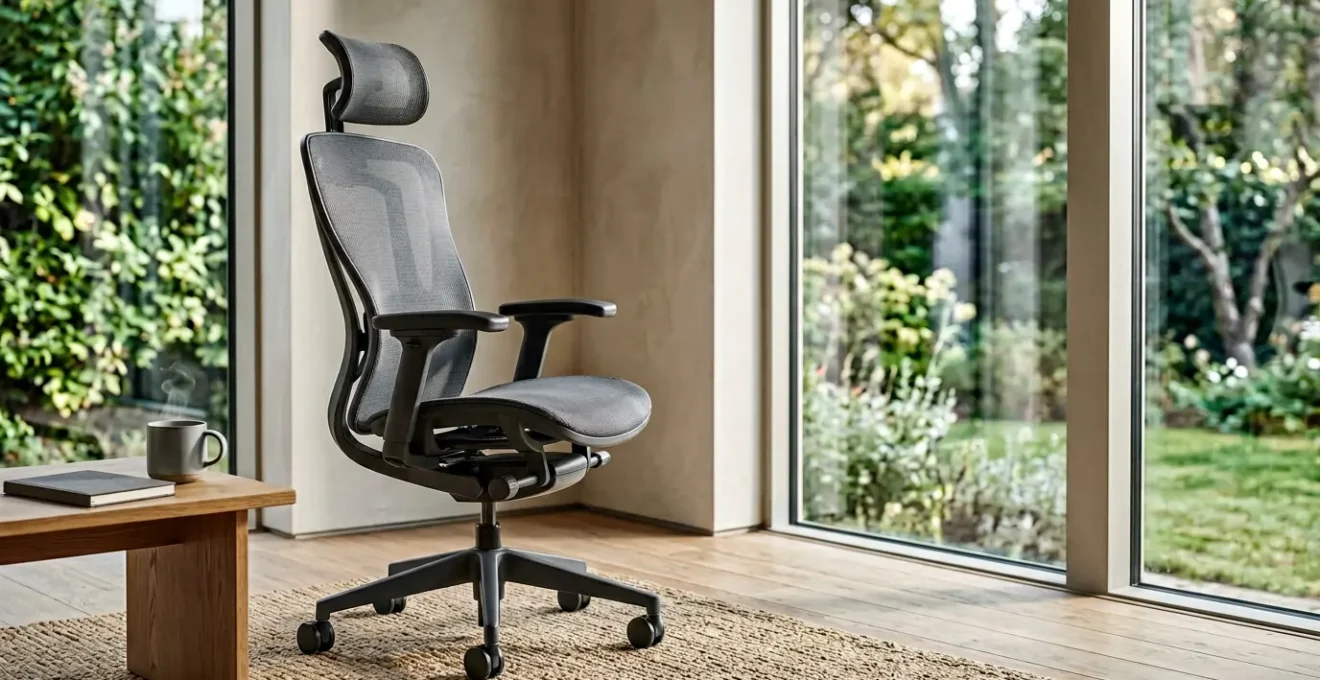
The long-held belief that you must choose between a supportive “medical” chair and a stylish living room piece is a design fallacy.
- True ergonomic excellence is achieved through specific, science-backed choices in seat depth, cushion materials, and frame design that are often invisible.
- Aesthetics and support are not opposing forces; features like raised legs and transparent materials can enhance both visual lightness and ergonomic function.
Recommendation: Shift your focus from “finding a chair that looks less medical” to “identifying the design features that deliver superior biomechanical harmony,” and you will find a seat that masters both form and function.
For too long, the search for a comfortable armchair has presented a frustrating compromise, especially for those needing genuine postural support. You are faced with a choice: a clinically sound but aesthetically displeasing “health” chair that disrupts your home’s decor, or a beautiful designer piece that offers little more than a place to perch before the discomfort sets in. This dilemma forces many to endure unnecessary pain or sacrifice the stylish sanctuary they’ve worked hard to create. The common advice to simply “look for lumbar support” is woefully inadequate, failing to address the complex interplay of anatomy and design.
The truth is, an exceptional armchair doesn’t force a choice between health and style. It achieves both through a sophisticated fusion of physiological science and intentional design. The secret lies not in bulky, obvious medical features, but in the subtle, precise details of its construction: the exact depth of the seat, the recovery time of its foam, the breathability of its fabric, and its interaction with the light in your room. It’s about achieving a state of biomechanical harmony, where the chair actively supports your body’s natural structure while contributing to the visual harmony of your space.
This guide moves beyond superficial advice. We will deconstruct the armchair, exploring it from a physiotherapist’s and a designer’s perspective. We will analyze why a seat’s dimensions can cause pain, compare the performance of different fillings, and reveal how to choose a chair that provides robust support while appearing light and elegant. By understanding these core principles, you can select a piece that is not a compromise, but a perfect synthesis of comfort, health, and style.
This article provides a detailed roadmap to making an informed choice. You will find a clear breakdown of the key anatomical and aesthetic factors to consider, ensuring your next armchair is a true investment in both your well-being and your home’s character.
Summary: How to Choose a Chair That Unites Ergonomics and Elegance
- Why a deep seat causes back pain for people under 5’6″?
- Down vs. Foam: which filling keeps its shape and support after 2 hours of sitting?
- Ottoman vs. Recliner: which mechanism is better for circulation?
- The “sticky leather” problem: which fabric stays cool during a nap?
- How to choose a high-back chair that doesn’t dominate the room?
- Window seat vs. armchair corner: which offers better comfort for long reading sessions?
- How to select performance fabrics that resist juice spills and muddy paws?
- Ambient Floor Lamps: Creating Cozy Corners and Expanding Visual Space at Night
Why a deep seat causes back pain for people under 5’6″?
The most critical, and often overlooked, element of chair ergonomics is seat depth. For individuals with a shorter thigh-to-hip ratio, particularly those under 5’6″, a seat that is too deep is a direct cause of back pain. When the seat pan is too long, you cannot sit with your back fully against the backrest while keeping your feet on the floor. To compensate, you either perch on the edge of the seat, forfeiting all back support, or you slide back, which forces your pelvis to tilt backward into a “sacral sitting” position. This posture flattens the natural curve of your lumbar spine, placing immense strain on your lower back muscles and intervertebral discs. This is a widespread issue, as research shows that prolonged sitting is a major contributor to discomfort, with some studies confirming that over 39% of office workers develop significant pain from it.
This backward pelvic tilt also creates a secondary problem: it increases tension in your hamstring muscles and can compress the nerves and blood vessels behind your knees in the popliteal fossa. The ideal posture requires your feet to be flat on the floor with a small gap of two to three fingers’ width between the back of your knees and the front edge of the seat. This allows for proper postural alignment from the ground up, ensuring your spine is supported in its natural ‘S’ curve. Without this foundational alignment, even a chair with the most advanced “lumbar support” feature becomes ineffective, as your body is not positioned to receive its benefit.
Your 5-Point Ergonomic Audit: A Practical Checklist
- Identify Contact Points: Sit in the chair and consciously note every point of contact: are your feet flat on the floor? Does the back of your knees touch the seat edge? Is your lower back making contact with the backrest?
- Inventory Support Elements: Measure the seat depth from the front edge to the backrest. Is there a 2-3 finger gap behind your knees? Identify the cushion type (firm foam, soft down) and note the height of the armrests.
- Check for Coherence: Assess your posture against core ergonomic principles. Are your knees and hips at roughly a 90-degree angle? Do the armrests allow your elbows to rest at 90 degrees without shrugging your shoulders? Does the backrest meet the natural curve of your spine (around the L3-L4 vertebrae)?
- Evaluate Dynamic Comfort: Gently shift your weight. Does the chair’s support adapt and move with you, or does it force you into a single, rigid posture? A good chair allows for micro-movements.
- Create an Integration Plan: Based on the gaps identified, form a clear action plan. This could be adding a firm lumbar pillow, installing an adjustable footrest, or ultimately, recognizing the chair is fundamentally mismatched to your body.
Down vs. Foam: which filling keeps its shape and support after 2 hours of sitting?
The material inside your armchair’s cushion is the engine of its support system. While aesthetics often drive the choice of upholstery, the filling determines the chair’s long-term comfort and postural integrity. The two most common options, down and foam, offer vastly different performance, particularly after prolonged use. Down-filled cushions provide an initial feeling of luxurious softness, but they compress significantly and are slow to recover. After just a couple of hours, the supportive loft can collapse, leaving you with a flattened, unsupportive surface that encourages poor posture.
In contrast, high-resiliency (HR) foam is engineered for both comfort and durability. Unlike conventional foam, HR foam has a higher density and a more irregular cell structure, which allows it to contour to the body while providing consistent, firm support. Its key advantage is its ability to retain its shape and “push back” against compression, maintaining support over long periods. For those requiring reliable postural stability, a cushion with an HR foam core is non-negotiable. The most sophisticated designs often use a hybrid model: a firm HR foam core for foundational support, wrapped in a jacket of down or a down-alternative for surface softness. This offers the best of both worlds—unwavering support and a plush feel.
This comparative data highlights the clear performance differences. As an analysis of filling performance metrics shows, HR foam is superior in shape retention and longevity.
| Feature | High-Resiliency Foam | Down Filling | Hybrid (HR Core + Down Jacket) |
|---|---|---|---|
| Shape Retention (2+ hours) | Excellent (95%) | Poor (60%) | Very Good (85%) |
| Support Level | Firm/Consistent | Soft/Variable | Medium/Adaptive |
| Recovery Time | Immediate | 5-10 minutes | 1-2 minutes |
| Longevity | 5-10 years | 2-3 years | 4-7 years |
| Heat Retention | Moderate | High | Moderate-Low |
Visually understanding these materials can further clarify their function. The image below illustrates the layered construction that provides both resilience and surface comfort, a key to long-lasting ergonomic support.
As you can see, the structured cells of the foam core provide a stable base, while the softer outer layer creates the initial inviting feel. This combination is the hallmark of a high-quality, supportive seat.
Ottoman vs. Recliner: which mechanism is better for circulation?
Elevating the legs is crucial for promoting venous return and reducing lower limb swelling (edema), a common issue during prolonged sitting. The debate between an integrated recliner and a separate ottoman centers on which provides better kinetic comfort and circulatory benefits. A recliner offers a synchronized system where the backrest and footrest move in a pre-determined, biomechanically optimized arc. This can create a “zero-gravity” sensation that distributes body weight evenly and reduces pressure on the spine.
However, a separate ottoman offers superior flexibility and can often achieve a more effective leg elevation for circulation. From a physiological standpoint, the greatest benefit occurs when the feet are elevated slightly above the level of the hips. Many integrated recliners do not achieve this height, whereas a well-chosen ottoman can be positioned precisely. Furthermore, an ottoman’s detached nature allows for micro-adjustments in leg position and encourages more frequent changes in posture, which is vital for preventing circulatory stagnation. While a recliner provides passive, unified support, an ottoman promotes active, customizable comfort.
Case Study: The Ergonomics of Leg Elevation
A study on ergonomic positioning found compelling evidence favouring adjustable elevation. The research discovered that elevating the feet 10-12 inches above hip level, a position easily achieved with a separate, appropriately sized ottoman, reduces lower extremity swelling by 28% compared to traditional recliners that often lock into a feet-level position. This highlights the significant circulatory advantage of a flexible, independent footrest.
The choice ultimately depends on the user’s primary need. As one expert notes, the two options serve different functions. In an article for Forbes, Dr. Ehsan Jazini, a spine surgeon, offers a balanced perspective on ergonomic furniture choices:
A recliner offers a perfectly synchronized, biomechanically ideal recline. An ottoman offers flexibility—it can be a coffee table, extra seating, or footrest.
– Dr. Ehsan Jazini, Forbes Feature on Office Chair Ergonomics
The “sticky leather” problem: which fabric stays cool during a nap?
Thermal comfort is a frequently ignored aspect of ergonomic seating, yet it’s essential for long-term use, especially during rest. The dreaded “sticky leather” phenomenon, where non-breathable materials trap heat and moisture against the skin, can turn a relaxing nap into an uncomfortable experience. This occurs with pigmented or corrected-grain leathers, which are coated with a synthetic, non-porous layer that inhibits airflow. While durable, these materials prevent the body’s natural thermoregulation process.
The solution lies in the material science of breathable fabrics. Natural fibers are inherently superior in this regard. Full-aniline leather, which is minimally treated and retains its natural pores, allows for excellent air exchange. However, the champion of thermoregulation is wool, particularly Merino wool. Its complex fiber structure actively wicks moisture away from the body and allows it to evaporate, keeping you cool when it’s warm and warm when it’s cool. In fact, textile research demonstrates that Merino wool regulates temperature 30% better than many synthetic fabrics. Modern performance fabrics, such as blends of wool and synthetic fibers, can also offer excellent breathability combined with enhanced durability and stain resistance.
When selecting a fabric, consider these practical tests for breathability:
- Weave Density: Hold a fabric swatch up to a light source. If you can see small gaps of light passing through the weave, it indicates better airflow.
- Touch Test: Press your hand firmly onto the material for ten seconds. A breathable fabric will feel cool to the touch and won’t leave a patch of moisture.
- Moisture Wicking: If possible, place a tiny drop of water on the fabric. On a high-performance, moisture-wicking material, the droplet should absorb and spread quickly rather than beading on the surface.
How to choose a high-back chair that doesn’t dominate the room?
A high-back chair is excellent for providing full thoracic and cervical (upper back and neck) support, but its size can easily overwhelm a living space. The key to integrating one successfully is to focus on its visual weight, not just its physical footprint. Visual weight is the perceived heaviness of an object in a room. A chair with a solid, blocky silhouette that extends to the floor will have a high visual weight, appearing massive and cumbersome. The goal is to find a design that provides the necessary height while maintaining a sense of lightness and airiness.
This is achieved through several clever design strategies. First, look for “leggy” designs. Chairs with legs that raise the body of the seat at least 6 inches off the ground create negative space underneath, allowing light and sightlines to flow. This simple feature dramatically reduces the chair’s perceived bulk. Second, consider the silhouette and materials of the backrest itself. A design that incorporates transparency—such as a cane back, wooden slats, or even a strong mesh panel—allows light to pass through, integrating the chair into its surroundings rather than obstructing them. Finally, a curved or sculpted silhouette will feel less imposing than a hard, rectangular one. These soft lines help the chair blend more naturally with the other elements in the room.
This image perfectly demonstrates how a high-back chair can command a presence without dominating the space. The tall legs and open back structure create an elegant, light profile.
Here are some actionable techniques to reduce a chair’s visual weight:
- Choose Leggy Designs: Ensure a minimum of 6-inch clearance underneath to create an airy feel.
- Incorporate Transparency: Opt for cane, slatted, or woven backrests that allow light to filter through.
- Select Curved Silhouettes: Soft, organic shapes feel less massive and improve the visual flow of a room.
- Match Chair to Wall Color: A low-contrast color scheme helps the chair recede into the background, minimizing its visual impact.
- Balance with Scale: Pair the chair with a substantial floor lamp or side table to create a balanced, intentional vignette.
Window seat vs. armchair corner: which offers better comfort for long reading sessions?
Creating a dedicated reading nook is a wonderful way to foster a habit of quiet contemplation. While a built-in window seat holds a certain romantic appeal, an armchair corner almost always offers superior ergonomic comfort for long reading sessions. A window seat is a fixed architectural element, offering limited flexibility. The support it provides is entirely dependent on the quality and placement of loose cushions, which can shift and compress over time, leading to poor neck and back posture. Lighting is also a challenge; natural light is wonderful but highly variable and often creates glare on pages, leading to eye strain.
An armchair corner, by contrast, is a modular and fully adaptable ergonomic system. A well-chosen armchair provides dedicated, built-in support for the lumbar and thoracic spine. Its armrests are positioned at the ideal height to support the weight of your arms and book, reducing strain on your shoulders and neck. Most importantly, the lighting is fully controllable. You can pair the chair with a dedicated task lamp that provides consistent, directed light at the optimal color temperature (around 3000K) to reduce eye fatigue. This combination of dedicated support and controlled lighting makes the armchair corner a clinically superior choice for anyone who enjoys reading for more than a few minutes at a time.
The ergonomic differences are stark when directly compared, especially concerning key factors for prolonged comfort.
| Criteria | Window Seat | Armchair Corner |
|---|---|---|
| Neck Support Angle | Variable/Limited | Adjustable/Optimal |
| Elbow Support | Depends on cushions | Dedicated armrests |
| Light Control | Natural but variable | Fully adjustable |
| Temperature Stability | Drafts/heat issues | Climate controlled |
| Flexibility | Fixed position | Fully modular |
| Long-term Investment | Architectural commitment | Easily updatable |
Case Study: Reducing Reader’s Eye Strain
An analysis of 100 home readers found that those using an armchair corner with adjustable task lighting experienced a 45% reduction in self-reported eye strain compared to those using window seats. Furthermore, participants who read for over two hours reported significantly less neck pain when using a dedicated reading chair, confirming the ergonomic benefits of a purpose-built seating solution.
How to select performance fabrics that resist juice spills and muddy paws?
For a chair to be truly part of a living space, it must withstand life’s realities, from accidental spills to contact with pets. This is where performance fabrics come in. These are not simply durable materials; they are textiles engineered at a molecular level for cleanability and longevity. The key distinction to understand is between fabrics that are topically treated and those made from solution-dyed fibers. Topical treatments are surface-level coatings that can wear off over time with cleaning and use, leaving the fabric vulnerable.
Solution-dyeing, by contrast, is a revolutionary process where the pigment is added to the liquid polymer solution before the fiber is even created. This means the color and stain-resistant properties are an integral part of the fiber’s very core. It’s the difference between a carrot (colored all the way through) and a radish (colored only on the surface). This technology, used by brands like Crypton and Sunbrella, makes the fabric inherently resistant to stains, fading, and moisture. Spills sit on the surface, waiting to be blotted away, rather than soaking in. Industry testing confirms that solution-dyed fibers can maintain their stain resistance for over a decade of regular use, making them a wise investment for a bustling home.
When shopping, it’s important to look for specific indicators of a true performance fabric:
- Rub Count: Look for a “Wyzenbeek” or “Martindale” rub count. A rating of 30,000 double rubs on the Wyzenbeek scale is considered heavy-duty and suitable for high-traffic residential use.
- Cleaning Code: Check the fabric’s tag for a “W” or “WS” cleaning code, which indicates it can be safely cleaned with water-based solutions, making maintenance much simpler.
- Certification: A GREENGUARD Gold certification ensures the fabric has low chemical emissions, contributing to healthier indoor air quality.
- Pattern Strategy: Multi-tonal or heathered patterns are brilliant at camouflaging minor wear and tear, extending the pristine look of your armchair far longer than a solid color might.
Key Takeaways
- Anatomy First: The perfect seat depth is non-negotiable. Ensure a 2-3 finger gap between your knees and the seat edge for proper spinal alignment.
- Support is Internal: Choose high-resiliency (HR) foam for consistent, long-lasting support. Down provides softness but collapses under weight over time.
- Style is About Subtraction: Reduce a chair’s “visual weight” with leggy designs and transparent or curved backrests to maintain an airy, open feel in your room.
Ambient Floor Lamps: Creating Cozy Corners and Expanding Visual Space at Night
The perfect armchair is only half of the equation for a truly comfortable corner. The right lighting not only enables activities like reading but also transforms the mood and perceived size of your space. A single, harsh overhead light flattens a room and creates glare. The most effective approach is a layered lighting strategy, combining three distinct types of light to create depth, warmth, and functionality.
The foundation is the ambient layer, which provides overall illumination. An arc floor lamp positioned to wash a wall with a soft, warm glow (around 2700K color temperature) can make a corner feel cozy and inviting. This indirect light reduces harsh shadows and visually expands the space. Next is the task layer, a focused beam of light for specific activities. An adjustable reading lamp with a slightly cooler light (3000-4000K) is ideal for reducing eye strain. Finally, the accent layer adds visual interest. A small uplight placed behind a plant or aimed at a piece of artwork creates depth and a sophisticated, curated feel. Varying the height of these light sources is also key to creating a dynamic, visually interesting composition.
Case Study: The Impact of Light Temperature on Fatigue
A 2025 workspace analysis revealed that the right combination of lighting has a measurable physiological effect. The study showed that combining warm 2700K ambient lighting with neutral 3000-4000K task lighting reduced reading fatigue and eye strain by 32% over a three-month period. This proves that a layered lighting scheme is not just an aesthetic choice, but an ergonomic one.
Building a layered lighting scheme is a straightforward process:
- Ambient Layer: Start with a main floor lamp to provide a warm, general glow (2700K).
- Task Layer: Add an adjustable reading light for focused activities, preventing eye strain (3000K-4000K).
- Accent Layer: Use a small, subtle light to highlight a plant or artwork, adding depth (2700K).
- Incorporate Dimmers: Installing dimmers on each layer gives you complete control over the mood, from bright and functional to soft and relaxing.
By integrating these principles of biomechanics, material science, and design, you elevate the selection of an armchair from a simple purchase to a deliberate act of curating your well-being. The result is a living space that not only looks beautiful but also actively supports and restores you. For a lasting investment in your health and home, always start by ensuring the chair’s core dimensions provide the right foundation for your body.