
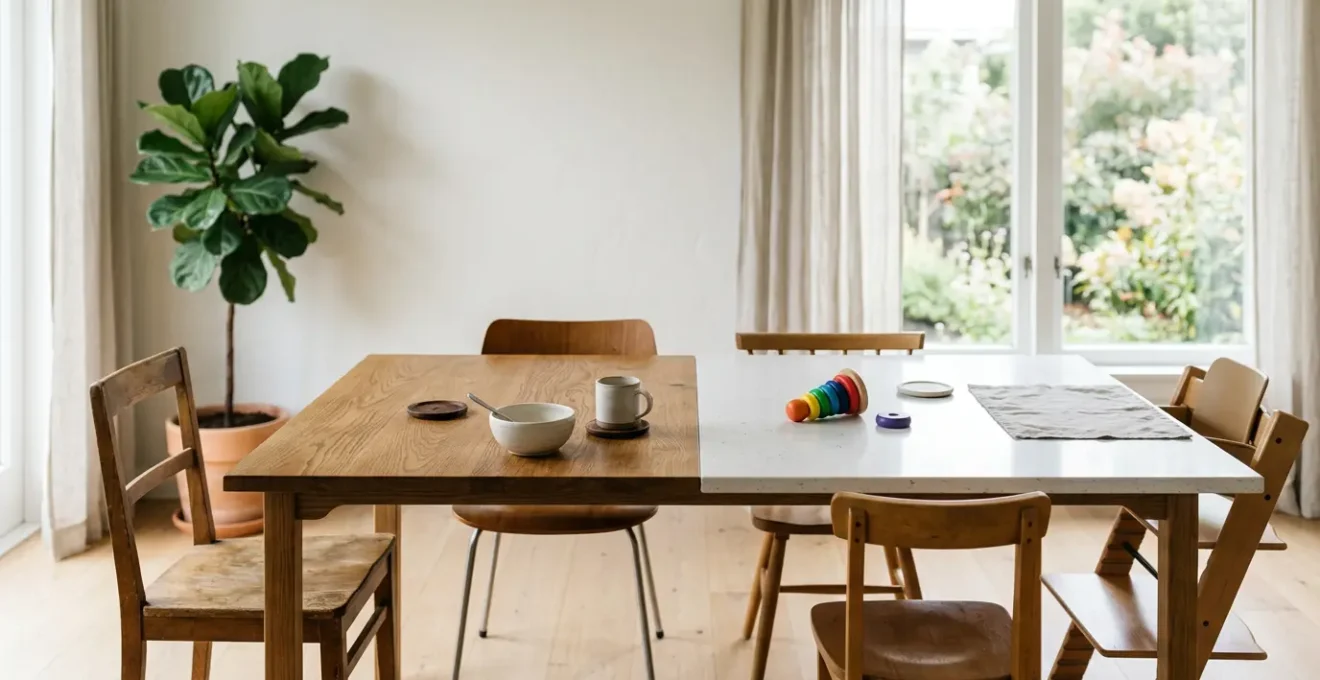
The key to a family-proof dining table isn’t finding an indestructible material, but choosing one whose weaknesses you can live with and repair.
- Solid wood offers superior repairability over veneer, which can delaminate under stress.
- Quartz resists acidic stains that permanently etch natural marble, making it a safer bet for mealtime spills.
- A table’s base (like a trestle) is as crucial as its surface for maximizing seating and minimizing frustration.
Recommendation: Prioritize a surface’s “repairability index” and a base’s “seating ergonomics” over simple hardness to find a table that will truly anchor your family life for years.
For many families, the dining table is less a piece of furniture and more the central stage for life’s beautiful chaos. It’s a homework station, a fortress for epic craft projects, a battlefield for board games, and occasionally, a place to eat dinner. This high-traffic reality means that choosing a table based on looks alone is a recipe for disappointment. Scratches from stray forks, white rings from hot plates, and the permanent ghost of a spilled juice box can quickly ruin a pristine finish.
Common advice often revolves around simple durability, pushing you towards the “hardest” material. But this overlooks a critical factor for any furniture destined for family life: its failure mechanics. How does a surface react when damage inevitably occurs? Is it a catastrophic failure or a recoverable incident? The true test of a family-proof table isn’t whether it can resist damage, but how gracefully it handles it and how easily it can be restored.
This guide abandons generic advice and instead adopts the mindset of a durability tester. We will stress-test the most common materials and structural designs against the specific challenges of family life. Instead of just looking at what a table is made of, we’ll examine how it breaks, how it stains, and how it can be fixed. This shift in perspective—from damage prevention to damage management—is the secret to selecting a dining table that not only survives your family but thrives alongside it.
To help you navigate these crucial decisions, this guide is structured to test every component of a potential dining table, from its surface material to its underlying support and lighting. Explore the sections below to find the perfect, battle-ready centerpiece for your home.
Summary: Dining Tables: Selecting a Surface That Survives Family Life
- Solid wood vs. Veneer: which handles the “fork stab” test better?
- Oak vs. Walnut: which wood species withstands family life better?
- Marble vs. Quartz: why acidic foods ruin one but not the other?
- How to choose a finish that works for both laptop mice and dinner plates?
- The trestle base advantage: how to fit more people without straddling legs?
- How to choose an extendable table mechanism that one person can operate alone?
- How to fix a heat mark on a wood table without stripping the whole top?
- Pendant Lights: Anchoring Furniture and Providing Task Lighting
Solid wood vs. Veneer: which handles the “fork stab” test better?
In the unforgiving environment of family dining, the “fork stab” test—a metaphor for the daily barrage of impacts, scrapes, and dents—is a critical measure of durability. When comparing solid wood and wood veneer, the winner isn’t determined by initial resistance, but by long-term resilience and repairability. Solid wood, by its nature, is a homogenous material. When a fork (or a toy car, or a dropped glass) makes an impact, it will likely leave a dent. However, this damage is contained within the wood itself and can be fixed. According to research from furniture manufacturers, solid wood can be sanded and refinished multiple times, effectively erasing years of wear and tear and significantly extending its lifespan.
Veneer, on the other hand, consists of a thin layer of real wood bonded to a substrate like MDF or particleboard. While high-quality veneers can be surprisingly tough, their failure mechanic is fundamentally different and far more severe. A deep scratch or a hard impact doesn’t just dent the surface; it can puncture the thin wood layer, exposing the less attractive substrate underneath. As a 2025 analysis from Cabinfield shows, veneer is also more vulnerable to heat and moisture, which can cause the adhesive to fail, leading to peeling, bubbling, or delamination—damage that is difficult and expensive to repair professionally.
This comparative table, based on data from architectural material suppliers, clearly illustrates the trade-offs in terms of everyday damage response.
| Material | Scratch Resistance | Impact Response | Repairability |
|---|---|---|---|
| Solid Wood | Dents but repairable | Absorbs impact, may dent | Can be sanded & refinished |
| Wood Veneer | Surface scratches reveal substrate | Can fracture or delaminate | Limited repair options |
| High-Quality Veneer on HDF | Better resistance than MDF | More stable than particleboard | Professional repair needed |
Ultimately, solid wood wins the “fork stab” test not by being indestructible, but by being infinitely more forgiving. It embraces the certainty of damage with a clear and accessible path to recovery, embodying a superior repairability index. For a family, this means peace of mind, knowing that life’s little accidents are temporary setbacks, not permanent blemishes.
Oak vs. Walnut: which wood species withstands family life better?
Once you’ve settled on solid wood, the next question is: which species? Oak and Walnut are two of the most popular choices for dining tables, but they offer very different approaches to withstanding family life. The primary difference lies in their hardness and grain structure. Hardness is measured on the Janka scale, which rates the force required to embed a steel ball into the wood. According to hardness testing data, oak rates ~1300 on the Janka scale, while Walnut comes in lower at around 1010. This means Oak is inherently more resistant to dents and deep scratches from the outset.
However, hardness is only part of the story. The grain pattern plays a huge role in the visual aspect of durability. Oak has a very prominent, open grain with a coarse texture. This busy pattern is exceptionally good at camouflaging minor scratches, dings, and daily wear. For a high-traffic family table, this visual forgiveness can be a significant advantage, keeping the table looking good even when it’s not perfect.
Walnut, conversely, has a finer, straighter, and darker grain. While beautiful, this smoother surface tends to show dust and scratches more readily. Yet, its appeal lies in how it ages. Walnut is known for developing a rich, sought-after patina over time, a story of use that many homeowners cherish. It’s a trade-off between hiding daily damage (Oak) and embracing a graceful aging process (Walnut).
Wood Aging and Patina Development Study
Long-term observations from furniture makers reveal crucial differences in how these woods age under real-world conditions. Oak’s prominent grain is a master at hiding the daily onslaught of minor scratches common in family homes. Over time, it tends to take on golden or amber hues with UV exposure. In contrast, Walnut’s finer grain shows imperfections more clearly but develops a desirable patina that adds character. It’s also important to note that Walnut naturally lightens with sun exposure, a factor that should be considered for long-term aesthetic planning in a sunny dining room.
The choice between Oak and Walnut is a choice between two philosophies of durability. Oak is the pragmatic workhorse, using its strong grain to mask the chaos of family life. Walnut is the elegant classic, offering less camouflage but rewarding you with a beautiful, evolving character over the decades. For most families focused on low-maintenance durability, Oak’s superior hardness and grain pattern make it the more resilient choice.
Marble vs. Quartz: why acidic foods ruin one but not the other?
For those desiring a stone tabletop, the choice often boils down to classic marble versus engineered quartz. While both offer a premium look, their performance under the duress of family meals is worlds apart, and the reason lies in their fundamental material science. The critical vulnerability of marble is its porosity and chemical composition. Marble is a metamorphic rock composed primarily of calcite, which is highly reactive to acids. As the Caesarstone Technical Team notes in their maintenance guide:
Acidic foods, such as lemon juice, vinegar, soda, and alcohol, can cause etching in marble, leaving the surface dull or chalky
– Caesarstone Technical Team, Caesarstone Maintenance Guide
This “etching” is not a stain; it is a chemical burn that physically alters the surface of the stone. For a family with children, where spills of orange juice, ketchup, or salad dressing are a daily occurrence, this makes a marble table a source of constant anxiety. Once etched, the damage is permanent unless the entire surface is professionally honed and resealed.
Quartz, on the other hand, is an engineered product. It’s made from approximately 90-95% ground natural quartz crystals mixed with polymer resins and pigments. This manufacturing process makes the final slab non-porous and chemically inert. It does not react to common household acids, so a puddle of lemonade can be wiped away hours later with no ill effect. Furthermore, quartz is significantly harder. The material science data reveals that marble rates 3-5 on the Mohs scale of hardness, while quartz comes in at a solid 7 (for comparison, a steel knife is about 5.5). This gives quartz superior scratch resistance against cutlery and dragging ceramic plates.
While marble offers an undeniable natural beauty with unique veining, its high-maintenance nature and extreme vulnerability to acid etching make it a poor functional choice for a family dining table. Quartz delivers a highly similar aesthetic with vastly superior, worry-free durability, making it the clear winner for homes where life is meant to be lived, not tiptoed around.
How to choose a finish that works for both laptop mice and dinner plates?
The finish on your dining table is its first line of defense, but in a modern home, it must be a multi-talented protector. It needs to repel spills from dinner plates and withstand the heat of a warm bowl, while also providing a smooth, non-glare surface for homework and a functional trackpad for a laptop mouse. Balancing these demands—food-safety and office-functionality—is the key to choosing the right finish.
For heavy family use, three types of finishes are common: polyurethane, lacquer, and hardwax oil. Polyurethane is the modern workhorse. It creates a thick, plastic-like layer over the wood that is highly resistant to water, heat, and scratches. Its smooth, durable surface works well for optical mice and is easy to wipe clean. However, its thick film can feel less natural and can produce glare under direct light. If it gets a deep scratch, a spot repair is difficult; the entire surface often needs to be refinished.
Lacquer offers a harder, more professional-looking finish that is also very durable. It is less prone to yellowing than some oil-based polyurethanes and provides excellent protection. The main drawback is its application process often involves strong solvents, and like polyurethane, spot repairs can be tricky for a DIYer. Both polyurethane and lacquer are excellent at creating a sealed, impervious barrier perfect for withstanding dinner plate messes.
For those who prioritize the natural feel of the wood and ease of repair, a hardwax oil finish is an outstanding choice. It soaks into the wood fibers rather than sitting on top, preserving the natural texture. This creates a matte, low-glare surface that is ideal for writing and computer use. It offers good water resistance for short periods (spills should be wiped up promptly) and excellent heat resistance. Its greatest strength is repairability. Minor scratches or worn areas can be fixed by lightly sanding the spot and reapplying a small amount of oil, seamlessly blending the repair. This makes it a forgiving choice for a table that sees constant use and abuse.
The trestle base advantage: how to fit more people without straddling legs?
When selecting a family dining table, parents often focus on the length and width of the tabletop, but the design of the base is just as critical for functional seating. The common four-legged table, while traditional, creates a major ergonomic problem: the dreaded corner-leg straddle. Anyone seated at the corners or ends has to awkwardly navigate around a leg, which also makes it nearly impossible to slide a high chair or booster seat close to the table. This is where the trestle base offers a significant structural advantage.
A trestle table features a base constructed with one or two central supports connected by a long stretcher. This design eliminates corner legs entirely, freeing up the entire perimeter of the table for seating. This has two immediate benefits for families. First, it allows you to fit more people comfortably, especially when squeezing in extra guests. You can utilize the full length of the bench or place chairs right at the corners without obstruction. Second, it provides unparalleled flexibility for non-standard seating. A high chair can be positioned anywhere along the edge, and children can slide in and out without bumping their knees on a poorly placed leg.
This overhead view demonstrates the superior “seating ergonomics” provided by a trestle base, allowing chairs and high chairs to be positioned freely without obstruction.
While trestle bases are a top choice, other designs offer different compromises for family life:
- Pedestal Base: A single, central column offers even more legroom than a trestle and is very stable. It’s great for round or square tables, but cleaning around a large, heavy base can be cumbersome.
- Double Pedestal: Common on very long or extendable tables, this design provides excellent stability and legroom along the sides, though the pedestals can interfere with seating at the head of the table.
- Four Legs: The classic design is stable and easy to clean around, but it is the least efficient for maximizing seating capacity and accommodating high chairs.
For maximum seating flexibility and family-friendly functionality, the trestle base is a clear winner. It solves the most common frustrations of shared mealtimes by prioritizing unobstructed legroom and adaptable chair placement.
How to choose an extendable table mechanism that one person can operate alone?
An extendable table is a family’s best friend, effortlessly accommodating everything from a quiet weeknight dinner for four to a bustling holiday feast for ten. However, the magic disappears if operating the extension mechanism requires two adults and a degree in engineering. For a busy parent, often with a toddler in one arm, the ability to operate the table alone is not a luxury—it’s a necessity. The key is to stress-test the mechanism for one-person operation.
As the Furniture Fair Design Team wisely notes, the storage of the leaf itself is a major pain point. “Self-storing leaves are a great feature as they eliminate the need for separate storage when not in use,” they advise in their Family-Friendly Dining Guide. This feature is often found in the most user-friendly mechanisms, preventing the leaf from getting damaged in a closet and ensuring it’s always on hand when needed.
When shopping, don’t just ask if a table is extendable; ask to operate it yourself. Can you pull the ends apart smoothly? Is the leaf heavy or cumbersome? Does it lock securely into place? A mechanism that feels clunky or difficult in the showroom will be ten times more frustrating at home.
Action Plan: Rating Extendable Mechanisms for Solo Operation
- Butterfly Leaf (Self-Storing): Test the central seam. Does it open smoothly to reveal the folded leaf? Can you unfold and lock it into place with one hand? This is typically the easiest one-person mechanism, rated 5/5 for solo use.
- Geared Slide Mechanism: Pull on one end of the table. Does the other end move simultaneously? This indicates a geared slide, which requires moderate but manageable effort. Rated 4/5.
- Drop Leaf Design: Locate the support brackets underneath. Can you swing them into place and lift the leaf easily? This is a simple, effective action for small spaces. Rated 4/5.
- Traditional Removable Leaf: Lift the leaf. Is it heavy? Imagine carrying it from another room while also managing a child. This is the most difficult mechanism for one person. Rated 2/5.
- Final Check for Self-Storing: After testing the mechanism, confirm where the leaf is stored. If it’s not inside the table, you must account for the extra hassle and storage space required.
Choosing an extendable table is a functional decision. By prioritizing a smooth, self-storing mechanism like a butterfly leaf, you’re investing in a table that adapts to your life with ease, rather than adding another chore to your list.
How to fix a heat mark on a wood table without stripping the whole top?
The dreaded white ring—a cloudy blemish left by a hot pizza box or a mug of tea—is the bane of many wood table owners. This mark isn’t a burn; it’s trapped moisture. The heat from the object has caused condensation to get caught within the top layers of the table’s finish (typically lacquer or shellac). The good news is that because the damage is in the finish and not the wood itself, you can often fix it without resorting to a full, costly refinishing project.
The secret is to gently re-introduce heat to the affected area, allowing the trapped moisture to evaporate. There are several methods for this, but the safest and most common involves a simple household iron and a cloth. Before you begin, ensure the table is clean and dry. It’s crucial to start with the lowest heat setting and work your way up, as too much heat can cause real damage to the finish.
The image below shows the stark contrast between a faded heat mark and a restored section of wood, illustrating the effectiveness of a targeted repair.
Here is the step-by-step process for a non-abrasive repair:
- Prepare your tools: You’ll need a dry, clean cotton cloth (like a t-shirt or tea towel, with no prints or textures) and a clothes iron emptied of all water.
- Set the iron: Turn the iron on to its lowest, driest heat setting. Do NOT use the steam function.
- Apply heat: Place the dry cloth over the white ring. Gently press the warm iron onto the cloth over the mark for a few seconds at a time.
- Check your progress: Lift the iron and the cloth frequently to check the mark. You should see it gradually fade as the moisture escapes. If you see no change, you can cautiously increase the iron’s heat, but proceed slowly.
- Final Touches: Once the mark is gone, let the area cool completely. You can then apply a bit of furniture polish or wax to restore the luster of the finish.
This simple technique is a perfect example of the “repairability index” in action. By understanding the failure mechanic (trapped moisture, not a burn), you can apply a targeted, low-effort solution. This empowers you to manage life’s little accidents and maintain the beauty of your wood furniture for years.
Key Takeaways
- Surface vs. Repair: The most durable table isn’t the one that never gets damaged, but the one that’s easiest to fix. Solid wood’s repairability often trumps veneer’s initial resistance.
- Chemical Warfare: Hardness isn’t everything. A material’s resistance to chemical etching from common foods (like acid in juice) is a critical factor for family dining.
- Base Is Boss: A table’s functionality is defined by its base. Trestle and pedestal designs maximize seating flexibility and eliminate the frustration of corner legs.
Pendant Lights: Anchoring Furniture and Providing Task Lighting
After carefully selecting the surface and structure of your dining table, the final element that ties it all together is lighting. A well-chosen pendant light does more than just illuminate the space; it acts as a visual anchor, defining the dining zone within an open-plan room and enhancing the material character of your table. It’s also a critical piece of task lighting, ensuring that homework can be done without eye strain and meals are seen in their best light.
The color temperature of the lightbulb you choose has a dramatic effect on how your table’s surface appears. Measured in Kelvins (K), a lower temperature produces a warm, yellow light, while a higher temperature emits a cool, blue-white light. This choice can either complement or clash with your table’s material. A warm light (around 2700K) will bring out the golden, cozy tones in an oak table and enrich the chocolate hues of walnut. A neutral light (around 3500K) will show the “true” color of the material, which can be ideal for white quartz. A cool light (4000K-5000K) creates a crisp, modern look that can make marble appear stark and contemporary but might give warm woods a slightly grayish cast.
This table, with data drawn from interior design guides like the one from curated furniture retailers, shows how different light temperatures can alter the mood and appearance of common table materials.
| Material | 2700K Warm | 3500K Neutral | 5000K Cool |
|---|---|---|---|
| Oak Wood | Golden, cozy appearance | Natural wood tone | Cooler, modern look |
| Walnut | Rich chocolate tones | True brown color | Grayish undertones |
| White Quartz | Creamy, warm white | Pure white | Crisp, bright white |
| Marble | Soft, luxurious glow | Classic appearance | Contemporary, stark |
Beyond color, the height and scale of the pendant are crucial. A general rule is to hang the bottom of the fixture 30-36 inches above the tabletop. This is low enough to create a sense of intimacy and provide effective task lighting, but high enough not to obstruct views across the table. The fixture’s diameter should be about 1/2 to 2/3 the width of your table to feel visually balanced. Properly chosen lighting doesn’t just complete the room; it elevates the very material you so carefully selected.
Now that you are equipped with a durability tester’s mindset, apply this critical lens to every table you consider. Stress-test its features, question its failure mechanics, and choose the piece of furniture that is truly ready to become the heart of your home.