
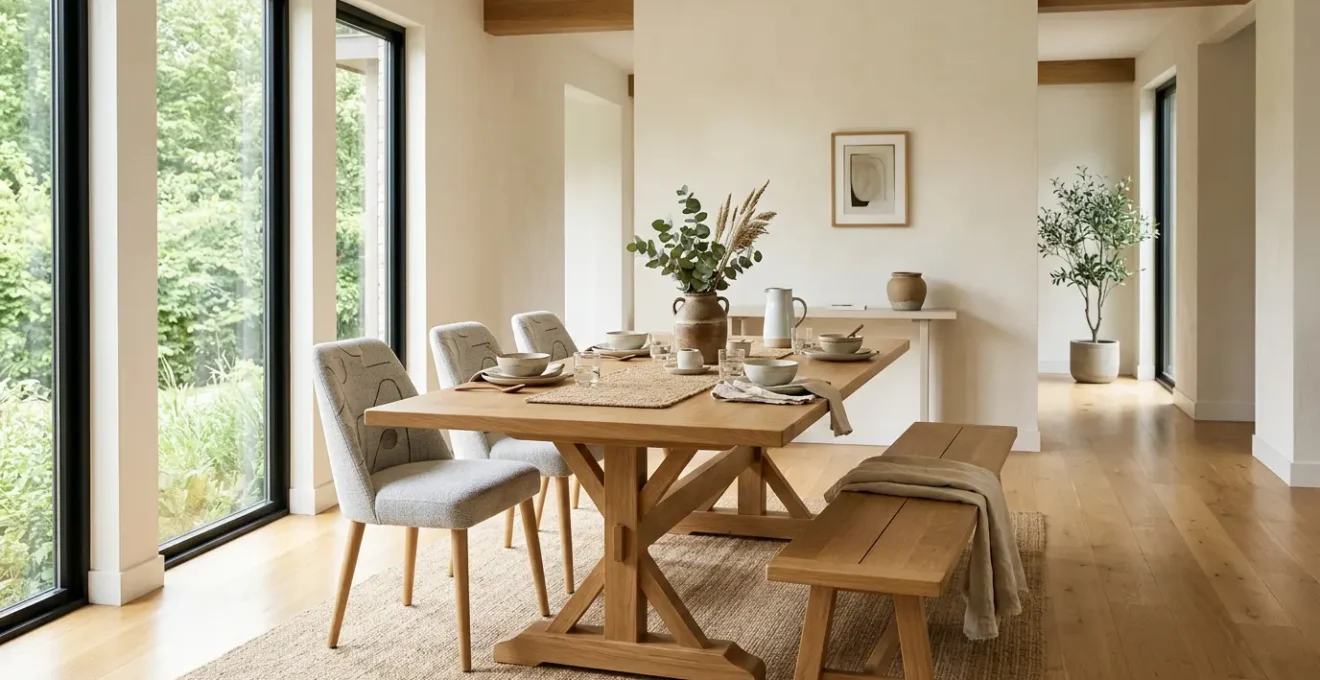
The secret to a perfect dining setup isn’t about cramming in the biggest table, but about mastering the art of spatial choreography for your home.
- The impact of a table’s shape on saving space is often a myth; the functional flow and clearance around it are what truly matter.
- A table’s base design (like a trestle or pedestal) can have a greater impact on comfortable seating capacity than the tabletop shape itself.
Recommendation: Before committing, use painter’s tape on your floor to visualize not just the table’s footprint, but the crucial movement paths for you and your guests during a lively dinner party.
As hosts, we’ve all felt it: that subtle panic when a guest needs to leave the table and the resulting shuffle feels less like a polite maneuver and more like a human game of Tetris. We dream of long, lingering dinners filled with laughter and conversation, but the reality of our space often feels limiting. The common advice is to “measure your room” or “leave three feet of clearance,” but these static rules fail to capture the dynamic, human element of a great get-together. They tell you how to fit an object into a box, not how to create an experience.
What if the key wasn’t just about the table’s dimensions, but about the flow of movement and energy in the room? The real challenge for hosts with limited or awkward spaces isn’t just seating everyone; it’s creating an environment that feels generous, comfortable, and effortless. This requires a shift in thinking from static space-filling to a more graceful concept: spatial choreography. It’s the art of arranging your dining area to guide movement, encourage interaction, and make every guest feel catered to, even in the coziest of settings.
This guide moves beyond the measuring tape to explore the nuanced decisions that make a dining set truly work for your entertaining style. We’ll deconstruct common myths, analyze the overlooked details like table bases, and give you the tools to plan a space that supports the vibrant, social gatherings you love to host. It’s time to choose a dining set that doesn’t just fit your room, but choreographs the perfect party.
Summary: Mastering the Art of the Dining Space
- Myth: do round tables really save more space than rectangular ones?
- How to measure chair clearance to avoid “elbow wars” during dinner?
- Pedestal base vs. legs: which table type fits more guests comfortably?
- The error of buying a dining set that crowds the room and blocks flow
- How to choose an extendable table mechanism that one person can operate alone?
- The trestle base advantage: how to fit more people without straddling legs?
- How to calculate the exact clearance needed between sofa and coffee table?
- Pendant Lights: Anchoring Furniture and Providing Task Lighting
Myth: Do Round Tables Really Save More Space Than Rectangular Ones?
One of the most persistent beliefs in home decor is that a round table is an automatic space-saver. The logic seems sound: no sharp corners means a smaller footprint. However, this is a dangerous oversimplification that ignores the most critical factor for any host: flow dynamics. A 48-inch round table and a 48-inch long rectangular table might occupy similar square footage, but how they function within a room is completely different. A round table pushed into a corner creates awkward, unusable space around its curves, while a rectangular table can sit flush against a wall or banquette, maximizing the open area.
The question isn’t “which shape is smaller?” but “which shape best supports the movement in my room?” Think about the primary pathways: from the kitchen to the table, from the table to the powder room. A rectangular table can create a clear, defined channel for traffic along its long side, while a round table can sometimes create an obstacle that forces people to navigate a wider, more ambiguous path. The ultimate goal is to create generous walkways and a feeling of ease.
To truly understand the impact, forget abstract measurements and perform a physical test. Use painter’s tape to outline the potential table’s footprint on your floor. Then, walk your typical hosting routes. Simulate pulling out chairs, carrying a tray of drinks, and a guest excusing themselves from the table. This simple act of spatial choreography will reveal more about the right shape for your room than any diagram ever could. You may discover that a slim rectangular table actually makes your room feel larger and more functional than the supposedly “space-saving” round option.
How to Measure Chair Clearance to Avoid “Elbow Wars” During Dinner?
A successful dinner party is measured in comfortable guests, not just delicious food. The single biggest threat to that comfort is a cramped seating arrangement. “Elbow wars” are a clear sign that you’ve neglected the most crucial measurement of all: the guest comfort zone. This isn’t just the space the chair occupies, but the dynamic area a person needs to sit down, get up, and feel relaxed without bumping into a wall or their neighbor.
The standard rule of thumb is to allow for 36 inches of clearance from the table edge to the nearest wall or piece of furniture. However, this is a bare minimum. For true hosting grace, you need to think in layers. If the space behind a chair is just for scooting in and out, 36 inches works. But if it’s also a walkway for you or other guests to pass through during the meal, the standard changes. In these cases, furniture crafting specialists at Lamon Luther recommend 48 inches of clearance for a walkway behind seated guests. This extra foot of space is the difference between an awkward shuffle and an effortless glide.
A Bel Furniture analysis of Texas homes validated this principle, finding that families who implemented the 36-inch minimum rule reported 75% fewer complaints about cramped dining spaces. This allowed them to comfortably seat 4-6 people in standard 12-by-10-foot dining rooms by choosing appropriately scaled tables. Don’t forget the space between chairs, either. Each guest needs about 24 inches of table width to themselves to avoid feeling crowded. By respecting these zones, you’re not just placing furniture; you’re designing for human comfort and social ease.
Pedestal Base vs. Legs: Which Table Type Fits More Guests Comfortably?
When trying to maximize seating density, we often focus exclusively on the tabletop’s length and width. However, what’s happening underneath the table is just as important. The base of your dining table—be it a central pedestal, traditional four legs, or a trestle—dictates how many people can truly sit comfortably, free from the dreaded leg-straddle. Each design has distinct advantages for the savvy host.
A pedestal base, with its single, central support, is the champion of corner seating. It eliminates the corner legs that act as barriers, making it easy to squeeze in an extra person at a round or square table. This design offers unparalleled flexibility for foot and leg placement. However, on very long rectangular tables, a single pedestal can lack stability, leading to a slight wobble when pressure is applied to the ends.
The traditional four-leg design is the most stable, providing a solid anchor at each corner. Its weakness, however, is its rigidity. The legs create fixed “dead zones” where a chair simply cannot go. This can limit your ability to accommodate an unexpected guest. The most flexible and stable option for larger gatherings is often the trestle base, which we’ll explore in more detail later. This comparison shows how the base directly influences your hosting capabilities.
As this comparative analysis from Design Within Reach shows, the choice of base is a strategic trade-off between flexibility and stability.
| Base Type | Seating Flexibility | Stability | Best For |
|---|---|---|---|
| Pedestal Base | High – no corner legs | Medium – can wobble on long tables | Round/square tables up to 60 inches |
| 4-Leg Base | Medium – legs can obstruct | High – very stable | Traditional rectangular tables |
| Trestle Base | Highest – clear sides | High – stretcher adds stability | Long tables 8+ seats |
The Error of Buying a Dining Set That Crowds the Room and Blocks Flow
The most common mistake a host can make is falling in love with a large, stately dining set that technically “fits” but functionally suffocates the room. This error stems from ignoring the room’s flow dynamics—the invisible pathways people use to move through a space. A crowded dining set can create frustrating bottlenecks, blocking the route from the kitchen to the living room or making it difficult to access a patio door. The result is a room that feels smaller and more stressful, the exact opposite of a welcoming environment for entertaining.
To avoid this, you must plan for two distinct types of clearance. First is the seating clearance—the space a person needs to pull out their chair and sit down (a minimum of 36 inches). The second, and often forgotten, is the major traffic clearance for walkways that will be used throughout the evening, which should be closer to 48 inches. Also, remember the personal space at the table itself; interior space planning experts note that a minimum of 24 inches of table width per person is required for comfortable dining. Without this, guests will feel like they’re on top of one another.
If you’re working with a particularly tight or awkward space, consider visual tricks to reduce the feeling of clutter. A table with a glass top or chairs made of clear acrylic can perform a “transparency trick,” allowing the eye to see through them and creating an illusion of openness. Similarly, tables with slender legs and chairs with a more open or woven back feel less visually heavy than solid, chunky pieces. The goal is to choose a set that respects the room’s natural pathways and creates a sense of airy generosity, not a beautiful obstacle course.
How to Choose an Extendable Table Mechanism That One Person Can Operate Alone?
For the host who entertains groups of varying sizes, the extendable table is an indispensable tool. It’s the ultimate in furniture flexibility, transforming from a cozy family table to a party-ready banquet surface. However, not all extension mechanisms are created equal. The moment you need a partner and a complex series of maneuvers to add a leaf is the moment the table starts working against you. The ideal mechanism is one you can operate smoothly and single-handedly, allowing for a spontaneous “let’s add another couple!” decision. This is where the host’s pivot—the ability to adapt the space quickly—becomes essential.
The most user-friendly design is the butterfly leaf. The leaf is hinged and stored within the table itself. To extend it, you simply pull the two halves of the tabletop apart, and the leaf unfolds and lifts into place like a butterfly’s wings. There are no heavy, separate leaves to haul from a closet. Another excellent single-person option is a geared slide mechanism, where pulling on one end of the table automatically and evenly separates the other end, making the process smooth and requiring minimal muscle.
When shopping, always test the mechanism in the showroom. Can you operate it alone? Is the action smooth or does it catch and stick? While it’s always good practice to verify the seating capacity, the ease of transformation is what you’ll appreciate most in the real world of hosting. As the experts at Ethan Allen point out, the table’s capacity is a key feature, but its usability is what makes it a joy to own. The Ethan Allen Design Team notes in their guide:
Always check your table’s product description to confirm capacity, but a rectangular table can usually accommodate 6 to 8 people
– Ethan Allen Design Team, Ethan Allen Dining Room Furniture Guide
The Trestle Base Advantage: How to Fit More People Without Straddling Legs?
When your goal is to maximize seating for large family gatherings or bustling dinner parties, the trestle table emerges as a clear hero. Unlike a traditional four-leg table that creates immovable obstacles at the corners, a trestle base features two supports (or “trestles”) positioned inwards from the ends and connected by a horizontal stretcher. This brilliant design liberates the entire perimeter of the table, eliminating the dreaded leg-straddling issue and dramatically increasing your seating density and flexibility.
The primary advantage is the ability to use benches. A bench can be tucked completely underneath a trestle table when not in use, and during dinner, it allows for a fluid number of guests. You can comfortably seat three adults or four children where you might only fit two chairs. This is a game-changer for holiday meals or kids’ parties. Furthermore, the absence of corner legs means no one is “stuck” in an awkward spot; every seat is a good seat with ample legroom.
A case study on large family dining solutions by Cabinfield, specializing in Amish-crafted furniture, highlighted this benefit perfectly. Their analysis revealed that trestle base tables measuring 94 inches can comfortably accommodate up to 10 guests. Families reported that the ability to pair them with benches was particularly beneficial during holiday gatherings, allowing them to squeeze in additional seating without compromising comfort. This makes the trestle base the ultimate choice for hosts who value both form and high-capacity function.
Your Trestle Table Selection Checklist
- Verify table length: The trestle advantage is minimal for tables under 6 seats but becomes a game-changer for accommodating 10 or more guests.
- Pair with benches: For maximum seating flexibility, choose at least one bench which can tuck completely under the table when not in use.
- Check stretcher bar height: Ensure the connecting stretcher bar is high enough or positioned so it doesn’t interfere with the leg position of seated guests.
- Consider multi-purpose use: The even weight distribution of a trestle base makes it an excellent and stable surface for work or craft projects.
- Assess end-of-table seating: Confirm there is enough clearance between the trestle support and the end of the table to comfortably seat a person at the head.
How to Calculate the Exact Clearance Needed Between Sofa and Coffee Table?
While our focus is the dining area, the flow dynamics of your entire home impact the entertaining experience. A common chokepoint is the living room, specifically the space between the sofa and the coffee table. If this gap is too tight, it can hinder movement to and from the dining area, creating a subtle but constant source of friction for your guests. Getting this measurement right is a key part of choreographing a seamless journey through your home.
The golden rule for this space is a careful balance between reachability and maneuverability. You want the coffee table close enough that a seated guest can comfortably set down a drink or grab a snack without straining. At the same time, you need enough room for people to walk through without turning sideways. To achieve this balance, interior design professionals establish that an ideal distance of 14 to 18 inches between the edge of your sofa and the edge of your coffee table is best for standard use.
However, this “standard” measurement needs to adapt to how you use your space. If your sofa has a recliner function, you’ll need to measure the distance with the recliner fully extended, which often requires 24 inches or more of clearance. Similarly, if your family enjoys playing board games or your children play on the floor, a more generous gap of 24 to 30 inches will create a much more functional and comfortable activity zone. The key is to assess your daily activities and plan the clearance accordingly, ensuring the living room is a comfortable lounge area and not an obstacle on the way to dinner.
Key Takeaways
- Prioritize Flow Over Footprint: The best table shape is the one that enhances movement and pathways in your specific room, which may defy common “space-saving” myths.
- The Base is Boss for Seating: A table’s base design (pedestal or trestle) often has a greater impact on squeezing in extra guests comfortably than the tabletop shape itself.
- Clearance is Situational: The space you need around your table isn’t one-size-fits-all; distinguish between minimum seating clearance (36″) and ideal walkway clearance (48″).
Pendant Lights: Anchoring Furniture and Providing Task Lighting
Once you’ve perfectly choreographed the layout of your furniture, the final act is lighting. The right lighting does more than just illuminate the room; it defines the dining space as a distinct “stage” for your social gathering. A pendant light or a chandelier hung directly over the dining table is the most effective way to achieve this. It acts as a visual anchor, drawing the eye, creating a sense of place, and signaling to guests, “this is where we gather.” This is the finishing touch that transforms a collection of furniture into an inviting destination.
Beyond its aesthetic role, overhead lighting provides critical task lighting. It ensures your beautifully prepared food is seen in its best light and that guests can see each other clearly, fostering better conversation and connection. The key to getting this right is scale and height. A light fixture that is too small will look lost, while one that is too large will overwhelm the table. A good rule of thumb is to choose a fixture with a diameter that is one-half to two-thirds the width of your table.
Height is even more critical. Hang the light too high, and you’ll create glare and lose the sense of intimacy. Hang it too low, and it will block sightlines across the table. For the perfect balance of illumination and intimacy, professional interior designers at Kathy Kuo Home specify that the bottom of the pendant light should hang 30 to 36 inches above the tabletop. This placement creates a warm pool of light that defines the space and puts your guests—and your meal—in the spotlight.
Now, you’re equipped with the insights of a seasoned host and a design expert. You can look beyond simple dimensions to see the hidden potential in your space. By focusing on spatial choreography, guest comfort, and functional flow, you can choose a dining set that doesn’t just fit your room, but elevates every gathering you host. Start planning your perfect dinner party setting today, confident that you can create an experience that is both beautiful and beautifully functional.