
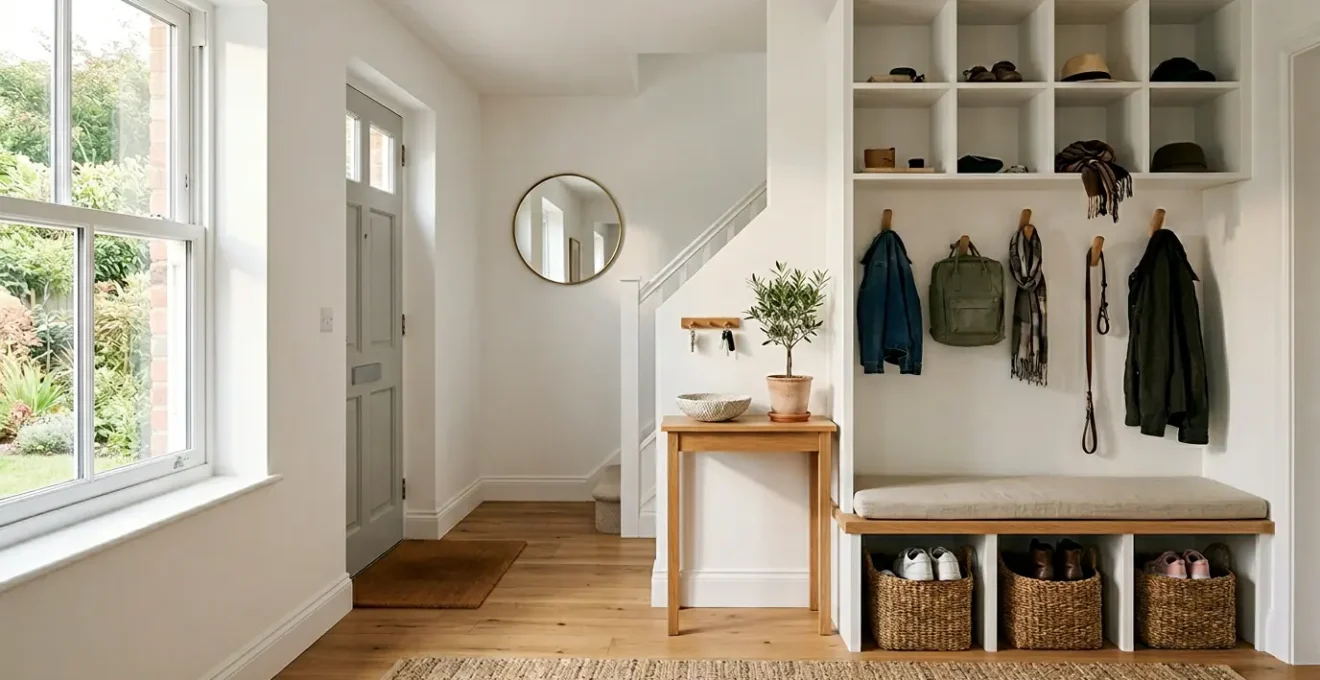
The key to a permanently organized entryway isn’t more storage—it’s designing a system that makes tidying up easier than making a mess.
- Analyze and reduce “clutter friction” by making daily-use items effortless to put away.
- Go vertical with storage to maximize capacity in even the narrowest of halls.
Recommendation: Start by creating a dedicated “landing strip” for the items that enter your home every single day.
That familiar mountain of shoes by the door, the frantic search for keys, the precarious pile of mail on the nearest surface—this is the daily reality for countless families. You invest in storage baskets and hooks, determined to create order, yet within a week, the chaos returns. It’s a frustrating cycle that can set a stressful tone for your entire home from the moment you walk in the door.
Most organizational advice focuses on the tools: buy this bench, use these labels. While helpful, these are just pieces of the puzzle. They address the symptoms of clutter, not the root cause. The truth is, entryways are high-traffic, high-velocity zones. If a system isn’t designed for speed and simplicity, it’s destined to fail. The problem isn’t a lack of effort; it’s a flawed design that works against human nature.
But what if the solution wasn’t about enforcing strict rules, but about creating an ergonomic system so intuitive that your family uses it automatically? This guide moves beyond generic tips to focus on the behavioral science of clutter. We will deconstruct why entryways become “drop zones” and design a “path of least resistance” that channels bags, shoes, and mail to their designated homes with minimal effort.
Together, we will build a functional, welcoming entryway that serves your family’s real-life needs, not an idealized version of them. By focusing on flow, accessibility, and strategic placement, you can finally reclaim your entrance and create a lasting sense of calm.
This article provides a step-by-step blueprint for transforming your entryway. Explore the sections below to diagnose your clutter issues and implement lasting solutions.
Contents: Your Blueprint for a Serene and Organized Entryway
- Why 80% of entryways become cluttered drop zones within a week?
- How to create a “landing strip” for keys and mail that actually works?
- Bench with storage vs. console table: which maximizes functionality in narrow halls?
- The flooring mistake that ruins your entryway aesthetics after one winter
- When to rotate your entryway storage from summer to winter gear?
- Why your kitchen feels crowded even when empty of furniture?
- Bedroom vs. Entryway: where should you NEVER place a mirror according to Feng Shui?
- Vertical Storage Units: How to Double Your Storage Capacity Without Losing Floor Space?
Why 80% of entryways become cluttered drop zones within a week?
The primary reason entryway systems fail is simple: they introduce too much “clutter friction.” Every extra step required to put something away—opening a closet door, lifting a heavy lid, fumbling with a hanger—makes the floor or the nearest flat surface a more attractive option. For a tired parent or an impatient child, the path of least resistance will always win. The goal isn’t to fight this behavior, but to design a system where the easiest path is the organized one.
This failure often starts with a psychological block. As noted by KonMari certified consultants, many people perceive their entryway as too small or awkward to be functional, so they don’t bother setting up a proper system at all. This mindset guarantees it will become a dumping ground. Professional organizer Caitlin McBride of The Home Edit adds that another key mistake is trying to store too much. Your entryway is for daily-use items only. The moment it becomes a home for backup supplies or overflow from other rooms, it descends into chaos.
An effective system prioritizes ease and accessibility above all. For instance, hooks are almost always better than hangers for daily coats because they require one swift motion. Open cubbies or baskets are better for kids’ shoes than a neat row on a shelf. By understanding these behavioral drivers, you can move from fighting clutter to preventing it at its source.
Your 5-Step Entryway Friction Audit
- Points of Contact: List every item that enters your home daily (keys, mail, shoes, coats, backpacks).
- Collection Points: Document where these items *actually* land right now. Be honest (floor, counter, chair).
- Friction Analysis: For each item, count the steps it takes to put it in its “proper” place. Is a lid, door, or hanger involved?
- Path of Least Resistance: Map the physical path from the door to the current drop zones. Is this the most direct route?
- System Redesign Plan: Identify one change per item to make the ‘put away’ location easier to access than the ‘drop’ location.
Ultimately, a successful entryway is one that acknowledges the reality of a busy family life and designs for it, rather than against it.
How to create a “landing strip” for keys and mail that actually works?
The “landing strip” is the most critical component of an organized entryway. It’s the designated, immediate destination for everything you carry in your hands: keys, mail, sunglasses, and phones. Without a clear and convenient landing strip, these items will inevitably scatter across the first available surface, creating instant clutter. The key to making it work is to design it for how you *actually* live, not how you think you *should* live.
First, establish a dedicated zone. This can be a console table with drawers for hidden storage or a simple wall-mounted shelf in a smaller space. The surface itself is for immediate processing. Use decorative trays or bowls to corral smaller items. Assigning one bowl for keys and another for wallets creates a muscle memory that makes putting things away automatic. This simple visual cue prevents items from spreading out.
Paperwork is a primary culprit of entryway chaos. To combat this, implement a simple in/out box system. A stylish letter tray or a wall-mounted file holder can serve this purpose. All incoming mail, school forms, and flyers go directly into the “in” box. This contains the paper clutter until you have a moment to process it, preventing it from migrating to the kitchen counter or dining table. The “out” box holds items that need to leave the house, like signed permission slips or letters to be mailed.
| Solution Type | Best For | Pros | Cons |
|---|---|---|---|
| Console Table with Drawers | Larger entryways | Hidden storage, multiple compartments | Takes floor space |
| Wall-Mounted Organizer | Small spaces | Saves floor space, always visible | Limited storage capacity |
| Basket System | Flexible spaces | Portable, adaptable | Can look cluttered if overfilled |
By creating a simple, three-part system—a surface for personal items, drawers for less-used essentials, and a folder for paper—you build an efficient processing center that stops clutter before it starts.
Bench with storage vs. console table: which maximizes functionality in narrow halls?
In a narrow hallway, every square inch counts. The choice between a storage bench and a console table often feels like a compromise between a place to sit and a place to drop your keys. However, the best solution isn’t about choosing one over the other, but about understanding which function is your primary bottleneck. If the biggest problem is a mountain of shoes, a storage bench is your best bet. It provides a convenient spot to sit while removing shoes and offers immediate, low-friction storage for them right underneath.
As one real-world example from Apartment Therapy shows, a multipurpose hallway bench can be a game-changer. The model they highlight features not only a shelf for shoes but also a clever integrated umbrella holder, proving that a single piece can solve multiple storage problems. This is the essence of maximizing functionality in a tight space: every item must serve at least two purposes.
If, however, your main issue is the lack of a “landing strip” for mail and personal items, a slim console table is superior. It provides that crucial surface-level organization at an ergonomic height. But what about seating? This is where creative, hybrid solutions come in. You can place low-profile stools or small ottomans *under* a taller console table, pulling them out only when needed. This preserves the landing strip while offering on-demand seating.
As the design experts at John Louis Home advise, when space is limited, you must think vertically. They state:
Entryways are often compact, making it challenging to find room for everything. When floor space is limited, think upwards! Utilizing wall space is a brilliant organization trick.
– John Louis Home Design Experts, Organize Your Entryway: Simple Solutions
For the ultimate narrow-hall solution, consider a wall-mounted floating console table with a low-profile storage bench tucked neatly underneath. This gives you the best of both worlds: a dedicated landing strip, seating, and shoe storage, all while maintaining a feeling of openness by keeping the floor clear.
The flooring mistake that ruins your entryway aesthetics after one winter
You can have the most beautifully organized entryway, but if you neglect your flooring, one season of rain, snow, or mud can leave it looking permanently worn and dirty. The single biggest mistake families make is underestimating the amount of debris that gets tracked inside. A single, flimsy doormat is simply not enough to protect your floors from the daily assault of the outdoors.
The solution is a robust, two-mat system. As organizing professionals on HGTV recommend, you should place an entrance mat on both sides of the door. The exterior mat should be a rugged, bristly workhorse designed to scrape off the worst of the mud, snow, and grit. The interior mat’s job is to catch any remaining moisture and finer dirt. During fall and winter, this dual-mat strategy is non-negotiable for preserving your floors.
This floor protection strategy is directly linked to your storage system. According to home organization experts, strategic shoe storage is the key to clean floors, as wet and muddy boots are the primary culprits. Creating an immediate and easy “shoe drop zone” on or next to the interior mat prevents family members from tracking dirt further into the house. A simple boot tray or a water-resistant rug can define this area and contain the mess effectively.
Choosing the right material for your interior mat is also crucial. Opt for something that is highly absorbent but also durable and easy to clean. Commercial-grade, low-pile mats or those made from recycled materials often perform best and can be hosed down or machine-washed. Don’t sacrifice function for aesthetics here; a beautiful but non-absorbent rug will only spread moisture around, potentially damaging hardwood or laminate over time.
Protecting your entryway floor isn’t just about cleanliness; it’s about preserving the value and appearance of your home and reducing your overall cleaning workload.
When to rotate your entryway storage from summer to winter gear?
An efficient entryway isn’t static; it’s a dynamic system that adapts to the changing seasons. The key to maintaining order year-round is to practice seasonal rotation, ensuring that only relevant, in-season items are taking up valuable, front-line storage space. The best time to perform this rotation is during the transitional weeks of spring and fall—before the new season’s gear is in high demand.
The first step is to designate storage that can be easily swapped. A row of open baskets or cubbies under a bench is perfect for this. In the summer, these can hold flip-flops, sunglasses, and pool towels. As winter approaches, you can swap them out for identical bins filled with hats, gloves, and scarves. This keeps daily-use items accessible without creating clutter. All out-of-season gear should be moved to secondary storage, like a basement, guest room closet, or in clearly labeled under-bed bins.
Beyond bulk items, creating seasonal “grab bins” streamlines hurried exits. In the summer, have a small, accessible bin with sunscreen and bug spray. In the winter, this could be a basket of hand warmers or extra chapstick. This small detail prevents last-minute rummaging through a cluttered “junk drawer” and keeps your landing strip clear for its primary purpose.
The rotation process itself is a perfect opportunity to declutter. As you pack away last season’s items, inspect them for wear and tear. Discard or donate anything that is broken, outgrown, or no longer used. This prevents you from storing unnecessary items and ensures that when you unpack them again next year, everything is ready to go. A good rule of thumb is to schedule this rotation in your calendar, just like any other home maintenance task, to ensure it doesn’t get forgotten in the seasonal rush.
By treating your entryway storage as a living system, you ensure it remains functional, organized, and perfectly attuned to your family’s needs, no matter the weather outside.
Why your kitchen feels crowded even when empty of furniture?
It’s a common complaint: the kitchen has become the home’s “clutter magnet.” Even with ample counter space, it feels perpetually crowded with items that don’t belong there. The reason often has nothing to do with the kitchen itself. The problem starts at the front door. When an entryway fails to do its job, the kitchen counter becomes the next logical—and most convenient—dumping ground.
Think about where mess usually starts: More often than not, it begins right at the door. Shoes get kicked off in random spots, bags get dropped on the floor, mail piles up on the nearest surface, and keys disappear into the abyss. Without a designated system, clutter spreads quickly.
– Jana, Military Spouse & Organization Expert, The Organized Military Life
This “clutter spillover” is a direct consequence of a high-friction entryway system. A case study from a home with a poorly designed mudroom illustrates this perfectly: backpacks, lunch boxes, and coats were thrown down because the provided shelves were too high for kids to reach and there weren’t enough hooks. This overflow inevitably spilled into the adjacent kitchen, turning a food prep area into a chaotic storage zone. Your kitchen feels crowded because it’s performing a job that the entryway was supposed to do.
To reclaim your kitchen, you must first fix your entrance. By creating an effective, low-friction landing strip and storage system at the door, you intercept the clutter before it has a chance to migrate. When mail has a designated inbox, keys have a hook, and backpacks have an accessible cubby, there is no longer a need for these items to land on the kitchen island. The solution to a crowded kitchen often lies in the hallway.
Think of your entryway as a dam. If it’s well-built, it contains the daily flood of items. If it has cracks, the chaos will leak out and flood the rest of your home, with the kitchen being the first and most frequent casualty.
Bedroom vs. Entryway: where should you NEVER place a mirror according to Feng Shui?
Mirrors are a powerful tool in entryway design. They perform the practical function of allowing a last-minute appearance check before you leave the house, but they also have a significant impact on the feel of the space. A well-placed mirror can make a narrow, dark hallway feel brighter and more expansive by reflecting natural light and creating an illusion of depth.
From a practical design standpoint, the best placement is on a wall perpendicular to the front door. This allows you to see yourself as you approach or leave, but it doesn’t create a jarring reflection of the outside world the moment you step inside. Placing a mirror opposite a window is another excellent strategy to maximize natural light and brighten up a typically dark area of the home.
However, some design philosophies, like Feng Shui, offer more specific guidance. While views vary, a widely-held principle in Feng Shui advises against placing a mirror directly facing the front door. The logic behind this belief is that the front door is the primary entry point for energy (or “Chi”) into the home. A mirror placed directly opposite is thought to push this positive energy right back out, preventing it from circulating throughout the house.
Whether you adhere to this principle or not, the underlying design lesson is valuable: a mirror’s placement has a strong psychological impact. A mirror directly facing the door can be startling and may make the space feel less settled and welcoming. By combining both practical and energetic considerations, the ideal placement emerges: on a side wall, where it can open up the space without creating an abrupt or unsettling focal point.
Use mirrors to enhance your entryway’s function and feel, but place them thoughtfully to create a welcoming and harmonious first impression.
Key Takeaways
- An entryway’s success depends on a low-friction “ergonomic system” that makes putting things away easier than dropping them.
- A dedicated “landing strip” for keys, mail, and phones is non-negotiable to prevent clutter from spreading into the home.
- Vertical storage is the most effective way to maximize capacity in small or narrow entryways without sacrificing floor space.
Vertical Storage Units: How to Double Your Storage Capacity Without Losing Floor Space?
When floor space is the most valuable commodity in your entryway, the only way to go is up. Vertical storage is the single most effective strategy for dramatically increasing your organizational capacity without making a narrow hall feel more cramped. By drawing the eye upward and utilizing the full height of your walls, you can create a storage powerhouse in a surprisingly small footprint.
Never underestimate the amount of storage you can use by going vertical. By incorporating floor to ceiling mudroom storage cabinets, you can give a dramatic effect to an overlooked area of your home.
– ShelfGenie Storage Solutions, 15 Mudroom Storage Cabinet Ideas
One of the best real-world examples of this principle in action is the use of narrow, wall-mounted shoe cabinets. In a case highlighted by Apartment Therapy, a homeowner installed slim IKEA shoe cabinets in a hallway just one meter wide. These tilt-out units can hold a surprising number of shoes while protruding only a few inches from the wall, keeping the walkway clear. The top surface provides a bonus landing strip for smaller items.
Beyond shoes, consider a modular system of wall-mounted shelves and cubbies that can be configured to your specific needs. You can place open cubbies at a lower height for kids to easily access their own belongings, reducing their reliance on you. Higher shelves are perfect for decorative items or less-frequently used storage bins. This approach not only organizes your gear but also empowers each family member to manage their own items, which is the cornerstone of a sustainable system.
Don’t be afraid to think like a professional organizer and go for a full floor-to-ceiling solution. A tall, narrow cabinet or a custom-built “mudroom locker” unit can house everything from coats and bags to sports equipment, all concealed behind a clean facade. This creates a powerful visual statement and transforms a cluttered, overlooked space into a highly functional and intentional part of your home.
By shifting your focus from the floor to the walls, you unlock a vast amount of previously untapped storage potential, finally solving the puzzle of the small, cluttered entryway.