
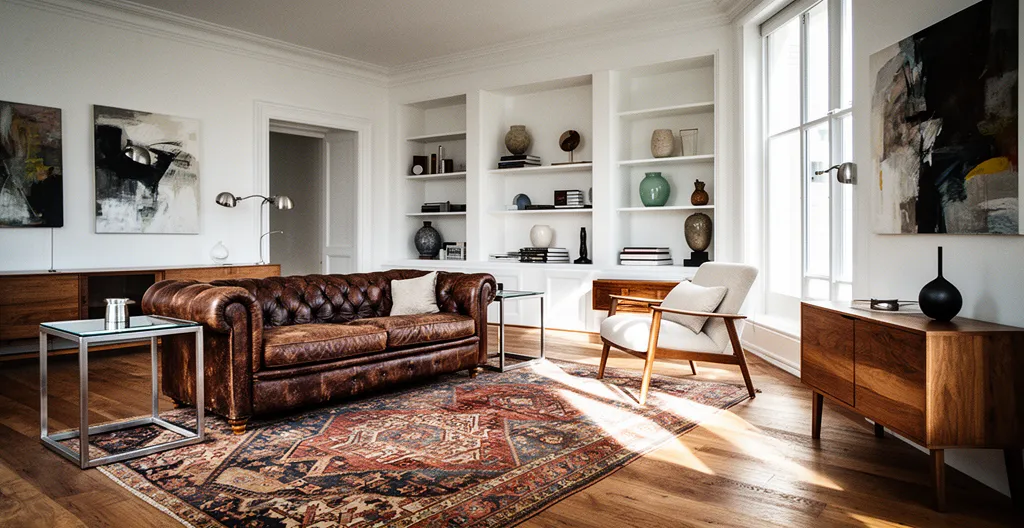
Building an elegant home on a budget isn’t about finding cheap replicas; it’s about adopting a curator’s discipline to invest in pieces with true intrinsic value.
- “Fast furniture” often costs more in the long run due to frequent replacement cycles and near-zero resale value.
- A curated mix of vintage and modern pieces creates a unique narrative, with quality vintage often being more affordable and durable than new, low-grade items.
Recommendation: Instead of furnishing a room all at once, begin by acquiring a single, high-quality “anchor” piece and let the story of your home unfold patiently around it.
The desire to create a beautiful, finished home often leads to a paradox: in our rush to fill the space, we default to the fleeting trends and disposable quality of “fast furniture.” We are told to “buy what we love” and “invest in quality,” yet we end up with rooms that feel generic, lacking the soul and character we crave. This cycle of buying, regretting, and replacing is not only financially draining but emotionally unfulfilling. It leaves us with a collection of objects, not a curated home.
The common advice to simply “mix old and new” is a platitude that ignores the sophisticated skill required to do it well. But what if the secret wasn’t about following trends or even about budget-hunting in the conventional sense? What if the key to building a timeless collection with lasting value was to stop thinking like a consumer and start thinking like a curator? This approach is not about acquiring items; it is about cultivating a personal narrative. It demands discipline, an eye for intrinsic quality over surface appeal, and an understanding that the most luxurious element in a room can often be the empty space itself.
This guide will walk you through the curatorial method for building a home. We will dismantle the true cost of disposable decor, provide a framework for creating a harmonious dialogue between objects from different eras, and explore the mindset that transforms a house into a personal gallery of your life’s story. It’s a slower, more deliberate path, but one that leads to a home that is not only timeless but deeply and authentically yours.
This article provides a structured approach to developing your curatorial eye. The table of contents below outlines the key principles we will explore to help you build a collection with confidence and patience.
Summary: The Art of Building a Lasting Furniture Collection
- Why buying “fast furniture” costs you $1,500 more over 5 years?
- How to mix vintage and modern pieces without it looking messy?
- Bespoke vs. mass-produced: when is the investment truly worth it?
- The “rush to finish” error that leads to a generic and soulless home
- How to refresh your curated look simply by swapping textiles and art?
- Why humidity changes can crack your expensive table within 6 months?
- How to style a Victorian dresser in a mid-century modern room?
- Contemporary Design: Achieving a “Now” Look That Doesn’t Age Quickly
Why buying “fast furniture” costs you $1,500 more over 5 years?
The allure of fast furniture is its immediate affordability. For a modest initial outlay, a room can be filled and functional within a weekend. However, this is a financial illusion. The true cost of an object is not its price tag but its total cost of ownership over time. Composed of particleboard, cheap veneers, and plastic hardware, these pieces are engineered for a short lifespan, not for endurance. Their value depreciates to zero the moment they enter your home, and they are destined for the landfill at the first sign of wear or the next shift in trends.
Contrast this with a well-made vintage or quality new piece. While the initial investment is higher, its longevity fundamentally changes the economic equation. A solid wood table can be refinished, a well-constructed sofa can be reupholstered, and a classic design retains its value—and can even appreciate. The growing furniture repair market, projected to more than double to $4.3 billion by 2032, is a testament to this shift in consumer thinking. Investing in repairable, durable assets prevents the cycle of repurchase. The fast-furniture sofa you replace three times in a decade ultimately costs far more than the single, quality sofa that becomes a family heirloom.
The calculation is simple: the fast-furniture advocate pays for the same item multiple times over, while the curator pays once. When you factor in the resale value of quality pieces versus the disposal cost of broken ones, the financial argument becomes undeniable. The “bargain” is, in fact, a long-term subscription to disposable goods. A true investment is a one-time purchase that pays dividends in beauty, function, and durability for decades.
How to mix vintage and modern pieces without it looking messy?
The most common fear in curating a home is creating a chaotic, garage-sale aesthetic rather than a chic, layered interior. The popular “80/20 rule,” which suggests an 80% modern to 20% vintage ratio, is a safe starting point. However, a true curator doesn’t rely on rigid formulas but on creating a dialogue between objects. The goal is not just to place old and new items in the same room, but to make them relate to one another through a shared visual language. This can be achieved by finding unifying threads in color, material, or form.
A piece does not need to match perfectly; it needs to be in conversation. For instance, you can pair a very ornate, curved Victorian dresser with a starkly minimalist, angular bed frame. Here, the forms are in direct contrast, creating dynamic tension. But if both are made of woods in a warm color family (like dark mahogany and honey-toned oak), that shared materiality creates a bridge between them. The harmony comes from the balance of contrasting and complementary elements. Thinking in terms of these unifying factors allows for much more sophisticated and personal combinations than a simple percentage rule allows.
This matrix provides a simple framework for analyzing potential pairings. By ensuring that at least two of the three pillars—silhouette, material, and color—find common ground, you can confidently create combinations that feel intentional and harmonious, rather than accidental and messy.
| Element | Vintage Piece | Modern Piece | Unifying Factor |
|---|---|---|---|
| Silhouette | Curved Victorian dresser | Angular minimalist bed | Keep different |
| Material | Dark mahogany wood | Light oak wood | Both natural wood |
| Color | Deep brown tones | Warm honey tones | Warm color family |
| 2 out of 3 pillars match = harmonious combination | |||
Bespoke vs. mass-produced: when is the investment truly worth it?
The line between a worthy investment and a frivolous expense can seem thin, especially when considering bespoke or custom-made furniture. While not every item in a home needs to be a custom commission, certain situations make the investment in bespoke not just justifiable, but profoundly wise. The decision should be guided by a single question: does this piece solve a problem or fulfill a role that mass-produced items simply cannot? This could be a bookshelf built to the exact dimensions of an awkward alcove or a dining table designed to accommodate a multi-generational family.
The demand for personalization is growing; recent market analysis shows that 41% of purchase decisions are influenced by the availability of customizable options. However, true heirloom potential goes beyond mere customization. It lies in the convergence of unique function, superior materials, and personal narrative. A bespoke piece becomes an investment when it is crafted from materials designed to last generations—solid hardwoods, expert joinery, natural fibers—and when it carries a story that imbues it with sentimental value. It’s the physical embodiment of a family’s history or a solution to its specific needs.
Before commissioning a piece, apply a simple litmus test to determine its potential as a future heirloom. If an item passes these three tests, its value will transcend its initial cost and become a meaningful part of your family’s legacy. This is the definition of a worthwhile investment.
Your Heirloom Potential Litmus Test
- Unique Need: Does it solve a unique and personal family need that mass-produced items cannot address?
- Material Integrity: Is it built with materials proven to last for generations (e.g., solid hardwood, quality joinery, natural fibers)?
- Personal Story: Does it possess a personal story or connection that adds irreplaceable sentimental value?
The “rush to finish” error that leads to a generic and soulless home
One of the greatest mistakes in decorating is the psychological pressure to “finish” a room. This impulse, born from a desire for comfort and order, often leads us to make hasty decisions, filling our homes with placeholders and pieces that are merely “good enough.” The result is an environment that lacks personality and story—a space that looks like a catalog page rather than a home. The most beautifully curated interiors are rarely, if ever, completed in a weekend. They are the product of patience, serendipity, and a guiding principle I call curatorial discipline.
This discipline involves embracing what I term “the curated void.” It is the conscious decision to live with empty space rather than filling it with something mediocre. This empty space is not a sign of an incomplete home; it is a declaration of intent. It is the breathing room that allows your truly special pieces to shine, and it holds the potential for the perfect object you have yet to discover. This approach was powerfully illustrated by a young woman on a tight budget who, by focusing only on the “functional minimum” (a bed, a table, two chairs), used the remaining empty space to create a sense of deliberate luxury, patiently hunting for perfect, affordable pieces over months to complete her vision.
The acclaimed designer Emily Henderson perfectly articulated the risk of an unbalanced collection, noting how her early, budget-driven apartments felt more like thrift stores until she learned the art of context. As she explains:
I used to have 90% vintage in my apartments, due to budget and the extremely good flea markets in LA. Looking back, without the mix of a few contemporary pieces, it did look more thrift store. Adding a few contemporary/modern pieces would elevate everything and give needed context to the vintage.
– Emily Henderson, Emily Henderson Design Blog
Her experience underscores the importance of patience and balance. A home is a living biography, written one meaningful object at a time. The “rush to finish” robs you of the joy of the hunt and the satisfaction of building a story.
How to refresh your curated look simply by swapping textiles and art?
A curated home, built on a foundation of timeless furniture, should never feel static or boring. The “bones” of the room—the sofa, the table, the credenza—provide a stable, high-quality canvas. The personality, seasonality, and energy of the space are then painted on with more transient and affordable elements: textiles and art. This is the curator’s secret to keeping a look fresh without having to constantly acquire new, large-scale items. It’s an approach that separates the permanent collection from the rotating exhibition.
Think of your textiles in layers. The base layer is your large area rug, typically a neutral or classic pattern that grounds the room year-round. The mid-layer consists of larger fabric elements like curtains or solid-colored pillows that can be swapped seasonally—think rich velvets and wools for winter, replaced by light linens and cottons for summer. The final accent layer is where you can have the most fun. This includes patterned pillows, throws, and small art prints that can be changed as often as monthly to reflect your mood, a new discovery, or a shift in the season. This method allows for a dramatic refresh with minimal expense and effort.
This layering strategy offers immense flexibility. A room with a classic navy sofa, a jute rug, and a walnut coffee table can feel entirely different when adorned with burnt orange and tweed in autumn versus pale blue and block prints in spring. Art plays a similar role. A gallery wall can be easily updated by swapping out a few prints, or a single large piece can be moved to a different room, changing the focal point and energy entirely. By investing in foundational furniture and treating textiles and art as a dynamic, evolving layer, you ensure your home remains a vibrant reflection of your personal style.
Why humidity changes can crack your expensive table within 6 months?
Acquiring a piece of quality furniture is only the first step; preserving its intrinsic value requires understanding its greatest enemy: environmental instability. Solid wood, the hallmark of most heirloom-quality furniture, is a “living” material. It breathes. It absorbs and releases moisture from the air, causing it to expand and contract. When humidity levels fluctuate dramatically—from a dry, heated winter to a humid summer—this movement can be catastrophic. The wood can swell, shrink, warp, and, in the worst cases, develop cracks and split joints, permanently damaging your investment.
This is why understanding a wood’s stability is paramount for a curator. Not all woods are created equal in their response to moisture. Teak, for example, is exceptionally stable due to its high natural oil content, making it suitable for almost any environment. Pine and beech, on the other hand, are far more volatile and are best used in climate-controlled spaces with consistent humidity. Protecting your collection might be as simple as running a humidifier in the winter and a dehumidifier in the summer to keep the relative humidity in a stable 45-55% range. According to furniture industry research, over 52% of households retain furniture for extended periods when it is properly maintained, and managing the environment is the cornerstone of that maintenance.
The following index provides a general guide to the stability of common furniture woods. Consulting this before a major purchase, especially for an antique piece whose provenance is unknown, can prevent a costly and heartbreaking mistake. A beautiful table is only timeless if it can physically withstand the test of time.
This comparative analysis highlights why material choice is critical for longevity, especially in climates with significant seasonal shifts. A piece’s ability to resist environmental stress is a key part of its long-term value.
| Wood Type | Stability Rating | Humidity Resistance | Best Climate |
|---|---|---|---|
| Teak | Excellent | Very High | All climates |
| White Oak | Very Good | High | Moderate humidity |
| Walnut | Good | Medium | Stable indoor |
| Pine | Fair | Low | Dry climates only |
| Beech | Poor | Very Low | Climate-controlled only |
How to style a Victorian dresser in a mid-century modern room?
Placing a highly ornate piece, like a Victorian dresser, into a clean-lined mid-century modern room is the ultimate test of a curator’s skill. Done poorly, the dresser can look like a misplaced relic. Done well, it becomes a stunning focal point that adds history and soul to the space. The key is to create intentional bridges between the two styles while respecting their inherent differences. The first step is to give the piece breathing room. Isolate the dresser against a clean, neutral wall, using negative space to frame it like a piece of sculpture in a gallery.
Next, establish a dialogue with the modern elements. Accessorize the dresser’s surface with objects that speak the language of mid-century design: a simple geometric lamp, a minimalist ceramic vase, or a stack of contemporary art books. This creates a visual link. An even more powerful technique is to modify the piece itself in a non-destructive way. The “Hardware Swap” is a classic designer trick: carefully remove the original ornate brass pulls (and store them safely!) and replace them with sleek, modern hardware in matte black or brushed nickel. This simple change helps the dresser’s silhouette integrate more seamlessly into its modern surroundings.
The final layer of integration comes from repetition. Echo the dark wood of the Victorian dresser in a smaller modern element elsewhere in the room, such as the legs of a chair or a picture frame. This creates a subtle rhythm that tells the eye these disparate pieces belong together. By isolating, accessorizing, modifying, and repeating, you transform a potential clash of styles into a sophisticated and deeply personal design statement.
Key Takeaways
- Adopt a curator’s mindset: Prioritize intrinsic value, craftsmanship, and personal story over fleeting trends.
- Embrace “The Curated Void”: Use empty space deliberately to give your best pieces breathing room and wait patiently for the right additions.
- Create a dialogue between objects: Unify vintage and modern pieces through shared elements like color, material, or form, rather than perfect matching.
Contemporary Design: Achieving a “Now” Look That Doesn’t Age Quickly
In a world saturated with fleeting trends, the ultimate goal of a curator is to select pieces that feel relevant today but will not feel dated tomorrow. This is the essence of timeless design. The challenge is that many items marketed as “contemporary” are, in fact, “trendy.” They are defined by of-the-moment colors, shapes, or materials that will inevitably fall out of fashion. Market research reveals that while 44% of consumers replace furniture due to trend changes, a more discerning 51% prioritize durability—a clear indicator of the desire for longevity.
True timelessness is found not in a specific style, but in foundational principles: honest materials, functional form, and impeccable craftsmanship. A piece that clearly expresses what it’s made of and what it’s for has a far greater chance of aging gracefully than one that relies on ornamental novelty. Before acquiring a new contemporary piece, apply the “10-Year Test”: can you easily imagine this piece looking just as relevant and beautiful in your home a decade from now? If you hesitate, it is likely a trend, not a classic.
This principle is perfectly embodied by pieces that have passed not just a 10-year test, but a 70-year test. Their enduring appeal lies in their commitment to form and function over fleeting fashion.
Case Study: The 10-Year Test in Practice
The Kasper dining table, a simple refectory table designed in 1949, exemplifies furniture that passes the ’10-Year Test’ with flying colors. It remains in production today because its design is rooted in the timeless Danish principles of pure form and practical function. As one design director noted, it is ‘a classic, strong, and simple table that fits seamlessly into any home environment.’ Its honesty of material and simplicity of purpose have allowed it to remain contemporary for over seven decades, proving that furniture with timeless silhouettes and material integrity ages gracefully across decades rather than following fleeting trends.
By focusing your contemporary acquisitions on pieces that exhibit this same commitment to quality and functional purity, you build a collection that feels “now” without being tied to a moment that will quickly become “then.” This is the final and most important act of curatorial discipline.
Begin your curatorial journey today. Instead of browsing for quick fixes, start by identifying the single most important “anchor piece” your home needs and dedicate yourself to finding an example with true intrinsic value, whether new or vintage.