
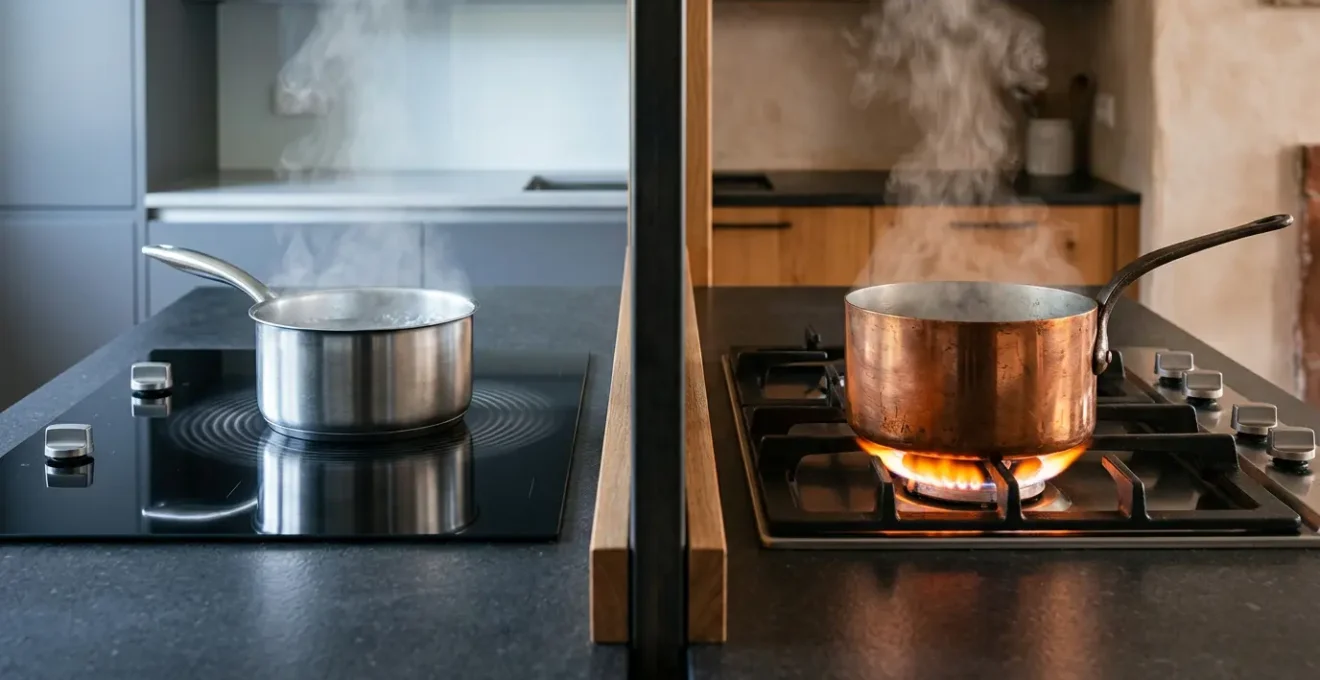
For most modern kitchen renovations, induction is the superior choice, offering a safer, more efficient, and cleaner culinary system than gas.
- Induction eliminates indoor air pollutants linked to health issues and is significantly safer for families.
- It provides more precise temperature control and is easier to ventilate, offering greater design flexibility.
Recommendation: Evaluate your choice not as a standalone appliance, but as the foundational component that dictates your kitchen’s electrical, ventilation, and spatial design.
The decision between an induction and a gas cooktop is a pivotal moment in any kitchen renovation. For decades, the open flame of a gas stove has been the symbol of a serious home chef, promising immediate response and visual feedback. Many renovators default to this classic choice, focusing on familiar feature comparisons: boiling speed, energy costs, and cookware compatibility. This approach, however, often overlooks the most critical factor: a cooktop isn’t just an appliance, it’s the heart of a complex culinary system.
The real choice isn’t just about how you heat a pan. It’s a foundational design decision with cascading consequences for your home’s air quality, your electrical infrastructure, the effectiveness of your ventilation, and even the social dynamics of your kitchen layout. While traditional advice pits the “feel” of gas against the “efficiency” of induction, this perspective is outdated. A modern analysis must go deeper, examining the technical and practical trade-offs that truly impact a home chef’s daily life and a family’s well-being.
This guide abandons the superficial feature-by-feature battle. Instead, we will analyze the systemic impact of your heat source. We will explore why the conversation has shifted from simple preference to a data-driven evaluation of safety, performance, and long-term usability. By understanding how your cooktop choice influences everything from cabinet cleanliness to your electrical panel, you can design a truly cohesive, high-performing, and future-proof kitchen.
This article provides a comprehensive analysis of the key factors that should guide your decision. By exploring each aspect, from safety and cleaning to layout and infrastructure, you will gain the technical understanding needed to choose the right cooktop for your home. The following summary outlines the critical points we will cover.
Summary: Cooktop Selection: A System-Level Analysis
- Why induction is the safest choice for families with young children?
- How to clean glass ceramic surfaces without scratching them permanently?
- Downdraft vs. overhead hood: which effectively clears smoke from searing?
- The error of using warped pans that reduces induction efficiency by 50%
- When do you need to upgrade your electrical panel for a new induction cooktop?
- In what sequence should you plan outlets for small appliances during design?
- Sink on island vs. cooktop on island: which configuration is more social?
- Handleless cabinets vs. hardware: which is easier to keep clean while cooking?
Why induction is the safest choice for families with young children?
While the risk of an open flame is obvious, the most significant safety advantage of induction lies in what you can’t see: indoor air quality. Gas stoves, even when operating correctly, release combustion byproducts like nitrogen dioxide (NO2), carbon monoxide (CO), and fine particulate matter directly into your home. These pollutants are known respiratory irritants and are particularly harmful to children. In fact, research indicates that gas and propane stove emissions are responsible for an estimated 200,000 current cases of pediatric asthma in the United States alone.
Induction cooking, by contrast, generates no combustion emissions. It uses an electromagnetic field to heat the pan directly, not the air around it. This fundamentally eliminates the primary source of cooking-related indoor air pollution, creating a healthier environment for the entire family. The surface itself also presents a lower burn risk; because it only heats the pan, the surrounding glass-ceramic stays relatively cool to the touch and cools down much faster than a gas grate or electric coil once the pan is removed.
Case Study: Bronx Air Quality Pilot Program
The real-world benefits of switching are significant. A pilot program in the Bronx, New York, monitored homes that replaced gas stoves with induction. The results were dramatic: over a 10-month period, the study documented a 35% decline in daily nitrogen dioxide concentrations and a reduction in carbon monoxide levels. This initiative by WE ACT for Environmental Justice provides powerful evidence that choosing induction is a direct and effective way to improve a home’s air quality.
For families with young children, the combination of no open flame, a cooler cooking surface, and zero direct emissions makes induction the unequivocal choice for a safer and healthier kitchen environment. This advantage goes far beyond simple accident prevention, contributing to long-term respiratory wellness.
How to clean glass ceramic surfaces without scratching them permanently?
One of induction’s most celebrated benefits is its ease of cleaning. The completely flat, smooth glass-ceramic surface has no grates, burner caps, or crevices to trap food and grease. However, maintaining its pristine, scratch-free appearance requires the right technique and tools. Aggressive scrubbing with abrasive sponges or powders can cause micro-scratches that dull the surface over time, while burnt-on sugar can cause permanent pitting if not addressed correctly.
The key to permanent shine is a multi-tiered approach based on the type of spill. For daily maintenance, a simple wipe-down is all that’s needed. Because the surface itself doesn’t get scorching hot, splatters are less likely to bake on, making them easy to remove with a damp microfiber cloth and a dab of specialized cooktop cleaner. This immediate cleaning is the most effective way to prevent buildup.
For more stubborn residue or light staining, a weekly polish with a dedicated ceramic cooktop cleaner is recommended. These cleaners contain conditioners that help protect the surface and lift away films that a simple wipe might miss. The most critical tool for serious, burnt-on messes is a razor scraper. Held at a 45-degree angle, it can safely lift away even the most carbonized spills without scratching the glass. This should be followed by a polishing cream to restore a uniform sheen.
A consistent, gentle cleaning routine is the best defense against permanent damage. Adopting this schedule ensures your cooktop remains a sleek, functional centerpiece of your kitchen for years to come.
Downdraft vs. overhead hood: which effectively clears smoke from searing?
Effective ventilation is not just about eliminating odors; it’s about capturing heat, grease, smoke, and—in the case of gas—combustion byproducts before they circulate in your home. The choice between an overhead hood and a downdraft system is heavily dictated by your cooktop technology. The critical factor is the thermal plume—the column of hot, rising air and gases generated by the cooktop.
Gas cooktops produce a strong thermal plume because they heat the air around the pan as well as the pan itself. This hot air rises rapidly, carrying smoke and pollutants with it. An overhead hood works with physics, positioned directly in the path of this rising plume to capture it effectively. Downdraft systems, which attempt to pull air down or across the cooktop, must fight against the natural upward momentum of this powerful plume, making them significantly less effective with gas ranges. This is a crucial point, as a recent 2021 Study on Cooking Appliance Emissions from the Lawrence Berkeley National Laboratory notes:
Residential building codes for ventilation are inadequate to address the risk.
– Lawrence Berkeley National Laboratory, 2021 Study on Cooking Appliance Emissions
Induction cooktops, on the other hand, produce a much weaker thermal plume. Since they only heat the pan, the surrounding air stays cooler. The rising air is driven primarily by the heat from the food and pan, not by combustion. This makes downdraft ventilation a much more viable option, as the system doesn’t have to work as hard to redirect the airflow. This opens up significant design possibilities, especially for kitchen islands where an overhead hood can be visually intrusive.
The following table from a recent analysis breaks down the key considerations for each ventilation type.
| Ventilation Type | Gas Cooktop | Induction Cooktop | Key Consideration |
|---|---|---|---|
| Overhead Hood | Essential – captures rising heat plume and combustion byproducts | Effective – less thermal plume to capture | Works with physics as smoke naturally rises |
| Downdraft System | Less effective – must work against strong thermal plume | More viable – weaker thermal plume from pan-only heating | Requires higher CFM to pull smoke down |
| Required CFM | 400-600 CFM minimum | 300-400 CFM sufficient | Hood should extend 3 inches beyond cooktop |
The error of using warped pans that reduces induction efficiency by 50%
Induction cooking is renowned for its incredible efficiency. By transferring energy directly to the cookware via a magnetic field, modern induction cooktops achieve an impressive 85-90% energy transfer efficiency. For comparison, gas cooktops often hover around 40-50%, with a significant amount of heat lost to the surrounding air. However, this remarkable efficiency is entirely dependent on one critical factor: a perfectly flat-bottomed pan.
The magnetic field that generates the heat is strongest in the millimeter of space just above the glass surface. If a pan is warped or bowed, it creates an air gap between the pan’s bottom and the cooktop. This gap dramatically weakens the magnetic coupling, causing the energy transfer to plummet. A seemingly minor warp can reduce heating efficiency by as much as 50%, leading to slow heating, uneven cooking, and a pulsating or clicking noise as the cooktop struggles to maintain a connection. This is the single biggest error new induction users make—using old, damaged, or low-quality cookware.
Ensuring your cookware is induction-compatible (a magnet must stick firmly to the base) and perfectly flat is non-negotiable for performance. This doesn’t mean you need to buy expensive sets; many high-quality stainless steel and cast iron pans are ideal for induction. Protecting your investment in good pans is crucial for maintaining peak performance.
Action Plan: Auditing Your Cookware for Induction
- The Magnet Test: Check all your pans. If a standard refrigerator magnet does not stick firmly to the bottom, the pan is not induction-compatible.
- The Ruler Test: Place a straight edge or ruler across the bottom of each compatible pan. If you can see daylight or slide a piece of paper underneath, the pan is warped and will perform poorly.
- Avoid Thermal Shock: Never place a hot pan directly into cold water or onto a very cold surface. This rapid temperature change is the primary cause of warping.
- Heat with Content: Avoid heating an empty pan on a high setting. Always add oil, liquid, or food before turning the power up to prevent the metal from overheating and deforming.
- Store Correctly: Stack pans with pan protectors or cloths in between to prevent the bases from getting scratched or dented, which can lead to warping over time.
When do you need to upgrade your electrical panel for a new induction cooktop?
Shifting from a standard gas cooktop to a powerful induction model is a significant electrical event. While a gas cooktop may only require a standard 120V outlet for its igniter, a typical 30- or 36-inch induction cooktop requires a dedicated 240V circuit with a 40- or 50-amp breaker. For many renovators, this raises the concern of a costly and complex electrical panel upgrade.
Whether an upgrade is necessary depends on your home’s existing electrical service and current load. Modern homes built in the last couple of decades often have a 200-amp service panel, which typically has sufficient capacity to handle an induction cooktop alongside other major appliances like an EV charger or a heat pump. Older homes, however, may have a 100-amp or even a 60-amp panel, which could easily be overloaded by adding a new high-draw appliance.
Case Study: Assessing Electrical Capacity for Electrification
An analysis of home retrofits reveals that the need for a panel upgrade is not a given. In fact, about half of homes already have sufficient unused capacity in their existing panels to accommodate a new induction cooktop without major changes. A licensed electrician can perform a load calculation to determine your panel’s current usage and available capacity. Even in capacity-limited homes, solutions like smart load management systems or home batteries can help manage power distribution and potentially avoid a full panel upgrade, which can be a significant expense. According to home services data, a 200-amp electrical panel upgrade costs between $1,630 to $4,070 on average.
The first step in planning for an induction cooktop is consulting an electrician. They can assess your panel, determine if a new circuit can be added safely, and provide a clear cost estimate for the necessary work. Factoring this potential cost into your renovation budget from the outset is essential for a smooth project.
In what sequence should you plan outlets for small appliances during design?
A high-performance kitchen is more than just its primary cooking appliance; it’s an ecosystem of tools that need power. Proper outlet planning is critical for a functional and uncluttered workspace, and it should be approached with the same strategic mindset as your main layout. The best method is to plan outlets based on “work zones” rather than simply spacing them evenly along a wall.
The most active and power-hungry area is the Prep Zone, typically the counter space between the sink and the cooktop. This is where food processors, stand mixers, and blenders are used. Plan for at least two separate circuits in this area to avoid tripping a breaker when using multiple appliances simultaneously. Near the Cooking Zone, dedicated outlets for immersion blenders or instant-read thermometers are useful. In the Cleaning Zone, outlets for the dishwasher and garbage disposal must be placed safely away from direct water sources. Finally, for dedicated stations like a coffee bar, consider a dedicated 20-amp circuit to handle the high draw of an espresso machine and grinder.
For renovators focused on a clean, modern aesthetic, the type and placement of outlets are as important as their number. Hiding outlets while keeping them accessible is a key design challenge. The following table compares modern solutions that can help achieve a seamless look.
| Outlet Type | Best Location | Pros | Cons |
|---|---|---|---|
| Pop-up Outlets | Kitchen Island | Hidden when not in use, preserves clean lines | Higher installation cost ($200-400 per outlet) |
| Under-Cabinet Strips | Below upper cabinets | Accessible yet hidden, easy retrofit | May interfere with backsplash lighting |
| Appliance Garage | Corner counter space | Hides small appliances and outlets completely | Reduces usable counter space |
| Drawer Outlets | Inside deep drawers | Perfect for charging stations | Requires special drawer slides |
Thinking in terms of workflow and zones ensures that power is always available exactly where it’s needed, preventing a tangle of extension cords and creating a safer, more efficient cooking environment.
Sink on island vs. cooktop on island: which configuration is more social?
The kitchen island is the modern hearth, a central gathering point for family and guests. Deciding whether to place the sink or the cooktop on the island is a major decision that profoundly impacts the social ergonomics of the space. While both can work, one configuration is inherently more conducive to social interaction.
Placing a cooktop on an island seems social in theory—the chef can face guests while cooking. However, the reality is often compromised by the necessity of ventilation. As discussed, a powerful overhead hood is essential for gas cooktops and highly recommended for any high-heat searing. This hood creates a significant physical and visual barrier, blocking sightlines and forcing conversation to happen around a noisy, imposing appliance. While a downdraft system is more discreet, its effectiveness can be limited, and its operational noise can still stifle interaction.
Case Study: The Ventilation Barrier
Kitchen design analysis consistently shows that island cooktops, especially with prominent hoods, tend to isolate the cook. The noise and physical presence of the ventilation system disrupt the flow of conversation. In contrast, a sink on the island maintains completely open sightlines. The majority of kitchen work is prep—chopping, mixing, washing—which typically happens near the sink. Placing the sink on the island allows the host to perform these tasks while facing guests, with no barrier or noise interfering with the social connection.
The choice of cooktop technology also plays a crucial role. An induction cooktop on an island is a safer proposition than an open-flame gas cooktop, especially when guests (and children) are gathered around. As one kitchen design expert notes:
Induction cooktops are inherently more social and safer because there’s no open flame for guests to get near and the surface cools quickly.
– Kitchen Design Expert, Prudent Reviews Kitchen Design Analysis
For a truly social and interactive kitchen, placing the sink on the island is generally the superior choice. It allows the cook to be part of the gathering during the bulk of their work, creating a more connected and welcoming environment.
Key Takeaways
- Systemic Impact: Your cooktop choice affects air quality, electrical systems, ventilation design, and social layout—it’s more than just a heating element.
- Safety First: Induction eliminates harmful indoor air pollution from gas combustion, making it fundamentally safer for families.
- Efficiency is Conditional: Induction’s high efficiency is dependent on flat, compatible cookware; warped pans can cut performance in half.
Handleless cabinets vs. hardware: which is easier to keep clean while cooking?
In the midst of a complex renovation, the choice of cabinet hardware can seem like a minor detail. Yet, in the context of a working kitchen, it has a significant impact on daily cleaning and usability. The debate between traditional hardware and sleek, handleless designs comes down to a trade-off between aesthetic purity and practical maintenance.
Handleless cabinets, which use integrated channels (J-pull) or push-to-open mechanisms, offer a minimalist look that is visually clean. However, keeping them physically clean can be a challenge. With push-to-open systems, you are constantly touching the cabinet face, leaving fingerprints and smudges, especially when cooking with messy hands. J-pull or channel systems are even more problematic; the grooves that serve as handles are perfect traps for flour, spices, and grease, making them difficult to wipe down thoroughly.
Traditional hardware, such as pulls or knobs, acts as the primary point of contact, protecting the cabinet face from fingerprints and grime. While the hardware itself needs occasional cleaning, it’s a much smaller and more manageable task than wiping down an entire cabinet front. Furthermore, hardware serves a protective function, acting as a bumper that prevents pans and other objects from chipping the cabinet finish. The long-term maintenance costs also favor traditional hardware. According to cost data, traditional hardware replacement costs $20-50 per handle vs $200-400 for push mechanism repair if it fails.
This comparative table highlights the practical differences in day-to-day cleaning and durability.
| Cabinet Type | Cleaning Ease | Fingerprint Risk | Long-term Durability |
|---|---|---|---|
| J-pull/Channel | Difficult – grooves trap flour and spices | Medium – touch points limited to groove | Good – no hardware to loosen |
| Push-to-Open | Easy – smooth surface | High – entire face touched | Medium – mechanism may wear |
| Traditional Hardware | Moderate – hardware needs cleaning | Low – only hardware touched | Excellent – acts as bumper protection |
| Integrated Handle | Good – minimal crevices | Medium – defined touch area | Very Good – part of door structure |
Ultimately, selecting the right cooktop and designing the surrounding environment requires a holistic view. By treating your kitchen as an integrated system, you move beyond simple appliance features and make choices that enhance safety, performance, and daily enjoyment. The next logical step is to translate this knowledge into a cohesive plan for your own space.