
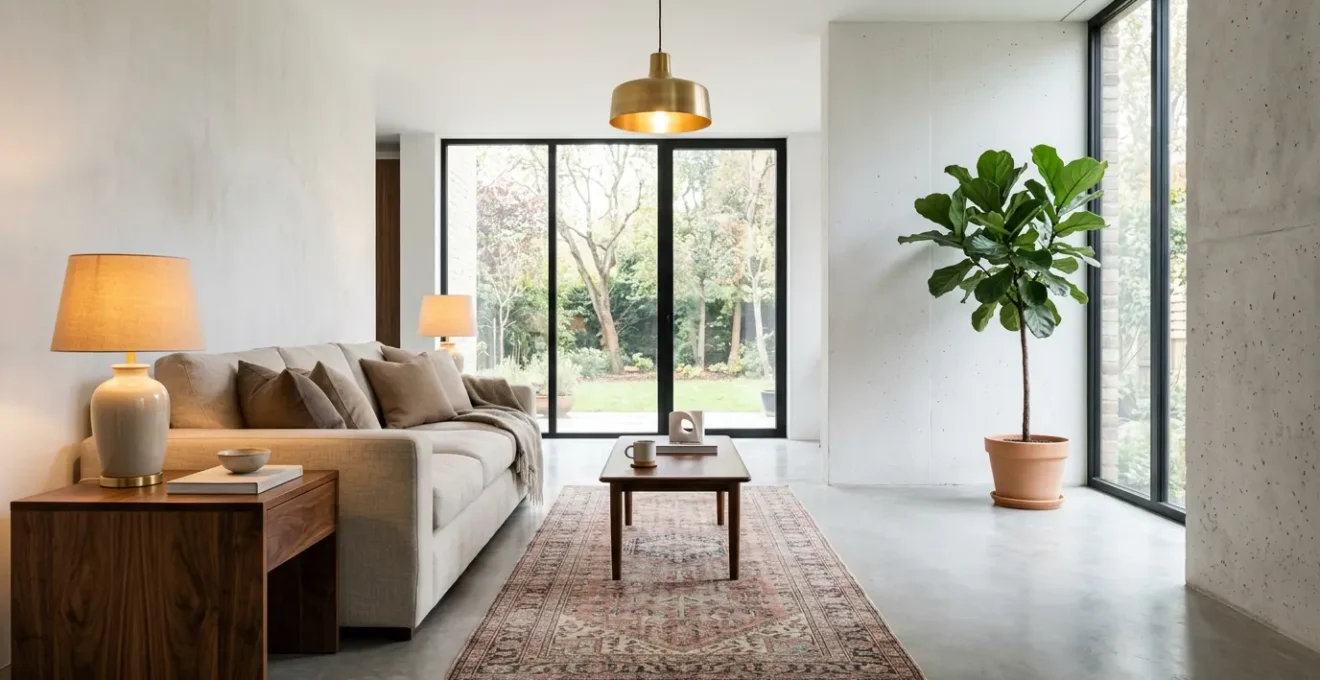
The key to a timeless contemporary home isn’t avoiding trends, but treating your design choices as a strategic investment portfolio.
- Prioritize foundational “assets” like quality materials and smart layouts over volatile, fast-fashion “micro-trends”.
- Focus on features with proven resale value and the ability to adapt as your style evolves.
Recommendation: Shift your mindset from decorating for today to curating a collection of furnishings and finishes that build value and personal meaning over time.
There’s a common fear among homeowners embracing contemporary design: the fear of the “five-year-flush.” You invest time, energy, and significant capital into creating a space that feels perfectly “now,” only to find it looks painfully dated in what feels like a blink of an eye. The sleek lines that once felt sophisticated now seem sterile, and the “it” color of the season suddenly feels ubiquitous and uninspired. Many guides will advise you to simply “choose neutrals” or “buy classic pieces,” but this advice is often too generic to be truly useful. It doesn’t explain how to differentiate a fleeting fad from a genuine evolution in design.
The truth is, “contemporary” literally means “of the moment,” making it a moving target. The real challenge isn’t to freeze a specific look in time, but to build a foundational aesthetic that is both current and resilient. This requires a shift in perspective. Instead of thinking like a decorator, you must think like a trend forecaster and a savvy investor. The key isn’t to reject trends outright, but to understand their velocity and lifecycle, separating the fast-burning micro-trends from the foundational macro-shifts that have staying power.
This approach reframes every design decision as a calculated investment in your home’s long-term value and your daily enjoyment. It’s about creating a ‘design ROI’ where your choices in materials, storage, warmth, and furnishings pay dividends for years to come. This guide will provide the strategic framework to do just that. We will deconstruct the elements of contemporary style, analyze what truly adds value, and outline a clear path to building a home that feels both modern today and timeless tomorrow.
To help you navigate this process, this article breaks down the essential strategies for building a contemporary home with lasting appeal. You’ll learn how to identify fleeting trends, which investments offer the best returns, and how to curate a space that is both stylish and deeply personal.
Summary: A Strategic Guide to Enduring Contemporary Style
- How to spot a “micro-trend” that will look dated by next year?
- Which contemporary kitchen features actually add value to your home resale?
- How to add warmth to a contemporary room so it doesn’t feel sterile?
- Concrete and Brass: why contrasting industrial and luxury materials works?
- The “hidden storage” requirement: why you can’t have contemporary design with clutter
- Myth: does a modern kitchen have to look cold and clinical to be stylish?
- In what order should you update finishes to shift from traditional to modern farmhouse?
- Curated Furnishings: How to Build a Timeless Collection on a Budget?
How to spot a “micro-trend” that will look dated by next year?
The first rule of design investment is to understand market volatility. In decor, the most volatile assets are “micro-trends”—the fast-burning, social media-fueled fads that peak and crash within a single season. Distinguishing these from durable, long-term “macro-shifts” is the most critical skill for creating a timeless interior. A key indicator is the trend velocity; industry analysis shows that while trends emerging from major design fairs can have a lifespan of 5-10 years, many social media-born trends last only 6-12 months.
Another tell-tale sign is the material and method. Micro-trends are often defined by a specific, easily replicable pattern, a DIY-friendly technique, or a cheap material. Think of specific checkered patterns, scalloped edges on everything, or the overuse of a single, bright “it” color. These are surface-level decorations, not foundational changes. A macro-shift, by contrast, is typically about a change in lifestyle or material philosophy—like the move toward sustainable materials, the integration of smart home technology, or the focus on biophilic design (connecting with nature).
Oversaturation is the final red flag. When a trend moves from niche design accounts to being mass-produced and featured in every big-box store, its novelty is gone. At this point, it’s no longer a forward-looking choice but a mainstream saturation point, signaling its imminent decline. To build a timeless space, you must learn to recognize these signals and choose to invest in ideas, not just items.
Your Checklist: 5 Indicators of a Fleeting Micro-Trend
- Check the source: Is it a viral TikTok/Instagram trend, or is it emerging from established design fairs and architectural discourse? The former has much higher velocity.
- Analyze retail saturation: If the trend is already available in every major home goods store, it’s likely at the peak of its lifecycle, not the beginning.
- Apply the ‘material vs. method’ test: Is the trend defined by a cheap material or a simple DIY method? Lasting styles are rooted in quality materials and craftsmanship.
- Look for lifestyle shifts: Does the trend support a larger change in how we live (e.g., working from home, wellness) or is it purely decorative? Foundational changes have more staying power.
- Evaluate oversaturation: If everyone you know is suddenly incorporating it, the trend’s uniqueness is fading, and it will soon feel dated.
Which contemporary kitchen features actually add value to your home resale?
The kitchen is the heart of the home and often the single biggest factor in its resale value. When applying an investment mindset, this is where your “blue-chip stocks” should be. Trendy backsplash tiles or of-the-moment hardware might create initial buyer appeal, but they don’t typically add quantifiable appraisal value. The real Design ROI comes from foundational upgrades that improve functionality and are built with quality materials. These are the features that stand the test of time, both aesthetically and financially.
Research consistently shows that even minor kitchen updates yield significant returns. For instance, Remodeling’s 2024 Cost vs. Value Report found a 96% ROI for minor kitchen remodels, making it one of the most financially sound home improvement projects. A deeper analysis reveals that the highest-value features are those that buyers perceive as permanent and high-quality. This includes high-grade, durable cabinetry with smart storage solutions, quality stone countertops like quartzite or marble, and the addition of functional pantry space. These elements form the timeless “bones” of the kitchen.
The key is to focus on the tactile and the functional. A buyer may not love your specific choice of pendant light, but they will always appreciate the silent, solid feel of a soft-close drawer, the cool touch of a stone work surface, and the logic of a well-organized pantry. These are the features that signal a well-maintained, high-quality home. While you can express personality through more easily changed elements like paint or bar stools, your primary investment should be in the enduring framework of the room.
As seen here, the emphasis is on the inherent quality of the materials. The smooth, veined countertops and the seamless, handleless cabinetry are not tied to a specific year. They are simply hallmarks of good design and craftsmanship, ensuring they remain desirable to future buyers and enjoyable for you in the long run. Accents can change, but a well-built kitchen is an asset that endures.
How to add warmth to a contemporary room so it doesn’t feel sterile?
One of the most significant risks of contemporary design is creating a space that feels cold, sterile, or impersonal. The clean lines and minimalist ethos can easily strip a room of its character, leaving it feeling more like a gallery than a home. As one design expert noted, this is a direct reaction to an over-indexed aesthetic.
There’s a return to warm, traditional, and classic design—think Ralph Lauren. The Apple Store Aesthetic has exhausted a lot of folks and they are looking for something with more richness and character.
– Hans Lorei, Dwell Magazine Design Trends Report
To counteract this, a forward-looking contemporary approach layers in warmth through multi-sensory experiences. This goes far beyond simply choosing a “warm” paint color. It’s about engaging the senses of touch and hearing, and creating an emotional connection. Start with acoustic warmth: hard surfaces like concrete or large panes of glass reflect sound, creating a harsh, empty feeling. Introducing soft materials like plush area rugs, heavy linen curtains, or upholstered wall panels absorbs sound, instantly making a room feel more intimate and comfortable.
Next, focus on tactile contrasts. A room filled with only smooth, slick surfaces feels one-dimensional. The key is to create a dynamic interplay of textures that invite touch. Pair a smooth leather sofa with a nubby bouclé pillow. Place a rough-hewn wooden bowl on a polished lacquer console. Mix materials like linen, aged leather, natural wool, and warm woods to add depth and a sense of lived-in reality. Finally, apply the ‘Personal Patina’ principle. A room devoid of history feels soulless. Incorporate pieces that tell a story—a vintage side table, an inherited piece of art, or a collection of handmade ceramics. This organic, un-designed warmth is impossible to replicate and is the ultimate guard against sterility.
Concrete and Brass: why contrasting industrial and luxury materials works?
A core principle of enduring contemporary design is the creation of material tension. This is the deliberate pairing of materials with opposing qualities—raw and refined, rough and smooth, industrial and luxurious. This contrast creates a dynamic visual dialogue that is far more interesting and sophisticated than a space where everything matches. The combination of raw concrete and polished brass is a perfect example of this principle in action. Concrete brings an industrial, humble, and structural quality, while brass introduces warmth, light, and a touch of luxury. Together, they balance each other, preventing the concrete from feeling too cold and the brass from feeling too ostentatious.
This principle of productive tension is not limited to one specific pairing. It’s a framework that can be applied with various materials to achieve a curated, layered look that ages gracefully. The beauty of this approach is that many of these materials, both raw and refined, develop a patina over time. The concrete may show subtle signs of wear, the brass will tarnish, and reclaimed wood will gain deeper character. This aging process adds to the story and soul of the home, rather than detracting from it, which is the hallmark of a timeless design.
This juxtaposition elevates both materials. The concrete’s raw texture makes the brass feel even more lustrous, and the brass’s warmth highlights the subtle tones within the concrete. It’s a partnership where the whole is greater than the sum of its parts. To apply this in your own space, think in pairs that create a compelling narrative of contrast.
To better visualize these dynamic partnerships, consider this breakdown of how different material contrasts contribute to a timeless contemporary aesthetic, as highlighted by a recent analysis of interior trends.
| Material Pairing | Visual Effect | Aging Character | Design Impact |
|---|---|---|---|
| Concrete & Brass | Raw/Refined contrast | Both develop patina over time | Creates productive tension |
| Reclaimed Wood & Lacquer | Rough/Smooth juxtaposition | Wood gains character, lacquer stays pristine | Balances history with modernity |
| Raw Linen & Chrome | Organic/Industrial mix | Linen softens, chrome maintains shine | Softens hard edges |
| Natural Stone & Glass | Heavy/Light opposition | Stone weathers naturally, glass stays clear | Creates visual lightness |
The “hidden storage” requirement: why you can’t have contemporary design with clutter
Contemporary design is defined by clean lines, negative space, and a sense of order. This aesthetic is fundamentally incompatible with clutter. However, life is inherently messy. The solution isn’t to own less (though that can help), but to integrate hyper-functional, seamlessly hidden storage. This is not just a preference; it is a non-negotiable requirement for achieving a successful contemporary look. Without it, the visual serenity is broken, and the design intent is lost.
Modern designers are increasingly engineering creative hidden storage solutions that go beyond simple cabinets. In the kitchen, this manifests as “appliance garages”—sections of the wall or countertop that lift or slide away to reveal coffee makers, toasters, and blenders. Pantry doors are disguised as seamless cabinet fronts or even full-height wall paneling. This approach tackles both physical clutter and digital clutter, with charging stations for devices cleverly tucked away inside drawers and cable conduits hidden within walls and furniture. The goal is to maintain the purity of the design’s lines while enhancing, not sacrificing, everyday functionality.
But the most forward-thinking approach to storage views it not just as a way to hide mess, but as a tool for curation. By providing a home for 90% of your belongings behind closed doors, you elevate the 10% that remain visible. This philosophy transforms the role of storage entirely.
Storage as a tool for ‘Intentional Curation’: The goal isn’t just hiding mess. It’s about creating a ‘gallery’ for the items that remain visible. By removing visual noise, each displayed object becomes a deliberate, curated choice.
– Interior Design Expert, Classic Casual Home
This concept of Intentional Curation is the endgame of hidden storage. The open shelf doesn’t hold random mugs; it displays a select few handmade ceramic pieces. The console table isn’t a drop-zone for keys and mail; it’s a platform for a single piece of sculpture and a beautiful book. By strategically concealing the mundane, you give the beautiful and meaningful room to breathe.
Myth: does a modern kitchen have to look cold and clinical to be stylish?
A pervasive myth in contemporary design is that a stylish modern kitchen must be a symphony of stark white, high-gloss surfaces, and cool-toned metals—a look that can often feel more like a laboratory than a living space. This clinical aesthetic is a holdover from an earlier wave of minimalism. However, current design thinking is moving decisively in the opposite direction. Trend analysis shows that by 2026, warm minimalism will fully replace stark white designs as the go-to for sophisticated interiors. This new approach proves that “modern” and “warm” are not mutually exclusive.
The key to warming up a modern kitchen lies in three strategic choices. First is the introduction of a “third material,” typically wood. In a kitchen dominated by two primary finishes (e.g., painted cabinets and stone countertops), adding wood through flooring, bar stools, a butcher block island, or even a range hood cover instantly breaks the monotony and adds organic warmth. It acts as a bridge between the other, often colder, materials.
Second is the selection of “living” materials—those with natural imperfections and variations. Instead of a perfectly uniform, man-made quartz, opt for a natural quartzite or marble with dynamic, unpredictable veining. Choose Zellige tiles for a backsplash, whose handmade quality ensures no two tiles are exactly alike, creating a surface that shimmers with life. Displaying handmade ceramics on open shelving further contributes to this feeling of authenticity. Finally, create warmth through historical juxtaposition. A vintage runner on the floor, an antique brass pot rail, or a framed piece of classic art provides a soulful contrast to the clean, modern lines of the cabinetry, telling a story and grounding the space in history.
In what order should you update finishes to shift from traditional to modern farmhouse?
Transforming a home from a traditional style to a more contemporary one, like modern farmhouse, requires a strategic plan. Simply adding shiplap and a barn door is a recipe for a dated look. A successful, lasting transformation follows an “Impact vs. Disruption” strategy, tackling updates in a specific order to maximize visual change while minimizing chaos. The first, and most crucial, step is Strategic Subtraction. Before adding any new elements, you must remove the old ones that define the traditional style. This means taking down ornate cornices, fussy wallpaper, heavy drapery, and elaborate light fixtures. This creates a clean, neutral canvas, which is the foundation of any modern aesthetic.
Once the slate is clean, the additions begin. The recommended order is: 1) Paint. Painting walls and even dated wood cabinets in a modern, neutral palette offers the highest visual impact for the lowest cost and disruption. 2) Lighting and Textiles. Swapping traditional chandeliers for simpler, modern fixtures and replacing old rugs and curtains dramatically shifts the mood. 3) Hardware. Changing cabinet knobs, pulls, and door handles is a small, easy update with a surprisingly large effect. 4) Furniture. Only after these foundational changes should you bring in new, larger furniture pieces. 5) Flooring and Tile. These are the most disruptive and expensive updates, and should be tackled last.
To ensure the resulting look has longevity and doesn’t become a caricature of the modern farmhouse style, a curated approach is essential. As one design expert advises, focus on the core principles rather than the clichés.
To ensure the modern farmhouse look doesn’t age quickly, adopt natural textures, simple forms, and neutral palettes. Avoid overuse of word-art signs, faux-distressed everything, and barn doors where a normal door is more practical.
– Design Expert, Home Design Trends Analysis
This advice is key: longevity comes from embracing the authentic spirit of the style—simplicity, texture, and function—not from collecting its most popular, and therefore most perishable, accessories.
Key takeaways
- Timeless design is an investment strategy, not a decorative style. Prioritize choices with proven long-term value.
- Learn to differentiate fast-burning “micro-trends” from foundational “macro-shifts” to avoid costly, dated mistakes.
- Warmth is created through layers of texture, personal history, and materials that age gracefully, not just through color.
Curated Furnishings: How to Build a Timeless Collection on a Budget?
The final layer of a timeless contemporary home is its furnishings. This is where your personal story comes to life. Building a collection of furniture should be approached with the same investment-savvy mindset as the rest of your home—not as a one-time shopping spree, but as the slow, deliberate process of curating a personal portfolio. The goal is to acquire pieces that have both enduring style and personal meaning, creating a space that is uniquely yours and will never feel dated because it is a true reflection of you.
A practical way to approach this on a budget is the Splurge, Mid-Range, and Save framework. This model helps you allocate your resources effectively:
- SPLURGE on the “hero” pieces you interact with daily and that impact your physical comfort most. This means your sofa, your bed, and your primary seating. Invest in the best quality you can afford here, focusing on solid construction and timeless forms.
- MID-RANGE investment is for foundational items that serve a functional purpose but are less central to your daily comfort. This includes dining tables, bookcases, and larger storage furniture.
- SAVE on trendy accents and decorative objects. Side tables, pillows, throws, and small decor are the perfect places to play with current trends without a major financial commitment. Find these at flea markets, thrift stores, and online marketplaces.
Beyond this framework, practice the art of the hunt. Look for “future classics” from reputable brands with solid wood construction and good joinery, often found secondhand at estate sales. Patience is your greatest asset. A home furnished over time with meaningful pieces will always have more soul and longevity than one furnished overnight from a single catalog. It’s this collection of stories that provides the deepest layer of warmth and personality.
Vintage pieces, heirlooms, mid-century furniture, and decor that references personal memories infuse interiors with meaning. Every piece in my cousin’s living room tells a story and he will share it.
– Mary Ann Pickett, Classic Casual Home
Ultimately, creating a contemporary home with lasting power is an active, ongoing process of curation. By adopting an investor’s mindset, focusing on foundational quality, and layering in personal history, you can build a space that not only looks sophisticated today but will continue to feel relevant, valuable, and uniquely yours for many years to come.