
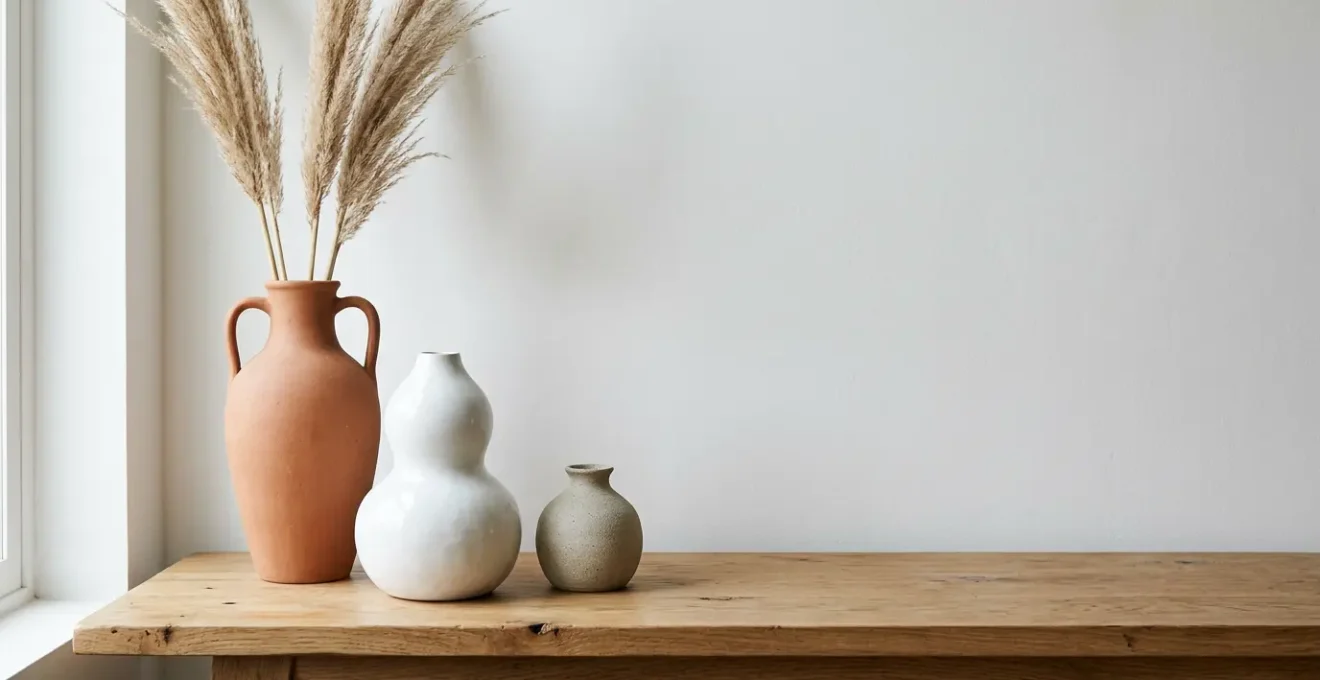
The true purpose of a vase is not to hold flowers, but to sculpt space with its form.
- A vase’s beauty lies in its shape and its interaction with the empty space around it, known as negative form.
- Styling an empty vase is an artistic act of creating a balanced, sculptural composition.
Recommendation: Stop seeing your vases as mere containers. Start treating them as primary sculptures to unlock a more intentional and minimalist aesthetic in your home.
An empty vase can feel like an unanswered question. We see a vessel and our first instinct is to fill it—with flowers, branches, or any foliage that justifies its presence. This impulse, while natural, overlooks the fundamental nature of a well-designed ceramic piece. We often focus so much on what goes inside the vase that we forget to appreciate the object itself: its form, its texture, its inherent visual weight. The minimalist who values objects that are beautiful in their own right understands this dilemma.
The conventional approach to decor treats a vase as a secondary element, a mere container for a more vibrant floral display. But what if we shifted our perspective? What if we treated the vase not as an accessory, but as a piece of sculpture? This changes everything. The focus moves from filling a void to celebrating a form. The empty space around the object becomes as important as the object itself, a concept artists call negative form. This is the key to creating arrangements that feel intentional, artistic, and complete, whether they hold a single dramatic stem or nothing at all.
This guide will deconstruct the art of styling ceramic vases from a sculptor’s point of view. We will explore how to group forms to create a collection rather than clutter, how to choose a shape that elevates even simple grocery store flowers, and why asymmetrical placement creates a more dynamic and engaging scene. By understanding the principles of form, balance, and material, you can transform any ceramic vase into a deliberate work of art that sculpts the space it occupies.
To help you master this artistic approach, this article breaks down the essential techniques for treating your vases as sculptural elements. The following sections will guide you through the core principles of composition, material choice, and practical care.
Summary: Ceramic Vases: Styling Sculptural Forms With or Without Flowers
- How to group empty vases so they look like a collection, not clutter?
- Wide mouth vs. Bud vase: which shape makes grocery store flowers look expensive?
- Why placing a vase off-center on the mantle looks more dynamic?
- The rice and vinegar trick to clean inside a vase you can’t reach into
- How to mix heavy ceramics with light books for a balanced bookshelf?
- Terra Cotta vs. Glazed Ceramic: which material suits succulents better?
- How to style a two-tier glass table without it looking like a junk pile?
- Contemporary Design: Achieving a “Now” Look That Doesn’t Age Quickly
How to group empty vases so they look like a collection, not clutter?
The line between a curated collection and simple clutter is drawn with intention. When grouping empty vases, the goal is not to fill a surface but to create a rhythmic composition that guides the eye. The secret lies in treating the empty space between the objects—the negative form—with the same respect as the vases themselves. A successful grouping feels like a single, cohesive sculpture rather than a lineup of individual items.
To achieve this, think in odd numbers. Grouping three or five pieces creates a natural sense of harmony and avoids the static, predictable look of symmetrical pairs. Vary the heights and volumes of the vases significantly to establish a visual hierarchy; a tall, slender form next to a short, stout one creates a dynamic dialogue. This interplay of shapes is what turns a simple arrangement into a compelling visual story. Each piece should have its own space to be appreciated, preventing the forms from visually merging into a single, undefined mass.
This principle of deliberate spacing is central to minimalist and artistic styling. As Los Angeles-based interior designer Dre Shapiro explains, this approach elevates each object. In her work, she emphasizes the power of restraint, a concept further detailed in an analysis on the use of negative space in interior design.
Allowing objects room to breathe gives each piece greater presence and importance. Rather than competing for attention, each item is elevated through restraint. Negative space, in this way, becomes a form of emphasis.
– Dre Shapiro, Interior Designer at Dre Design, Los Angeles
Use repetition with care. Instead of placing identical objects side-by-side, which can look monotonous, distribute similar forms or colors throughout a larger space, like a long shelf or console. This creates a subtle rhythm that ties the whole area together without overwhelming it. The result is a composition that feels both balanced and alive.
Wide mouth vs. Bud vase: which shape makes grocery store flowers look expensive?
The shape of a vase is not merely a stylistic choice; it is a functional tool that dictates how a floral arrangement is perceived. The right form can transform a simple handful of grocery store flowers into an intentional, high-end display. The key is to match the vase’s geometry to the type and quantity of stems. The two most fundamental shapes, the wide-mouth and the bud vase, serve entirely different sculptural purposes.
A bud vase is designed to be a frame. Its narrow opening isolates one to three stems, forcing the viewer to appreciate the singular beauty of each bloom and the elegant line of its stem. It is the perfect choice for a single, dramatic flower like a tulip or a delicate spray of ranunculus. By stripping away all distraction, the bud vase treats the flower like a portrait, making a minimal arrangement feel purposeful and chic. It celebrates simplicity and form.
Conversely, a wide-mouth vase is a stage for creating a layered landscape. It’s built for abundance, allowing for a fuller bouquet with a mix of focal flowers, filler blooms, and foliage. This shape hides the mechanics of the arrangement (like crisscrossed stems), creating a sense of effortless volume. However, it requires more material to look full; too few stems will appear lost and sparse. The “thriller-filler-spiller” method works best here to build a structured, multi-dimensional composition.
This comparative table, based on common floral practices, clarifies which vase to choose for maximum impact. The principles are widely discussed in floral design guides, such as this in-depth look at vase shapes.
| Feature | Bud Vase | Wide-Mouth Vase |
|---|---|---|
| Best For | Single stems or 1-4 flowers | Full bouquets with foliage |
| Visual Effect | Spotlights individual blooms | Creates layered arrangements |
| Stem Visibility | Showcases clean stems as part of composition | Mechanics hidden for effortless abundance |
| Arrangement Effort | Minimal – simple placement | Requires thriller-filler-spiller method |
| Cost Impact | Makes few flowers look intentional | Needs more stems to avoid sparse look |
Why placing a vase off-center on the mantle looks more dynamic?
Our brains are wired to seek symmetry, often leading us to place a decorative object squarely in the center of a mantle, table, or shelf. While this creates a sense of formal order, it can also feel static and predictable. Placing a vase off-center intentionally disrupts this symmetry, creating a more dynamic and visually engaging composition. This technique, rooted in the artistic “rule of thirds,” introduces a sense of movement and tension that captivates the eye.
When you place a vase at one-third of the way along a mantle, you create what is known as anchored asymmetry. The vase becomes the “anchor” or focal point, but the empty space on the other side gains importance. This negative form is no longer passive background; it becomes an active component that balances the visual weight of the vase. The eye is encouraged to travel across the entire length of the mantle, moving between the object and the space, creating a quiet, flowing rhythm.
This effect is especially powerful with a single, sculptural vase. Its form is highlighted by the surrounding emptiness, giving it more presence than it would have in a cluttered or perfectly centered arrangement. You can further enhance this balance by placing a smaller, low-profile object—like a small stack of books or a decorative box—on the opposite side to serve as a subtle counterweight.
As the image demonstrates, the composition feels balanced but not rigid. The dramatic shadow cast by the vase also becomes a design element, connecting the object to its surface and adding depth. This intentional imbalance transforms a simple decorative act into a sophisticated artistic statement, proving that what you leave out is just as important as what you put in.
The rice and vinegar trick to clean inside a vase you can’t reach into
A sculptural vase with a narrow neck is a beautiful object, but it presents a practical challenge: cleaning the interior. Over time, water residue, mineral deposits, and floral debris can create a cloudy film on the inside, diminishing its beauty, especially if the ceramic is translucent or light-colored. Since you can’t fit a brush inside, an effective cleaning method requires using friction and a gentle acidic solution.
The rice and vinegar trick is a time-tested, effective method for this exact problem. The uncooked rice acts as a gentle, abrasive scrubber, while the white vinegar works to dissolve mineral buildup and hard water stains. The combination provides a thorough clean without risking damage to the glazed interior of most ceramic pieces. A single drop of dish soap helps to break down any organic residue left by flowers.
Here is a simple, step-by-step process for deep cleaning your narrow-necked vases:
- Fill the vase about one-third full with warm water and add two tablespoons of white vinegar.
- Add a handful of uncooked rice to the mixture. This will provide the necessary friction.
- Add a single drop of dish soap for extra cleaning power against grime.
- Cover the opening securely with your hand or a stopper and shake the vase vigorously for two to three minutes. You should hear the rice scrubbing the interior walls.
- For particularly stubborn stains or mineral deposits, let the mixture sit in the vase for a few hours or even overnight.
- Empty the contents and rinse the vase thoroughly with clean water, ensuring all rice grains are removed.
While this method is excellent for glazed ceramics, it’s important to be cautious with certain materials. As experts from ceramic specialists Heinen Delfts Blauw note, porous surfaces require different care.
High temperatures and detergents can damage crystal. While the rice trick is excellent for glazed ceramics, it’s risky for unglazed or porous interiors like terracotta where moisture can be trapped.
– Heinen Delfts Blauw, Ceramic Care Guide
How to mix heavy ceramics with light books for a balanced bookshelf?
A bookshelf is more than just storage; it’s a canvas for composition. The common mistake is to line up books in rigid, uniform rows, resulting in a visually flat and uninspired display. Introducing heavy ceramic vases is the perfect way to break this monotony, but achieving balance requires a thoughtful approach to visual weight and a dialogue between materials.
The goal is to create a dynamic interplay between the linear, intellectual nature of books and the solid, sculptural presence of ceramic. Start by interrupting the vertical lines of standing books with horizontal stacks. This immediately creates variation and provides a perfect pedestal for a small vase or ceramic object. Place a heavy, textured vase next to a stack of books with smooth, minimalist covers. This “material dialogue”—the contrast between the rough, matte finish of a ceramic and the slight sheen of a book cover—adds a layer of tactile and visual interest.
Distribute the ceramic pieces asymmetrically across the shelves. Place a large, commanding pot on a lower shelf, perhaps even resting on the floor beside the unit, to anchor the entire display. Then, position a medium-sized vase on a middle shelf and a smaller piece on an upper one. This creates a “visual triangle” that guides the eye up and across the bookshelf, creating a sense of cohesive flow. Remember to group objects in odd numbers (three or five) to maintain a natural, organic feel.
Finally, embrace negative space. Do not feel compelled to fill every inch of every shelf. Leaving empty areas allows both the books and the ceramic forms to breathe, giving them greater presence. This intentional emptiness is a hallmark of sophisticated styling, transforming a simple bookshelf into a curated display of forms, textures, and ideas.
Terra Cotta vs. Glazed Ceramic: which material suits succulents better?
When a vase is intended to hold a plant, its material is not just an aesthetic choice—it’s a crucial factor for the plant’s health. For succulents and other drought-tolerant plants, the debate between terracotta and glazed ceramic is central. The difference comes down to one key property: porosity. Understanding how each material interacts with water and air is essential for choosing the right home for your plant.
Terracotta is unglazed ceramic, which means it is porous. This is its greatest strength for succulents. The porous walls allow water to evaporate and air to circulate to the plant’s roots. This “breathability” is vital for preventing root rot, the most common issue for succulent owners who tend to overwater. The soil in a terracotta pot will dry out much faster than in a glazed one, mimicking the arid conditions these plants are native to. Aesthetically, terracotta develops a beautiful patina over time, with mineral deposits creating a rustic, earthy look that complements the organic forms of succulents.
Glazed ceramic, on the other hand, has a sealed, non-porous surface. This means it retains moisture for much longer. While this is beneficial for moisture-loving plants like ferns, it can be a death sentence for succulents if not managed carefully. If you choose a glazed pot for its color or finish, you must ensure it has ample drainage holes and consider using a grittier soil mix with extra perlite or pumice to improve aeration. The aesthetic of glazed ceramic is more pristine and controlled, remaining unchanged over time and offering a wider range of colors to match your decor.
This breakdown, based on horticultural best practices highlighted by institutions like Platt Hill Nursery, clarifies the core differences.
| Aspect | Terracotta | Glazed Ceramic |
|---|---|---|
| Breathability | Excellent – porous material allows air flow | Limited – sealed surface prevents air exchange |
| Water Retention | Dries quickly, prevents root rot | Retains moisture longer, requires careful watering |
| Aesthetic Aging | Develops patina and mineral deposits over time | Remains pristine and unchanged |
| Maintenance | Requires soaking in vinegar to remove deposits | Easy to clean with simple wipe down |
| Best Practice | Natural choice for succulent health | Use with extra perlite and drainage holes |
How to style a two-tier glass table without it looking like a junk pile?
A two-tier glass table, like a coffee or side table, offers double the surface area but also double the risk of creating a cluttered, chaotic mess. Its transparency means there’s nowhere to hide; every object on both levels is always on display. The key to success is not to fill the space, but to create a clear visual hierarchy and a curated story that flows between the two tiers.
Think of the tiers as having distinct roles. The top tier is “The Protagonist”—this is where you place your most stunning, sculptural object. A single, beautifully shaped ceramic vase is the perfect candidate. It should command attention without overwhelming the space. The bottom tier, by contrast, is “The Landscape.” It should support the protagonist without competing with it. This is the place for low-profile, ordered items, such as a neat stack of two or three large art books, a decorative tray, or a lidded box. These items should feel grounded and organized.
Resist the temptation to over-decorate. A maximum of three to five focal points across both tiers is ideal. Because of the glass transparency, consider how the objects will be viewed from all angles, including from above. Use the shadows cast by the top-tier objects as an intentional design element that connects the upper and lower displays. A dramatic shadow from your ceramic vase can create a beautiful, abstract pattern on the books below, unifying the entire composition. Maintaining clear space around the edges is also crucial; this “breathing room” prevents the arrangement from looking like a pile of junk and reinforces a sense of luxury and intention.
Your Action Plan: Sculpting a Two-Tier Table
- Assign clear roles: Designate the top tier for one ‘Protagonist’ piece (e.g., a sculptural vase) and the bottom tier for a supportive ‘Landscape’ (e.g., stacked books).
- Collect your focal points: Select a maximum of 3 to 5 key items in total to display across both tiers to avoid a cluttered look.
- Establish coherence and contrast: Ensure the items on both tiers relate in color or material, but vary in height and shape to create visual interest.
- Assess from all angles: Check the composition from the top, sides, and eye-level, considering how shadows from the top tier interact with the bottom.
- Implement negative space: Ensure there are at least 6 to 12 inches of empty space around the outer edges of both surfaces to allow the arrangement to breathe.
Key Takeaways
- Treat empty space as a “negative form” in your composition; it is as important as the object itself.
- Group objects in odd numbers (3, 5) and vary their heights and shapes to create a dynamic, natural visual rhythm.
- The vase’s shape dictates the arrangement: bud vases frame single stems like portraits, while wide-mouth vases create abundant landscapes.
Contemporary Design: Achieving a “Now” Look That Doesn’t Age Quickly
In the world of interior design, “contemporary” can be a fleeting concept. Trends come and go, and what feels fresh and “now” can quickly look dated. The secret to achieving a contemporary look that possesses timeless appeal lies not in chasing the latest fad, but in choosing objects with classic forms and styling them in a modern way. A ceramic vase is the quintessential example of this principle.
Think of an amphora, a form that is thousands of years old. Placed in a minimalist interior, perhaps empty on a stack of stark white books or holding a single, dramatic monstera leaf, it feels entirely contemporary. Its power lies in its pure, sculptural shape—a shape that has been refined over centuries and speaks a universal language of form and function. This is the essence of timeless design: an object whose inherent beauty transcends any single era.
The versatility of a classic ceramic piece is its greatest asset. It can be reinterpreted endlessly to fit the evolving style of a room. As luxury home decor designer Kim Seybert suggests, this capacity for reinvention is the very definition of timelessness.
The secret to a look that doesn’t age is a versatile object. A classic ceramic vase can be styled in a very ‘now’ way (empty, on a stack of minimalist books) and then be completely reinvented in five years with a dramatic floral arrangement. Timelessness lies in the object’s capacity for reinterpretation.
– Kim Seybert, Luxury Home Decor Designer
To create a “now” look that lasts, invest in vases with strong, simple, and elegant silhouettes. Focus on material and texture—the matte finish of unglazed terracotta, the subtle crackle of a raku glaze, the smooth perfection of high-fired porcelain. These are the details that provide lasting interest. By prioritizing form over ornamentation, you acquire not just a decorative accessory, but a piece of sculpture that will continue to feel relevant and beautiful for years to come.
Frequently Asked Questions about Ceramic Vases
Are ceramic vases fragile for floor placement?
High-fired ceramic vases are quite sturdy but still breakable. For floor placement, it is best to choose weighted or wide-based designs to ensure extra stability, especially in high-traffic areas or homes with pets and children.
How do I pick the right vase material for my plants?
The most important factor is your plant’s water needs. Choose terracotta for drought-tolerant plants like succulents and cacti, as its porous nature allows soil to dry out quickly. Opt for glazed ceramic for moisture-loving species like ferns, as it helps retain water longer.
Can ceramic vases be used outdoors?
Most decorative ceramic vases are best suited for indoor use. Prolonged exposure to outdoor elements like sun, rain, and frost can cause the glaze to fade, the material to crack, or mold to grow, particularly in humid or freezing climates. Always check if a vase is specified as “outdoor-safe.”