
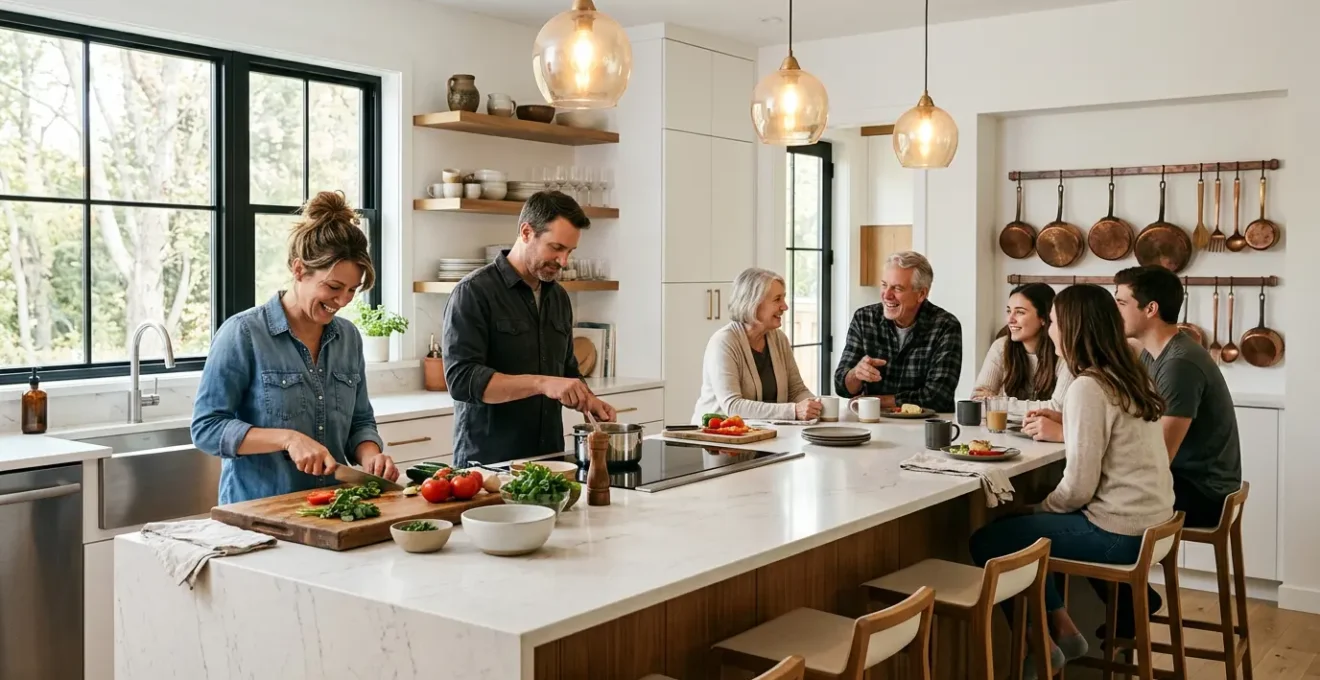
Contrary to popular belief, the best kitchen island isn’t the biggest one, but the one designed with social choreography in mind, prioritizing human connection over sheer size.
- The most social appliance configuration (sink vs. cooktop) is the one that best preserves sightlines and conversation flow.
- True efficiency isn’t just about minimizing steps; it’s about “radial efficiency” that supports multitasking and interaction.
- Ergonomics are non-negotiable: proper overhang for seating and reachable depth for cleaning define an island’s daily usability.
Recommendation: Before committing to a design, map your family’s daily movements and conversation patterns. Then, build the structure to support that natural flow, turning your island into the true center stage of your home.
The dream of a sprawling kitchen island is a powerful one, fueled by countless home renovation shows where it stands as the undisputed heart of the home. It’s presented as the default solution for modern living: a place for morning coffee, homework sessions, and lively dinner party prep. Homeowners often start with the assumption that they need one, focusing only on materials and colors. But this approach often overlooks the most critical element: the human-centric design that transforms a simple block of cabinetry into a dynamic social hub.
The conventional wisdom often boils down to a few generic tips: measure your space, add some stools, and pick a nice countertop. But what if the key to a successful island lies not in its physical presence, but in its ability to direct the flow of life in your kitchen? The true challenge is one of social architecture. It’s about understanding the choreography of cooking and conversation, the subtle dance between multiple cooks, and the ergonomics that invite people to linger comfortably. This guide moves beyond the platitudes to explore the structural and social principles that make an island the true center stage of your home, or reveal that a different solution might serve you better.
This article will deconstruct the island myth, providing a framework to analyze your real needs. We will explore the critical dimensions for comfort, weigh the social pros and cons of different appliance layouts, and uncover the secrets to maximizing efficiency and storage without sacrificing style or usability. Prepare to think like a kitchen architect.
Summary: Central Islands: Designing the Ultimate Hub for Cooking and Socializing
- Myth: does every modern kitchen really need a central island?
- How to determine the correct overhang for comfortable island seating?
- Sink on island vs. cooktop on island: which configuration is more social?
- The mistake of building an island so deep you can’t clean the center
- How to utilize the back side of the island under the stools for storage?
- The “odd number” rule: why 3 pendants look better than 2 over a kitchen island?
- Galley vs. Island layout: which offers the most efficient steps-per-meal?
- How to adapt the workflow when two cooks share the kitchen?
Myth: does every modern kitchen really need a central island?
The first rule of good architectural design is to question every assumption. The idea that a modern kitchen is incomplete without a central island is a powerful myth, but a myth nonetheless. Forcing an island into a space that lacks the proper clearance (typically 36 to 48 inches on all sides) can create frustrating bottlenecks, making the kitchen feel cramped and inefficient. The island should solve problems, not create them. Its purpose is to enhance workflow and social connection, and if it fails on those fronts due to spatial constraints, it’s the wrong solution.
The decision should be driven by function, not by trend. Do you need more continuous countertop for large baking projects? Do you host gatherings where guests naturally congregate in the kitchen? Do you need to create a functional barrier between the cooking zone and a high-traffic family room? If the answer to these is yes, an island might be ideal. However, for smaller spaces or linear workflows, other solutions can be far more effective. A well-designed peninsula can offer similar seating and prep space while maintaining a more open feel. For ultimate flexibility, a mobile solution can be a game-changer.
Case in Point: The Flexible “Un-Island” Hub
Thinking beyond the fixed island can unlock incredible functionality. For instance, HGTV showcases a rolling island solution that provides a perfect example of adaptive design. This portable unit offers a dedicated workspace, houses essential equipment like a stand mixer and sheet pans, and even provides seating. This “un-island” approach demonstrates that mobility can be more valuable than a permanent installation, allowing homeowners to reconfigure their space on demand—proving that the best “island” is sometimes the one you can move out of the way.
How to determine the correct overhang for comfortable island seating?
An island’s success as a social hub hinges on a single, often overlooked detail: the countertop overhang. This is not just a measurement; it’s a statement about the island’s intended purpose. An insufficient overhang forces people to perch awkwardly, lean forward uncomfortably, and ultimately, leave sooner. True social design requires human-centric ergonomics. The goal is to create a space where someone can comfortably sit with their knees tucked under, enjoying a meal or conversation without feeling like a temporary visitor. This is what transforms a simple counter into a genuine dining and social space.
The depth of the overhang should be directly related to the island’s primary use. A shallow overhang might suffice for a quick coffee, but it fails for homework sessions or casual dinners. As a general rule, the more time you expect people to spend seated, the deeper the overhang should be. This ensures adequate knee space and a comfortable posture. Don’t forget to pair the overhang with the right type of stool; backless stools can be tucked away under a shallow overhang, while full-back stools require more depth and clearance to be comfortable.
As this image demonstrates, providing ample knee room is what allows for a relaxed, engaged posture. This isn’t just about comfort; it’s about fostering connection by designing a space where people want to stay. The following table breaks down the standard architectural guidelines for overhang depth.
| Overhang Depth | Best Use Case | Stool Type | Clearance Needed |
|---|---|---|---|
| 10-12 inches | Quick coffee/chat, staying close to cooking action | Backless stools that tuck under | 36 inches minimum |
| 12-15 inches | Casual dining, homework station | Low-back counter stools | 42 inches recommended |
| 15-18 inches | Formal dining comfort, longer meals | Full-back stools with armrests | 48 inches ideal |
Sink on island vs. cooktop on island: which configuration is more social?
The debate over placing a sink or a cooktop on the island is a classic design dilemma. From a purely social architecture perspective, the answer lies in which configuration best preserves sightlines and encourages interaction. The goal is to allow the cook to face outwards, engaging with family or guests rather than turning their back to the room. At first glance, both options seem to achieve this. However, the details of their implementation dramatically alter the social dynamic.
A cooktop on the island immediately becomes the center stage for culinary performance. It’s exciting and engaging, but it comes with significant considerations. The first is safety: splattering oil and hot surfaces require a larger clearance zone between the cooktop and any seating. The second is ventilation. A large, overhead range hood can create a massive visual and physical barrier, completely negating the social benefit. Downdraft systems are sleeker but can be less effective. Conversely, an island sink is often the more social choice. Modern, low-profile faucets don’t obstruct views, and the sink area naturally becomes a hub for both prep work and cleanup. You can wash vegetables while chatting with someone seated at the counter. The main drawback is the potential for dirty dishes to be on display, but this is a small price for maintaining an open, conversational flow.
Ultimately, a growing design consensus suggests a “third way.” As a comprehensive analysis of island configurations highlights, the most social layout may be to keep both major appliances on the perimeter. This dedicates the entire island surface to prep, serving, and gathering—an uninterrupted “active surface” that maximizes flexibility. It becomes a true communal table, free from the functional constraints and visual clutter of major appliances, allowing for the most fluid form of social choreography.
The mistake of building an island so deep you can’t clean the center
In the quest for a grand, statement-making island, it’s easy to fall into the “bigger is better” trap. One of the most common and frustrating design mistakes is creating an island so deep that the center becomes a no-man’s-land—impossible to reach for a quick wipe-down. An island that you have to climb onto to clean is a failure of functional design. The maximum depth of your island should be determined by a simple, non-negotiable factor: your own reach. If you can’t comfortably clean it, it’s too deep.
For an island accessible from both sides, ergonomic studies and technical specifications generally recommend a maximum depth of around 5 feet (60 inches), allowing a typical person to reach the center from either side. However, a single-sided island (one that backs onto a wall or cabinetry) should be no deeper than 30-36 inches. Specific guidelines often recommend a 900mm (approximately 35.5 inches) maximum depth for dual-sided islands that incorporate a cooktop to ensure both reachability and safety. Instead of relying on generic numbers, the best approach is a practical, personalized test to find your own ideal dimension before a single piece of cabinetry is ordered.
Your Action Plan: The Home Reach Test for Perfect Island Depth
- Use painter’s tape to mark your planned island dimensions on the floor. This makes the scale tangible.
- Stand at the center of one long side and reach across with a cleaning cloth in hand, as if you were wiping it down.
- Mark the furthest point you can comfortably reach and wipe without straining or having to stand on your toes.
- Measure from the island’s edge to the mark you just made. This is your maximum comfortable half-depth.
- Double this measurement to get the absolute maximum depth for a two-sided island, ensuring it’s fully reachable from both sides.
How to utilize the back side of the island under the stools for storage?
The space on the back side of a kitchen island, underneath the seating overhang, is one of the most underutilized pieces of real estate in the modern kitchen. It’s often treated as a simple decorative panel, a missed opportunity for valuable storage. With clever design, this “dead space” can be transformed into a highly functional zone for items you don’t need to access daily but want to keep handy. This could include seasonal platters, special occasion glassware, board games, or even a dedicated charging station for electronic devices.
The key to unlocking this potential is seamless integration. The storage should not interfere with knee space for those seated at the counter, nor should it create visual clutter. This is where modern hardware becomes essential. Traditional cabinet handles can snag on clothing and disrupt the island’s clean lines. Instead, opting for handleless, push-to-open mechanisms is a far superior architectural solution. A gentle press is all it takes to access the storage, maintaining a sleek, uninterrupted surface when closed.
As shown here, this approach turns a passive surface into an active storage zone. A great example of this in practice is highlighted in a Victorian House Tour project from Howdens, which uses this exact technology to integrate storage without compromising the island’s aesthetic. The cabinets are typically shallower than those on the working side of the island—often around 12 inches deep—which is perfect for cookbooks, wine bottles, or small appliances, adding immense utility without sacrificing seating comfort.
The “odd number” rule: why 3 pendants look better than 2 over a kitchen island?
Lighting is the jewelry of architecture, and over a kitchen island, pendant lights are the main event. A common question is how many to install, and the answer often lies in a fundamental principle of design psychology: the rule of odds. Our brains are hardwired to find symmetry and patterns. An even number of objects, like two pendants, can split our attention, creating a visual tension as our eyes dart between them. An odd number, however, creates a more balanced and natural composition.
As experts in design psychology note, this principle is about creating a clear focal point. As stated in design guidelines, “The brain is drawn to patterns. An odd number creates a clear central point flanked by symmetrical elements.” With three pendants, the central light acts as an anchor, creating a pleasing sense of balance and completeness. This arrangement feels more stable and resolved to the human eye. While the rule of three is a powerful guideline, it’s not absolute. A very long island might look spectacular with five smaller pendants, while a very short one might be best served by a single, large statement fixture. The key is to avoid the visual duality of an even-numbered set.
The size of your island and the diameter of your pendants are the practical factors that should guide your final decision. The goal is to illuminate the surface evenly without making the space feel cluttered. The following table provides a structural framework for applying the rule of odds to various island lengths.
| Island Length | Recommended # of Pendants | Spacing Formula | Alternative Option |
|---|---|---|---|
| 4-6 feet | 1 large or 2 medium | N/A for single, equal spacing for 2 | Single linear fixture |
| 6-8 feet | 3 medium pendants | Space = pendant diameter | 2 oversized statement pieces |
| 8-12 feet | 3 large or 5 small | Space = 1.5x pendant diameter | Double linear fixtures |
Galley vs. Island layout: which offers the most efficient steps-per-meal?
When it comes to pure, linear efficiency, the traditional galley kitchen often wins. If your primary goal is to minimize the number of steps taken between the fridge, sink, and stove (the classic “work triangle”), a compact galley layout is hard to beat. In this setup, a simple meal might require just a few pivots and steps. An island layout, by its very nature, often increases the distance between these key work zones, adding a few extra steps to the process. However, judging a kitchen’s efficiency on steps alone is a one-dimensional view that misses the island’s greatest strength: radial efficiency.
Radial efficiency is the ability to pivot and multitask, engaging with multiple zones and people from a central point. While a galley is efficient for a single cook focused on a single task, it creates bottlenecks when another person enters the space. An island, in contrast, excels in multi-cook and social scenarios. It allows one person to prep on the island while another works at the perimeter, both moving freely. It allows the cook to maintain eye contact and conversation with others in the room, turning cooking from an isolated task into a shared experience. This is the essence of social choreography.
A detailed analysis from Kitchen Cabinet Kings compares layouts through this modern lens, moving beyond the work triangle to focus on “Work Zones.” Their study confirms that while a galley kitchen may require fewer steps for a simple meal (averaging 7 steps), the island’s 10-12 steps are a trade-off for superior multitasking capability and social interaction. The choice, therefore, isn’t about which is “most efficient” in a vacuum, but which form of efficiency best matches your lifestyle: the step-saving economy of a galley or the social, radial efficiency of an island.
Key Takeaways
- Function over form: An island is a powerful tool, but only if it fits your space and lifestyle. Sometimes a peninsula or a mobile cart is the smarter architectural choice.
- Design for social dynamics: Prioritize sightlines and comfortable seating. The island’s success is measured by its ability to foster connection, not just provide a surface.
- Ergonomics are non-negotiable: A comfortable overhang and a reachable depth are the foundations of a usable island. Test these dimensions personally before finalizing any plans.
How to adapt the workflow when two cooks share the kitchen?
Designing a kitchen for one is a straightforward exercise in ergonomics. Designing for two is an exercise in social choreography. When two people frequently cook together, the traditional work triangle can quickly become a “clash corner.” A kitchen island, when designed correctly, is the single most effective tool for creating a harmonious and efficient dual-cook space. It works by creating separate work zones and multiple access points, transforming a linear path into a 360-degree workspace.
The key is to identify your collaborative cooking style. Are you a “Prep & Cook” team, where one person preps ingredients while the other cooks? Or do you engage in “Parallel Play,” with both of you working on different dishes simultaneously? For the first style, a linear design with a prep sink on the island and a main sink on the perimeter works beautifully. For the second, you need to create duplicate stations—two distinct prep areas, for example, one on the island and one on the counter. This zoning prevents you from bumping into each other and competing for the same resources. In fact, one 2024 kitchen functionality study reveals islands improve dual-cook efficiency by 40% in busy kitchens precisely because they eliminate these workflow conflicts.
Ample clearance is non-negotiable in a two-cook kitchen. While 36 inches is the minimum passage width, 42 to 48 inches is the ideal to allow two people to work back-to-back or pass each other without issue. This generous spacing, combined with smart zoning, is what allows an island to become the ultimate facilitator of collaborative cooking. It provides the architectural framework for two people to move in sync, turning the kitchen into a space of effortless partnership rather than constant negotiation.
To start designing a kitchen that truly connects people, the next step is to take these architectural principles and apply them to a floor plan of your own space, ensuring every choice supports the way you live.