
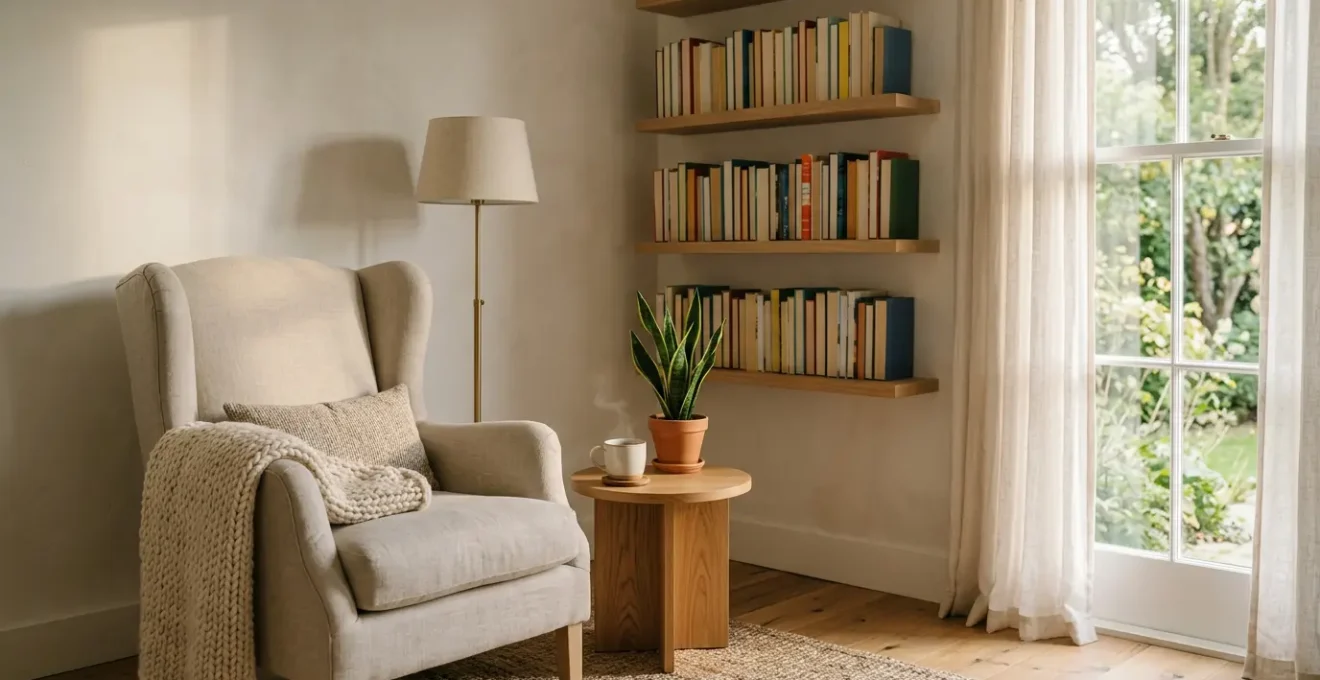
A shared home can feel chaotic, leaving no room for a quiet retreat. This guide reveals how to transform forgotten corners into true sanctuaries, not just with furniture, but through ‘psychological architecture’—using light, texture, and layout to actively support focus and emotional calm. It’s about designing a space that gives back.
For the book lover or the quiet soul, a shared home can often feel like a library where all the books are talking at once. The desire for a personal escape isn’t a luxury; it’s a necessity for mental clarity and peace. We often think the solution is simple: find a corner, add a comfy chair, maybe a lamp. But these makeshift spots rarely become the cherished sanctuaries we crave. They remain just corners, easily encroached upon by the daily hum of family life, lacking the invisible walls that command quiet and respect.
The true challenge isn’t finding the space, but consecrating it. What if the secret to a successful reading nook wasn’t just about plush cushions, but about a more intentional form of psychological architecture? This is the art of using design elements not just for aesthetics, but to send clear signals to our own brains—and to others—that this small territory is dedicated to retreat and replenishment. It’s about creating a sensory cocoon that actively supports our well-being.
This guide will walk you through the thoughtful layers of creating such a space. We will explore how to design a nook that functions not merely as furniture, but as a genuine tool for emotional regulation. We’ll delve into the science of lighting, the ergonomics of comfort, and the clever design tricks that make a tiny corner feel like a world of its own, proving that a true sanctuary is measured not in square feet, but in the depth of its tranquility.
To help you craft your personal retreat, this article breaks down the essential elements, from the foundational choices of seating and lighting to the finer details that elevate a simple corner into a cherished sanctuary. Explore the topics below to build your nook with intention and imagination.
Summary: Reading Nooks: Carving Out a Sanctuary in Underutilized Corners of Your Home
- Why having a dedicated quiet zone improves emotional regulation?
- How to light a reading nook effectively to prevent eye strain?
- Window seat vs. armchair corner: which offers better comfort for long reading sessions?
- The lack of surface space error that makes reading nooks unusable for tea drinkers
- How to integrate hidden book storage under your nook seat?
- How to layer light at different heights to add depth to your room?
- Down vs. Foam: which filling keeps its shape and support after 2 hours of sitting?
- Why hanging pendants instead of table lamps frees up critical nightstand space?
Why having a dedicated quiet zone improves emotional regulation?
A dedicated quiet zone acts as a predictable environmental cue for your nervous system, signaling that it’s time to downshift from a state of high alert to one of rest and recovery. In a busy home, our brains are constantly processing stimuli—conversations, screens, background noises. A reading nook physically separates you from this sensory clutter, creating a ‘permission structure’ for your mind to unwind. This isn’t just a feeling; it’s a documented psychological mechanism.
The power of such zones is rooted in the concept of environmental consistency. When we repeatedly use a specific space for a specific state of mind, our brain forms a powerful association. Just entering the nook begins to trigger a relaxation response before you even open your book. A 2024 peer-reviewed study on emotional regulation highlighted this very principle, demonstrating that creating designated ‘zones’ for different emotional states led to statistically significant improvements in emotional and behavioral outcomes. The research emphasized how a consistent environment helps individuals, including youth, develop superior self-regulation skills by reducing irritability and hyperactivity.
This deliberate act of carving out a sanctuary, no matter how small, becomes an external tool for internal management. It provides a reliable escape valve during moments of overwhelm, allowing you to proactively manage stress rather than simply reacting to it. It’s a physical manifestation of self-care, a quiet declaration that your mental peace is a priority.
How to light a reading nook effectively to prevent eye strain?
Effective lighting is the single most critical element for a functional reading nook, yet it’s often an afterthought. Improper lighting—too dim, too harsh, or poorly positioned—forces the muscles in your eyes to work harder to focus, leading to headaches, fatigue, and the very strain you’re trying to escape. The goal is to create a pool of clear, comfortable light that illuminates the page without creating glare or harsh shadows.
Eye strain is a pervasive issue for avid readers. In fact, a comprehensive study found that between 66-69% of regular readers experience symptoms of eye strain, a figure that can be dramatically reduced with proper lighting. The key lies in understanding a few technical specifications that go beyond just bulb brightness. Look for bulbs with a high Color Rendering Index (CRI) of 90+. This ensures colors are rendered accurately, reducing the cognitive load on your brain as it processes the text on the page.
The diagram below illustrates how different types of light work together to create an ergonomic and inviting reading environment. Notice the distinct roles of task, ambient, and accent lighting.
As you can see, the solution isn’t one light, but a layering of light. Your primary task light (like an adjustable sconce or floor lamp) should be positioned to the side, about 30-45 degrees from your book, to eliminate shadows. This should be complemented by softer ambient light in the room to reduce the harsh contrast between your bright nook and the darker surrounding space, allowing your eyes to relax.
Window seat vs. armchair corner: which offers better comfort for long reading sessions?
The choice between a window seat and an armchair corner is a foundational decision that shapes the very character of your nook. It’s a question that balances the allure of a dreamy, sun-drenched perch with the deep, enveloping comfort of a classic chair. The best choice depends on your personal reading style and the psychological state you seek, a concept best understood through the architectural principle of Prospect-Refuge theory. A window seat offers high “prospect” (a clear view outwards), while a high-backed armchair offers high “refuge” (a sense of being protected and enclosed).
For those who love to feel connected to the outdoors while reading, a window seat is unparalleled. It offers abundant natural light and a shifting view to rest your eyes on. However, this comes with ergonomic and thermal trade-offs. Window seats are often firmer and less adjustable, better for those who like to curl up, but they can also be prone to drafts in winter and solar heat gain in summer. An armchair, by contrast, offers superior ergonomic support for long sessions, especially for “leaners” who use an ottoman. It allows for micro-adjustments in posture that are crucial over several hours.
The following table breaks down the key differences to help guide your decision:
| Feature | Window Seat | Armchair Corner |
|---|---|---|
| Prospect-Refuge Balance | High prospect with outside view, moderate refuge | Low prospect, high refuge for deep focus |
| Ergonomic Support | Best for ‘curlers’ who draw knees up | Superior for ‘leaners’ with ottoman support |
| Thermal Comfort | Variable – prone to drafts and solar heat gain | Stable interior temperature year-round |
| Fidget Factor | Limited position adjustments | Multiple micro-adjustments possible |
| Storage Options | Built-in under-seat storage potential | Side table and ottoman storage |
| Natural Light | Excellent during day, requires blinds | Requires dedicated task lighting |
Ultimately, the perfect nook is deeply personal. As Julia Mack, an interior designer, wisely points out, the pressure for perfection can be a barrier to starting. The core idea is simply to create a comfortable space dedicated to you.
The most important thing is that people realize it does not need to be that really perfect little window seat or that paneled library fireside. It really just takes a comfortable chair.
– Julia Mack, Interior Designer at Julia Mack Design
The lack of surface space error that makes reading nooks unusable for tea drinkers
You’ve done it. You’ve found the perfect chair, the lighting is sublime, and a plush throw beckons. You settle in with your new book and a steaming cup of tea, only to realize a fatal flaw: there is nowhere to put the cup. This small oversight is the number one reason reading nooks fail. A sanctuary that can’t accommodate a simple beverage, your glasses, or the book you’re about to start is not a functional retreat; it’s just a chair in a corner.
The challenge, especially in small or underutilized spaces, is adding a surface without adding clutter or consuming a large footprint. The solution lies in clever, zero-footprint surface solutions that integrate seamlessly into your nook. Instead of a bulky side table, think vertically and multi-functionally. Floating shelves mounted at elbow height, articulating trays that fold flat against the wall, or narrow C-tables whose bases slide under the chair are all brilliant ways to add a surface exactly where you need it, when you need it.
The goal is to ensure that a surface is within arm’s reach without requiring you to twist or strain, which would pull you out of your state of deep relaxation. These small, thoughtful additions are what transform a nook from a pretty vignette into a truly livable, usable space.
Case Study: The Zero-Footprint NYC Sanctuary
A resident of a tiny 240-square-foot NYC apartment successfully integrated a fully functional reading nook into a previously unusable corner. To solve the surface problem without a side table, they installed narrow picture ledges on the wall for their mug and glasses, used a multi-tiered rolling cart that slides completely under the armchair when not in use, and chose an ottoman with a reversible lid that doubles as a hard tray surface. This vertical and hidden approach created a highly functional sanctuary with virtually no impact on the apartment’s precious floor space.
How to integrate hidden book storage under your nook seat?
For any true bibliophile, a reading nook must solve a second crucial function: housing books. A towering stack on the floor creates clutter and defeats the purpose of a serene retreat. The most elegant solution is to make the nook’s foundation do double duty by integrating hidden storage. This not only keeps your current and future reads close at hand but also significantly increases the nook’s utility and charm.
The impact of integrated storage is profound. In fact, design research from the Parade of Homes survey indicates that reading nooks with integrated storage see 73% more daily use than those without. When your books are part of the nook’s architecture, the space feels more intentional and inviting. For a custom-built window seat, this can mean a hinged lid revealing a deep cavity. For an armchair, it could be a low-profile plinth on casters with a pull-out drawer that slides underneath.
Even pre-made furniture can be hacked for this purpose. An IKEA KALLAX unit turned on its side, reinforced, and topped with a custom cushion becomes an instant storage bench. The key is to see the space beneath your seat not as dead space, but as prime real estate.
As this detail shows, thoughtful hardware like soft-close hinges or gas struts elevates the experience from a simple box to a piece of quality furniture. These small investments make accessing your books a smooth, quiet, and satisfying ritual. This integration of form and function is the hallmark of a truly well-designed sanctuary.
How to layer light at different heights to add depth to your room?
While task lighting is for function, layered lighting is for magic. It’s the art of using multiple light sources at different heights to sculpt a space, create mood, and add a sense of depth that a single overhead light can never achieve. In a reading nook, this technique is what visually separates your small sanctuary from the larger room, creating a “room within a room” effect without building a single wall.
The strategy involves three main layers: ambient, task, and accent. Your ambient light is the general, foundational glow of the room. Your task light is the focused beam on your book. The crucial third layer is accent lighting. This can be a small uplight in a corner behind your chair, a warm glow from a salt lamp on a shelf, or LED strips washing the wall behind the nook. These sources aren’t meant to be bright; their purpose is to eliminate harsh shadows and create soft, intriguing pools of light.
This layering creates what researchers call a “light cocoon.” A Cornell University ergonomics research lab demonstrated that a three-tier lighting setup (low, mid, and high) not only reduced eye strain but also psychologically separated the reading area, leading to an 80% increase in nook usage when programmed into a single “sanctuary scene.” This turns the act of turning on the lights into a ritual that signals a transition into your personal time.
Action Plan: Your Light Layering Checklist
- Low Layer (Depth): Install a floor uplight in the corner or use LED strips behind the seat for a “wall washing” effect that makes the space feel deeper.
- Mid Layer (Task): Position your primary reading lamp (sconce, floor, or pendant) so the bottom of the shade is 30-36 inches above your seated eye level.
- High Layer (Anchor): If using a pendant, ensure it acts as a visual anchor. If not, ensure the room’s general ambient lighting is soft and on a dimmer to complement the nook.
- Contrast Control: Use bias lighting (a soft, indirect light source) at about 10% of your main task light’s brightness to reduce the sharp contrast between your illuminated page and the surrounding darkness.
- Smart Programming: Program smart bulbs to create one-touch “scenes”—a warm, 2700K “evening read” scene and a brighter, 4000K “daytime focus” scene.
Down vs. Foam: which filling keeps its shape and support after 2 hours of sitting?
The soul of a comfortable chair lies hidden within its cushion. The choice of filling material is the invisible factor that determines whether your nook is a place you can happily lose yourself in for hours, or one that leaves you stiff and fidgety after just one chapter. The two primary contenders, down and foam, offer vastly different experiences in terms of initial feel, long-term support, and maintenance.
High-density foam is the champion of support and shape retention. It provides a consistent, firm foundation that springs back to its original shape almost immediately. After two hours of sitting, a quality foam cushion will retain about 95% of its shape, preventing that dreaded sinking feeling. Down and feather-filled cushions, on the other hand, offer an unmatched initial sense of luxurious softness. You sink into them in a way that feels incredibly cozy, but this comes at a cost: they compress significantly, losing up to 50-60% of their volume and support over a long reading session, requiring constant fluffing to stay comfortable.
For the ultimate reading nook, upholsterers often recommend a hybrid solution: a supportive high-density foam core wrapped in a plush layer of down and feathers. This gives you the best of both worlds—the reliable, “no-fluff” support of foam and the cloud-like, sink-in comfort of down. This combination ensures consistent support for your posture while still feeling sumptuously soft.
This comparative table highlights the performance differences that are critical for long-term comfort:
| Characteristic | High-Density Foam | Down/Feather | Hybrid (Foam Core + Down Wrap) |
|---|---|---|---|
| Shape Retention (2 hours) | 95% original shape | 40-50% compression | 85% shape retention |
| Support Consistency | Maintains firm support | Progressive softening | Balanced support with comfort |
| ILD Rating Range | 25-35 (optimal) | Not applicable | Core: 30-35, Wrap: soft |
| Daily Maintenance | None required | Daily fluffing essential | Weekly fluffing |
| Lifespan | 5-10 years | 20+ years (refillable) | 10-15 years |
| Temperature Regulation | Can retain heat | Excellent breathability | Good breathability |
Key Takeaways
- A nook is psychological architecture: Its primary function is to create a predictable ‘safe zone’ that supports emotional regulation.
- Layered lighting is non-negotiable: Combine ambient, task, and accent lighting to create a ‘light cocoon’ that reduces eye strain and defines the space.
- Function dictates form: Ensure your nook has a zero-footprint surface for essentials and integrated storage to keep the sanctuary clutter-free and highly usable.
Why hanging pendants instead of table lamps frees up critical nightstand space?
In the compact universe of a reading nook, every square inch of horizontal surface is precious real estate. One of the most common design missteps is dedicating a significant portion of a small side table to a bulky lamp base. The most graceful and efficient solution to this problem is to look up. Suspending a pendant light from the ceiling or a wall-mounted sconce frees up 100% of your surface space for what truly matters: your book, a warm drink, and perhaps a small vase of flowers.
This vertical approach to lighting does more than just save space; it acts as a powerful design statement. A well-chosen pendant light serves as a visual anchor, clearly defining the nook’s territory and drawing the eye. It creates a beautiful, focused pool of light that enhances the sense of intimacy and enclosure. For renters or those who shy away from electrical work, swag hooks offer a non-permanent way to hang a plug-in pendant exactly where it’s needed.
To be effective, the pendant must be positioned with care. It should hang slightly forward of your shoulder when seated to prevent your own head from casting a shadow on the page. The bottom of the shade should typically be 6-8 inches above your seated shoulder height to be out of your line of sight but close enough to provide concentrated light. Installing a dimmer is also essential, allowing you to tailor the light’s intensity to the time of day and your mood, completing the final layer of your personalized sanctuary.
By thoughtfully weaving together these elements—psychological purpose, ergonomic light, smart surfaces, and hidden storage—you move beyond simply decorating a corner. You are engaging in the quiet, imaginative act of building a sanctuary, a personal bookmark in the story of your home, always waiting for you to turn the page.