
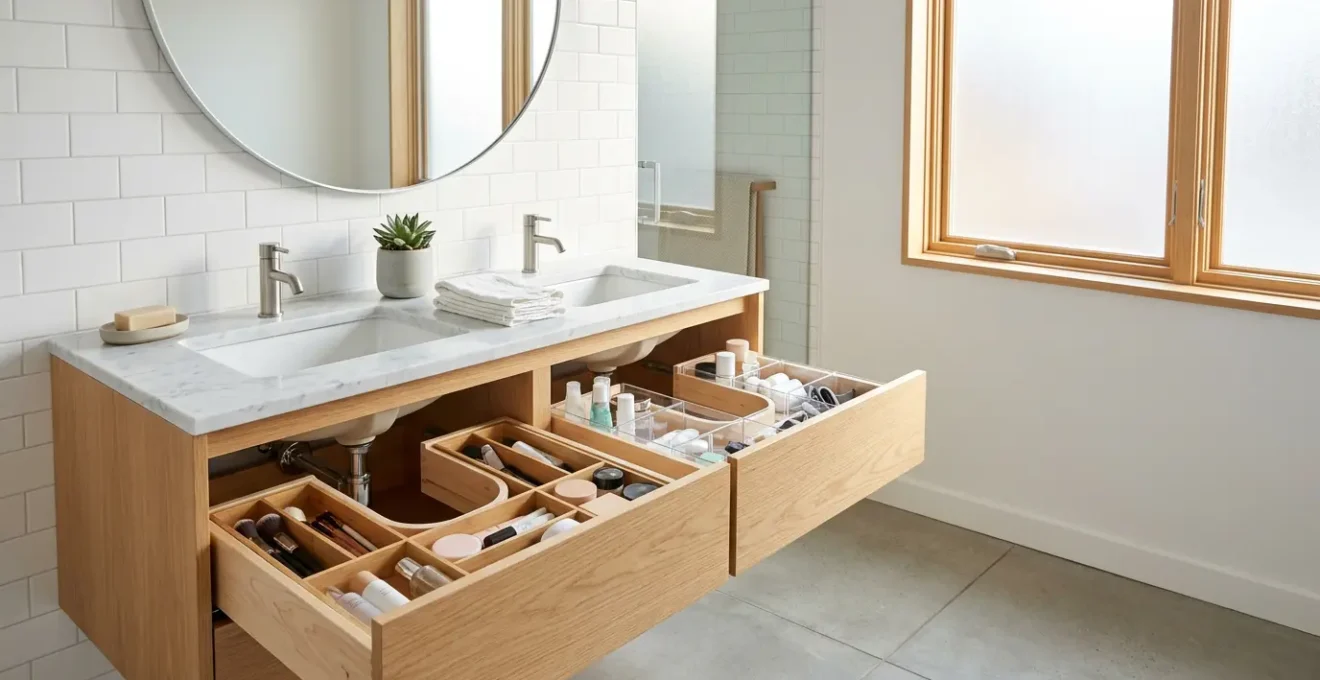
The daily frustration over a cluttered vanity isn’t a sign of messiness; it’s a system failure.
- Effective organization is an engineering project, not a cleaning task, focused on creating a frictionless workflow.
- By assigning every item a dedicated zone and reclaiming “wasted” space, you eliminate the daily search for products.
Recommendation: Shift your focus from temporary tidying to implementing a permanent, logical storage system for a permanently peaceful morning.
The morning standoff is a familiar scene for many couples: a chaotic battlefield of half-open makeup palettes, tangled cords, and a desperate search for that one specific product. The counter space, or lack thereof, becomes a source of daily friction, stealing precious minutes from an already rushed morning. The common advice—to simply “declutter” or “buy some bins”—treats the symptom, not the cause. These solutions offer temporary relief but fail to address the underlying flaw in the system’s design. A truly organized vanity isn’t just about hiding things away; it’s about creating an efficient, intuitive workflow station.
This goes beyond simple tidiness. It involves thinking like an efficiency expert, considering concepts like ergonomic access, designated “prime real estate” for daily-use items, and even the psychological impact of “visual noise” from mismatched branding. The goal is to build a system so logical that maintaining it is effortless. It’s about engineering a space where every object has a permanent home, accessible in seconds, turning the chaotic morning scramble into a smooth, automated process. What if the solution wasn’t just to find more space, but to make the space you have exponentially more intelligent?
This guide provides a systematic approach to re-engineering your bathroom vanity from the ground up. We will deconstruct common storage problems and provide concrete, expert-level solutions—from configuring dividers that grip your makeup to integrating hidden power sources. By the end, you will have a clear blueprint for transforming your vanity into a high-efficiency, conflict-free zone that gives you back your time and your sanity.
Summary: Ample Vanity Storage: A System for Morning Efficiency
- How to configure drawer dividers so makeup doesn’t slide around?
- The “U-shape” drawer hack that reclaims space around the sink plumbing
- His and Hers storage: how to divide a single vanity for two users fair and square?
- How to integrate power outlets inside drawers to hide hairdryers?
- What material should your organizer bins be to resist bathroom humidity?
- How to utilize the wasted space above door frames for long-term storage?
- Why removing branded bottles is the #1 step to a spa atmosphere?
- Light Fixtures: Choosing Sculptural Pieces That Define Your Room’s Style
How to configure drawer dividers so makeup doesn’t slide around?
The constant rattle and slide of cosmetics in a drawer is the first sign of a system breakdown. The key to silence and order is not just using dividers, but configuring them with a “zoning” strategy. Instead of grouping by product type (all lipsticks together), group by shape and frequency of use. Palettes lie flat, tubes stand up, and round pots are corralled in dedicated compartments. This creates a predictable layout where every item has a custom-fit slot, eliminating wasted space and movement.
This approach transforms a chaotic drawer into a functional grid. A professional organizer’s recent project provides a perfect example. By purging expired products and then grouping the remaining items by shape into modular iDesign clear organizers, she created distinct zones. This simple shift in strategy resulted in a reported 30% increase in usable space. The true innovation, however, was using a small dot of museum gel on the corners of the dividers and even on individual compacts to completely anchor them. After six months of daily use, the client reported zero sliding items.
As seen in the detailed view above, this level of compartmentalization creates a tactile and visual order. The front of the drawer becomes “prime real estate” for daily-use items, the middle for weekly products, and the back for occasional-use cosmetics. This ergonomic layout minimizes search time and makes the morning routine a frictionless, automated process. Every item is visible, accessible, and, most importantly, stationary.
Action Plan: The Makeup Drawer Tetris Method
- Measure & Map: Empty the drawer completely and measure its exact interior dimensions. This is your blueprint.
- Group by Form Factor: Sort all makeup by its physical shape (flat palettes, long tubes, round pots, brushes), not just its function.
- Container Matching: Select modular dividers and containers that most closely match the dimensions of each form-factor group.
- Zone by Frequency: Place daily-use items in the front third (prime real estate), weekly items in the middle, and rarely used items at the back.
- Anchor & Secure: Apply small, removable dots of museum gel to the bottom corners of your dividers to prevent them from shifting.
The “U-shape” drawer hack that reclaims space around the sink plumbing
The awkward, cavernous space under the bathroom sink is notoriously inefficient, a black hole where products get lost. The plumbing pipe creates a barrier that standard drawers and shelves cannot navigate. The most elegant engineering solution to this problem is the custom U-shaped drawer. This specialized drawer is built with a cutout in the center, allowing it to wrap perfectly around the plumbing trap and reclaim the valuable, otherwise-unusable space on both sides and in front of it.
While a custom solution might seem intimidating, its efficiency is unmatched. It transforms a deep, dark cabinet into a fully extendable, easily accessible storage zone. This is particularly effective for storing taller bottles and cleaning supplies that won’t fit in shallower top drawers. By bringing the contents of the cabinet out into the light, it eliminates the need to kneel and rummage through the back.
Compared to other, simpler solutions, the U-shaped drawer consistently provides the highest space efficiency. A recent analysis of under-sink storage options highlights its superior design for vanities with center-mounted sinks.
| Solution Type | Space Efficiency | Cost Range | Installation Difficulty | Best For |
|---|---|---|---|---|
| U-Shaped Drawer | 85% usable space | $150-300 | Moderate (custom fit) | Center-mounted sinks |
| Two-tier Sliding Baskets | 70% usable space | $50-100 | Easy (no custom work) | Pedestal sinks |
| Corner Pull-outs | 60% usable space | $75-150 | Easy-Moderate | Offset plumbing |
| Stackable Bins | 50% usable space | $30-60 | Very Easy | Rental properties |
Ultimately, investing in a U-shaped drawer is investing in a permanent solution that maximizes every square inch of your vanity. For those not ready for a custom build, two-tier sliding baskets offer a good-but-not-great alternative, but they cannot match the seamless integration and total space reclamation of the U-shaped design.
His and Hers storage: how to divide a single vanity for two users fair and square?
When two people share a single vanity, the root of conflict is rarely a lack of space, but a lack of clearly defined territory. A “fair and square” division requires a systematic approach, not an arbitrary line drawn down the middle. The most effective strategy is the “Core Needs Audit” combined with vertical zoning. This method prioritizes access based on daily habits, ensuring that the most-used items for each person are in the most accessible locations, regardless of total item count.
The process begins with each person independently listing their 5-7 absolute essential, must-have daily items. These are the products that get “prime real estate”—the top drawer or the most accessible part of the counter. The less-frequently used items are then stored in secondary locations. This moves the discussion from “my stuff vs. your stuff” to a more objective analysis of workflow and frequency of use. The second key is to think vertically. Using stackable clear drawers within a larger, deeper drawer can effectively double the personal territory by creating distinct “floors” for each person’s items.
This systematic approach is proven to reduce conflict. In a well-documented case study of a couple sharing a 48-inch vanity, this exact method was deployed. After conducting their “Core Needs Audits,” they installed stackable drawers to create separate vertical zones and established a central “neutral zone” basket on the counter for shared items like toothpaste. After six months, both partners reported zero conflicts over space and a significantly improved morning efficiency. The system worked because it was built on mutual respect for each other’s routines, not just physical space.
Finally, establish a small, shared “neutral zone” for items used by both people, such as hand soap or toothpaste. This keeps common-use products from encroaching on personal territory. This three-part system—audit, vertical layers, and neutral zone—transforms the vanity from a battleground into a cooperative, high-functioning workspace.
How to integrate power outlets inside drawers to hide hairdryers?
Leaving hot tools like hairdryers and curling irons on the counter is not just messy—it’s a significant safety hazard. Integrating power outlets directly inside a vanity drawer, often called a “docking drawer,” is the ultimate solution for a clean look and enhanced safety. This allows you to store tools even while they are still warm, connected, and ready for their next use, all while keeping cords and clutter completely out of sight. The key is to treat this as an electrical project, not a simple organizing hack, where safety is the absolute priority.
It is critical to use a UL-listed, pre-fabricated docking drawer unit rather than attempting a DIY installation. These certified units are specifically designed with safety mechanisms to handle the heat and power demands of styling tools. As professional cabinet builder Marc Sommerfeld notes, “The difference between a DIY outlet installation and a UL-listed docking drawer is life or death. These units have automatic shut-off mechanisms and proper ventilation that prevent the 450°F heat from hair tools from causing fires.”
The design of these drawers often includes stainless steel or heat-resistant containers to house the tools, further mitigating risk. This creates a self-contained, safe “hot zone” within the vanity. The data on their effectiveness is compelling; according to industry safety experts, using properly ventilated, certified docking drawer systems reduces heat-related incidents by 95%. This isn’t just about aesthetics; it’s a fundamental safety upgrade for any modern bathroom.
By investing in a certified in-drawer power solution, you are engineering a truly seamless and safe morning routine. The tools are hidden, the cords are gone, and the risk is virtually eliminated. It’s the final step in creating a vanity that is as functional and safe as it is beautiful.
What material should your organizer bins be to resist bathroom humidity?
In the high-humidity environment of a bathroom, not all organizer materials are created equal. Choosing the wrong material can lead to warping, discoloration, and, worst of all, mold and mildew growth that negates any organizational progress. The ideal material must be non-porous, easy to clean, and durable. While natural materials like bamboo or unsealed wood offer a warm aesthetic, they are often the worst offenders in a damp space.
The clear winner for bathroom applications is acrylic or clear PET plastic. These materials are completely waterproof, making them impervious to moisture and resistant to mold growth. They are also exceptionally easy to wipe clean and their transparency allows you to see contents at a glance, reducing the need to rummage. Silicone is another excellent waterproof option, particularly for lining drawers or holding items that might leak, though its flexibility can make it less ideal for rigid, stacking structures.
A long-term study by professional organizers confirms this. In a five-year test tracking various materials in high-humidity bathrooms, ventilated acrylic bins with perforated designs showed zero mold growth and remained crystal clear. Conversely, unsealed bamboo organizers warped within six months and developed visible black mold. This highlights a secondary principle: ventilation is as important as material. Bins with perforated or slatted designs that allow for air circulation will always outperform solid designs in preventing moisture buildup.
This comparative matrix breaks down the performance of common organizer materials in a humid environment, reinforcing why acrylic stands out.
| Material | Cleanability (1-10) | Mold Resistance (1-10) | Durability (1-10) | Aesthetics (1-10) | Overall Score |
|---|---|---|---|---|---|
| Acrylic/Clear Plastic | 10 | 10 | 8 | 9 | 37/40 |
| PET Plastic | 9 | 10 | 9 | 7 | 35/40 |
| Silicone | 10 | 10 | 7 | 6 | 33/40 |
| Stainless Steel | 8 | 9 | 10 | 8 | 35/40 |
| Sealed Bamboo | 7 | 6 | 7 | 30/40 | |
| Unsealed Wood | 3 | 2 | 3 | 8 | 16/40 |
How to utilize the wasted space above door frames for long-term storage?
In the quest for total space optimization, every unused vertical plane is an opportunity. The space above a bathroom door frame is often overlooked, yet it’s the perfect location for “deep storage”—items you need but don’t use daily. Think bulk supplies of cotton swabs, extra toilet paper rolls, or back-stock of your favorite products. Placing a single, high shelf in this area transforms dead air into a functional storage zone, freeing up prime real estate in your vanity for everyday essentials.
The key to making this storage solution look intentional and high-end, rather than like a cluttered afterthought, is aesthetics and safety. The shelf should be painted the exact same color as the wall or trim. This technique makes the shelf visually recede, giving it a custom, built-in appearance. Use matching, attractive baskets or bins to conceal the items stored on the shelf, presenting a uniform and tidy facade. This maintains a serene atmosphere while secretly hiding away your necessary clutter.
Safety, however, is paramount for an overhead shelf. It must be securely anchored to the wall to prevent any risk of it falling. Before you begin, use a stud finder to locate the wall studs. Whenever possible, secure the shelf brackets directly into these studs using 3-inch wood screws. If studs aren’t available where you need them, you must use the appropriate heavy-duty wall anchors for your wall type, such as toggle bolts for drywall, rated to hold significantly more weight than you intend to store. Always load-test the shelf before placing your items on it.
This simple addition is a powerful move in a total bathroom organization system. It effectively creates an “archive” space, allowing your main vanity to function as a clean, efficient “active workspace” for your daily routine.
Why removing branded bottles is the #1 step to a spa atmosphere?
The single most impactful step toward achieving a serene, spa-like bathroom has nothing to do with buying new things—it’s about removing visual information. The cacophony of mismatched brand logos, clashing colors, and shouting marketing text on commercial shampoo and soap bottles creates a constant, low-level visual stress. This is what designers call “visual noise.” Decanting your products into a set of uniform, brand-less dispensers is the act of silencing that noise, and its effect is psychological as much as it is aesthetic.
This isn’t just a stylistic preference; it has a measurable impact on our state of mind. As Barbara Brock of the National Association of Productivity and Organizing Professionals explains in a report on bathroom organization:
Visual noise from brand logos, clashing colors, and marketing text creates measurable stress responses. Studies show cortisol levels drop 23% in bathrooms with unified, brandless containers versus those with mixed commercial packaging.
– Barbara Brock, National Association of Productivity and Organizing Professionals
By replacing the visual chaos with a calm, cohesive set of containers, you are actively engineering a more peaceful environment. Your brain is no longer forced to process a dozen different marketing messages first thing in the morning. Instead, it is met with quiet repetition and order. The key to successful decanting is choosing the right dispenser for the right product, based on its thickness or viscosity.
A thick conditioner, for example, will clog a standard pump, requiring a wide-mouth pump or jar. A body oil is best served by a dropper bottle to prevent mess. Matching the container to the contents ensures the system is not only beautiful but also functional.
| Product Type | Viscosity Level | Best Dispenser Type | Avoid |
|---|---|---|---|
| Shampoo | Medium | Standard pump bottle | Narrow openings |
| Thick Conditioner | High | Wide-mouth pump | Standard pumps |
| Face Wash | Low-Medium | Foaming pump | Regular pump |
| Body Oil | Low | Dropper bottle | Pump bottles |
| Body Scrub | Very High | Wide-mouth jar | Any pump |
Key Takeaways
- Vanity organization is a system-design project, not a cleaning chore; focus on creating a frictionless workflow.
- Maximize space by using every inch: apply zoning to drawers, reclaim under-sink areas with U-shaped drawers, and use vertical space.
- Prioritize safety and longevity by choosing certified in-drawer outlets and humidity-resistant materials like acrylic.
Light Fixtures: Choosing Sculptural Pieces That Define Your Room’s Style
Lighting is the element that elevates a well-organized bathroom to a truly well-designed one. The right fixture is not just a source of illumination; it’s a piece of functional sculpture that acts as the primary style statement for the entire room. However, beautiful lighting is useless if it doesn’t perform its main task: providing clear, accurate light for grooming. The key is to balance form (sculptural aesthetics) with function (high-quality task lighting). This means paying close attention to the Color Rendering Index (CRI) of your bulbs.
CRI is a scale from 0 to 100 that measures how accurately a light source reveals the true colors of objects. For a bathroom vanity, where precise tasks like applying makeup or shaving occur, a high CRI is non-negotiable. A lighting design study found that lighting with a CRI below 90 causes color-matching errors in a staggering 67% of makeup applications. This is why you might apply foundation that looks perfect in the bathroom, only to find it’s the wrong shade in natural daylight. For vanity lighting, always choose bulbs with a CRI of 90 or above.
The most advanced lighting systems take this a step further by using smart, programmable bulbs that can change both brightness and color temperature to suit different needs throughout the day. This allows you to create specific “scenes” for different activities, providing the perfect light for any moment. This is the pinnacle of a user-centric, engineered bathroom environment. A typical program might include:
- Wake-Up Scene: A soft, 2700K warm white at 30% brightness that gradually increases, mimicking a sunrise.
- Makeup/Grooming Scene: A bright, 4000K neutral white at 90% brightness with a CRI of 95+ for maximum color accuracy.
- Daytime Scene: A clean, 5000K daylight-balanced light at 70% brightness for general use.
- Evening Wind-Down: A very warm, 2200K amber glow at 20% brightness to help prepare the body for sleep.
- Night Light Mode: A deep 1800K amber at just 5% brightness for navigating the bathroom at night without disrupting your sleep cycle.
By layering a beautiful, sculptural fixture with high-CRI, programmable bulbs, you create a system that is both a stunning design feature and a perfectly tuned tool for your daily routine.
A truly organized vanity is the result of a deliberate shift in mindset: from a reactive cycle of cleaning up messes to the proactive engineering of an efficient system. By implementing these structural solutions—zoning, reclaiming space, ensuring safety, and optimizing light—you build a foundation for a permanently calm and functional morning routine. To put these concepts into practice, the next logical step is to perform a “Core Needs Audit” for your own vanity and begin designing a system tailored to your specific workflow.